

July 3, 2026
•
13
min read

SEO vs GEO vs AEO: How to Get Found in Search and AI Answers
SEO, GEO, and AEO explained: how each gets your content found, ranked, and cited by Google and AI tools like ChatGPT, Gemini, and Perplexity.
For about twenty years, SEO had a single job: rank on Google, win the click, repeat. That job has quietly split into three.
The reason is a change in how people search. More than two-thirds of Google searches now end without a click to any website (SparkToro, 2026). And a growing share of your buyers skip Google altogether, asking ChatGPT, Gemini, or Perplexity instead. Ranking still matters. It just no longer guarantees anyone sees you.
That gap is where two newer disciplines come in: GEO and AEO. This guide covers what SEO, GEO, and AEO each do, how they actually differ, and how to handle all three without tripling your workload.
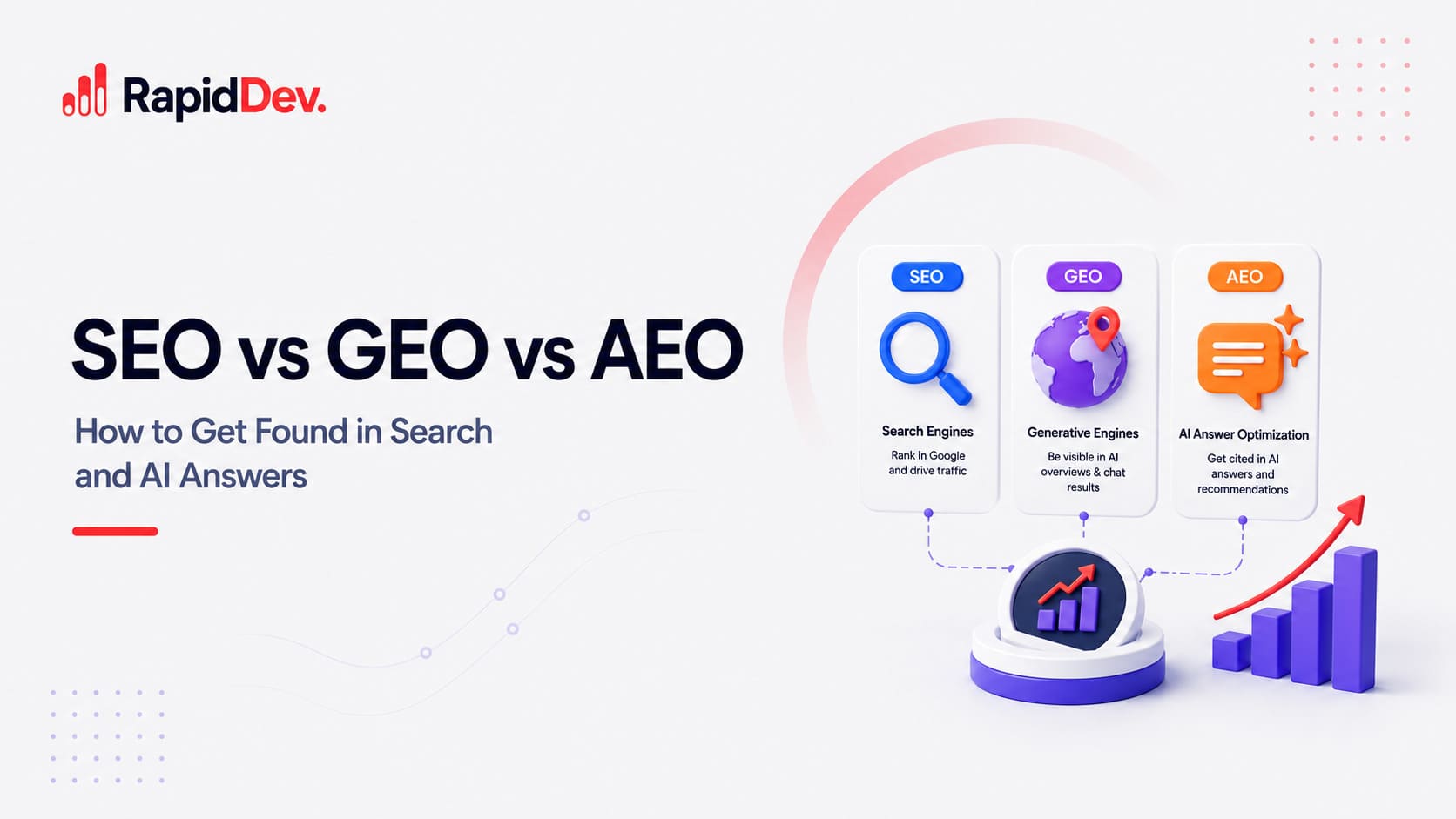
The short version: SEO gets your pages ranked. GEO gets your brand cited by AI tools. AEO gets your content picked as the direct answer. You need all three, and the good news is they lean on the same foundation. SEO vs GEO vs AEO isn't a cage match. It's a stack.
SEO vs GEO vs AEO at a glance
Before we go deep, here's the whole comparison on one screen. Each discipline aims at a different slice of search. Notice how much thecy still share.
If you take one thing from that table, take this: SEO competes for rankings, GEO for citations, AEO for the answer box. Now let's walk through them one at a time.
What is SEO (Search Engine Optimization)?
SEO, or search engine optimization, is the work of ranking higher in engines like Google and Bing. It's the oldest of the three, and marketers have been refining it for more than two decades.
The mechanics are familiar. A search engine sends crawlers out to find your pages, stores what they find in an index, then ranks those pages whenever someone searches. Say a founder types "best project management software for agencies." Google weighs hundreds of signals and hands back a list. SEO is the craft of earning a high spot on it.
Most of the work falls into a few buckets. On-page covers your titles, headings, and copy, and whether they match what people search for. Off-page is about earning backlinks from sites Google already trusts. Technical keeps your pages fast and reachable for crawlers. Underneath all of it sits the thing Google keeps hammering on: genuinely useful content backed by real expertise.
The scoreboard is simple enough. You're tracking rankings, organic traffic, and click-through rate, most of which live in Google Search Console.
The four types of SEO
People often ask how many types of SEO there are. The usual answer is four: on-page, off-page, technical, and local. Content quality isn't a fifth type. It's the thing all four depend on.
What is GEO (Generative Engine Optimization)?
Generative engine optimization, or GEO, is about getting AI models to use and cite your content. Those are the models behind ChatGPT, Gemini, Perplexity, and Google's AI Overviews. GEO answers a question SEO never had to face: how do you get named inside an answer the machine writes itself?
This matters more than it sounds. Bain found that about 80% of consumers now lean on AI-written summaries for at least 40% of their searches (Bain & Company, 2025). Picture a buyer asking Perplexity, "which CRM is best for a small marketing agency?" If the reply names three tools and yours isn't one of them, you've lost the sale before you knew it started. No ranking, no click, just a quiet omission.
How generative engine optimization works
An LLM doesn't read the web the way a crawler does. It pulls from many sources and blends them into one answer. So GEO rewards content that's clear, well-organized, and easy to trust.
Different engines don't behave identically, either. If you've ever watched ChatGPT and Claude tackle the same task, you know they reason and cite in their own ways. Still, the fundamentals travel well across all of them.
In practice, that comes down to three moves: write facts a model can quote without hedging, build authority through citations and brand mentions, and mark up your content so machines can tell one entity from another.
What actually gets you cited
There's real research behind this, not just opinion. In a Princeton and Georgia Tech study presented at SIGKDD, researchers ran thousands of AI queries to see what made a source more likely to be cited. The winners were unglamorous. Adding statistics, quoting credible sources, and simply cleaning up the prose lifted visibility by more than 40% (Aggarwal et al., 2024). The lesson more or less writes itself: vague, source-free content gets skipped, while specific, cited, readable content gets pulled into the answer.
What is AEO (Answer Engine Optimization)?
Answer engine optimization, or AEO, is about becoming the direct answer instead of one of ten links. Think featured snippets, voice results, People Also Ask boxes, and the summaries inside AI Overviews and Microsoft Copilot.
How answer engine optimization works
Answer engines look for the cleanest, most direct response to a question. A tight two-sentence answer usually beats a rambling paragraph that buries the point three lines down.
The playbook feels familiar to any SEO. Find the exact questions people ask, answer each one plainly, then add schema so the engine can read the structure. Do it well and the same content often feeds voice assistants like Siri and Alexa, since they draw from the same pool.
Winning at AEO changes what victory looks like. You stop being a link someone might click and start being the answer they hear out loud. The trade-off is honest: more visibility, fewer clicks.
GEO vs AEO vs GSO vs AIO: the acronym pileup
The terminology is a mess, and it isn't your fault. Different agencies coined different names for roughly the same shift. Here's the short map:
- GEO (generative engine optimization): getting cited inside AI-written answers.
- AEO (answer engine optimization): becoming the direct answer, in a snippet or out loud.
- GSO (generative search optimization): another name for GEO. Same idea, different letters.
- AIO (AI Overviews): Google's AI answer box, not a discipline you "do."
- LLMO (LLM optimization): tuning specifically for large language models, which overlaps heavily with GEO.
So are AEO and GEO the same thing? Not quite. AEO fights for the short, direct answer. GEO fights for how an AI model summarizes and credits you. They share tactics, but they're chasing different wins.
SEO vs GEO vs AEO: the key differences
Strip away the labels and three real differences remain: what each one wants, where it plays, and how it pays off.
SEO wants a spot on the results page, and it gets paid in rankings and clicks. GEO wants a mention inside a generated answer, and it gets paid in citations and brand references. AEO wants the answer slot itself, and it gets paid in snippets and zero-click impressions.
They get discovered differently, too. Crawlers index your pages for SEO. Language models absorb and remix your content for GEO. Answer engines lift a clean, quotable chunk for AEO.
Even the ideal content diverges. SEO favors depth, meaning a thorough page built around a keyword. GEO favors authority and clearly defined entities. AEO favors the crisp, self-contained answer. That's the honest split behind the SEO vs GEO and GEO vs AEO debates people keep having on LinkedIn.
Here's the part that usually gets lost. All three still reward the same underlying things: relevance, clarity, and trust. Which is why the "traditional SEO vs AI SEO" framing is a little silly. AI SEO isn't a rival system. It's the old fundamentals plus a few new signals.
SEO vs GEO vs AEO in practice: one page, three edits
An example makes this concrete. Say you run a project management app and you're writing about prioritizing tasks. The same knowledge can be shaped three ways.
For SEO, you publish a thorough guide called "How to Prioritize Tasks," target the related keywords, earn a few links, and climb the rankings. You're playing for the click.
For AEO, you drop a two-sentence answer near the top: "To prioritize tasks, list everything, score each item by impact and effort, then rank from highest to lowest." Wrap it in FAQ schema. You're playing for the snippet.
For GEO, you cite a study, name your method (say, the "impact-effort score"), and structure your entities so a model can follow them. Now ChatGPT can summarize your framework and credit you by name. You're playing for the citation.
Same idea, three edits. The best pages just do all three in a single pass.
How SEO, GEO, and AEO overlap
None of this requires three separate content teams. The disciplines share a core, and that core is the whole reason to plan them together.
At the center sit fundamentals you already know. Search intent shapes every page. Genuinely useful content earns trust wherever it shows up. Clear entities and real expertise, the whole E-E-A-T bundle, help crawlers and language models alike.
Because that center is shared, the work compounds. One well-built, well-sourced page can rank in Google, win a snippet, and get cited by ChatGPT, all off the same effort. You do the work once and collect on three channels.
Do GEO and AEO replace traditional SEO?
Short answer: no. GEO and AEO extend SEO. They don't retire it.
The reason is mechanical. AI answers still get assembled from indexed, trusted web pages. If your SEO foundation is shaky, you rarely get quoted or cited in the first place. Strong SEO is what feeds both GEO and AEO.
Is SEO dead in 2026? No, though the headlines love the idea. Zero-click results are rising, and Google's AI Mode now handles more queries on its own. But people still click, compare, and buy, especially once money is on the line. The smart response isn't to abandon SEO. It's to widen the net. That, more than any hot take, is what the future of SEO with AI actually looks like.
How to optimize for SEO, GEO, and AEO
You can serve all three with one connected plan. Think of it as three layers stacked on the same foundation.
The foundation that serves all three
Start where they overlap. Nail search intent, then cover the topic deeply enough that a reader, or a model, has no follow-up questions. Build topical authority with related content and sensible internal links. Earn backlinks and brand mentions from places people already trust. None of this is new. It's just newly important.
The technical layer most teams skip
This is where a lot of good content quietly loses. Start with schema. Mark up articles with Article, questions with FAQPage, step-by-steps with HowTo, and your company with Organization. Google's structured data guidelines spell out each type.
Next, publish an llms.txt file at your root domain, listing your key pages and a one-line site summary, so AI crawlers find your best work fast.
Finally, check how your pages actually render. If your site leans on client-side JavaScript, a lot of crawlers and AI bots see a blank page where your content should be. Server-side rendering or prerendering fixes that. Confirm the full text sits in the raw HTML, not just in the browser after scripts run. In the apps we build with tools like Bubble and Replit, that single change often surfaces content the bots were silently missing.
Formatting for humans and machines
Write for people first, then make it easy for machines to parse. Use headings that match real questions. Put a direct answer near the top of each section, before the throat-clearing. Add an FAQ with tight, quotable responses. Keep pages current, since AI tools lean toward fresh sources. And write real alt text and captions, because that's often how a model reads your visuals. These habits also happen to improve your odds of getting cited by ChatGPT and Gemini.
How to measure SEO, GEO, and AEO
Measurement is where the three split apart again, because each one keeps a different scoreboard.
SEO is the mature one: rankings, organic traffic, and click-through rate, all sitting in Google Search Console. AEO is fuzzier but still trackable, mostly through how often you win a featured snippet or answer box. GEO is the hardest, because you're measuring how often an AI names you at all. That means checking your citation and mention share across ChatGPT, Perplexity, and Gemini, and watching AI referral traffic climb up from near-zero.
The honest catch is that the data is thin. Google shares almost nothing on AI Overviews, and the chat tools share even less. The tooling is catching up, though. Ahrefs, Semrush, and Profound now track brand mentions across AI engines, and Search Console still anchors the classic-search side of the house.
Which one should you focus on?
Not every page needs all three running at full tilt. Match the effort to the content.
The patterns are fairly stable. Informational blog posts benefit from all three. FAQ pages lean toward AEO. Comparisons and original research lean toward GEO. Local "near me" pages still run on classic SEO.
One rule saves a lot of wasted effort: AI answers rarely show up for transactional or local searches. A "plumber in Austin" query still returns a map pack and real clicks. Informational queries are the opposite, since almost all of them now trigger an AI Overview. So aim your GEO and AEO work at the informational content, and keep classic SEO on the pages people search when they're ready to buy.
So for ecommerce, is it SEO or AEO? On product and category pages, SEO leads and AEO supports. GEO earns its keep on your guides, comparisons, and reviews, the content buyers dig into before they check out.
What's coming next: agentic search and AAO
One more shift is already forming. Soon AI agents won't just answer questions. They'll act on them, booking, buying, and comparing on a user's behalf. Bain already sees B2B buyers building shortlists inside LLMs before they ever reach a vendor's site. That's produced yet another acronym, AAO, for AI agent optimization.
The through-line is simple. Machines are doing more of the reading, judging, and deciding. So clean data, clear entities, and structured content only get more valuable from here. Build for that now and you're early instead of scrambling later.
Common misconceptions
A few myths keep circulating. Worth putting them down.
"GEO replaces SEO." It doesn't. GEO sits on top of solid SEO.
"AEO and GEO are the same thing." They're cousins, not twins. One targets the direct answer, the other targets the AI citation.
"You need separate content for each." You don't. You need one strong page with small, deliberate tweaks per channel.
"AI SEO is a whole new discipline." Mostly it's the same fundamentals with a few new signals bolted on.
Frequently asked questions
What's the difference between SEO, GEO, and AEO?
SEO ranks your pages. GEO gets you cited by AI models. AEO makes you the direct answer people see or hear first.
Is AEO part of SEO?
Mostly, yes. AEO uses core SEO skills to win snippets, answer boxes, and voice results.
Does GEO replace SEO?
No. GEO builds on SEO, and weak SEO usually means weak GEO results.
Are AEO and GEO the same?
No. AEO targets the direct answer. GEO targets how AI tools cite and summarize you.
How do I get cited by ChatGPT and Gemini?
Publish clear, factual, well-structured content, earn citations and mentions, and add schema so models can read your entities.
What tools track GEO and AEO?
Ahrefs, Semrush, and Profound track AI mentions. Google Search Console still covers classic search.
Is SEO dead in 2026?
No. Search is changing, not dying. SEO still drives clicks and quietly feeds the AI answers sitting on top of them.
Related reading
- What LLM does Replit use? A guide to its AI models
- Cursor vs Lovable: pros and cons
- What is Cursor and how does it work?
- Lovable AI: an introductory guide
- Rork AI review
Build a site that wins search and AI answers
You can write excellent content and still stay invisible. Usually the problem isn't the writing. It's the plumbing: slow pages, missing schema, or JavaScript that crawlers can't read.
That part is our job. RapidDev builds fast, well-structured, AI-ready web apps and sites, with the schema, rendering, and technical groundwork that SEO, GEO, and AEO all sit on. You can see how that plays out in our case studies.
Want a site built to show up in both search results and AI answers? Talk to the RapidDev team, and let's make your content easy to find and easy to quote.