

June 9, 2026
•
12
min read

Google I/O 2026: How the New AI Search Changes SEO. And What KPIs Actually Matter Now
Every Cursor release tracked in one place. Latest version, monthly changelogs, new features, bug fixes, and how to update Cursor on Mac, Windows & Linux.
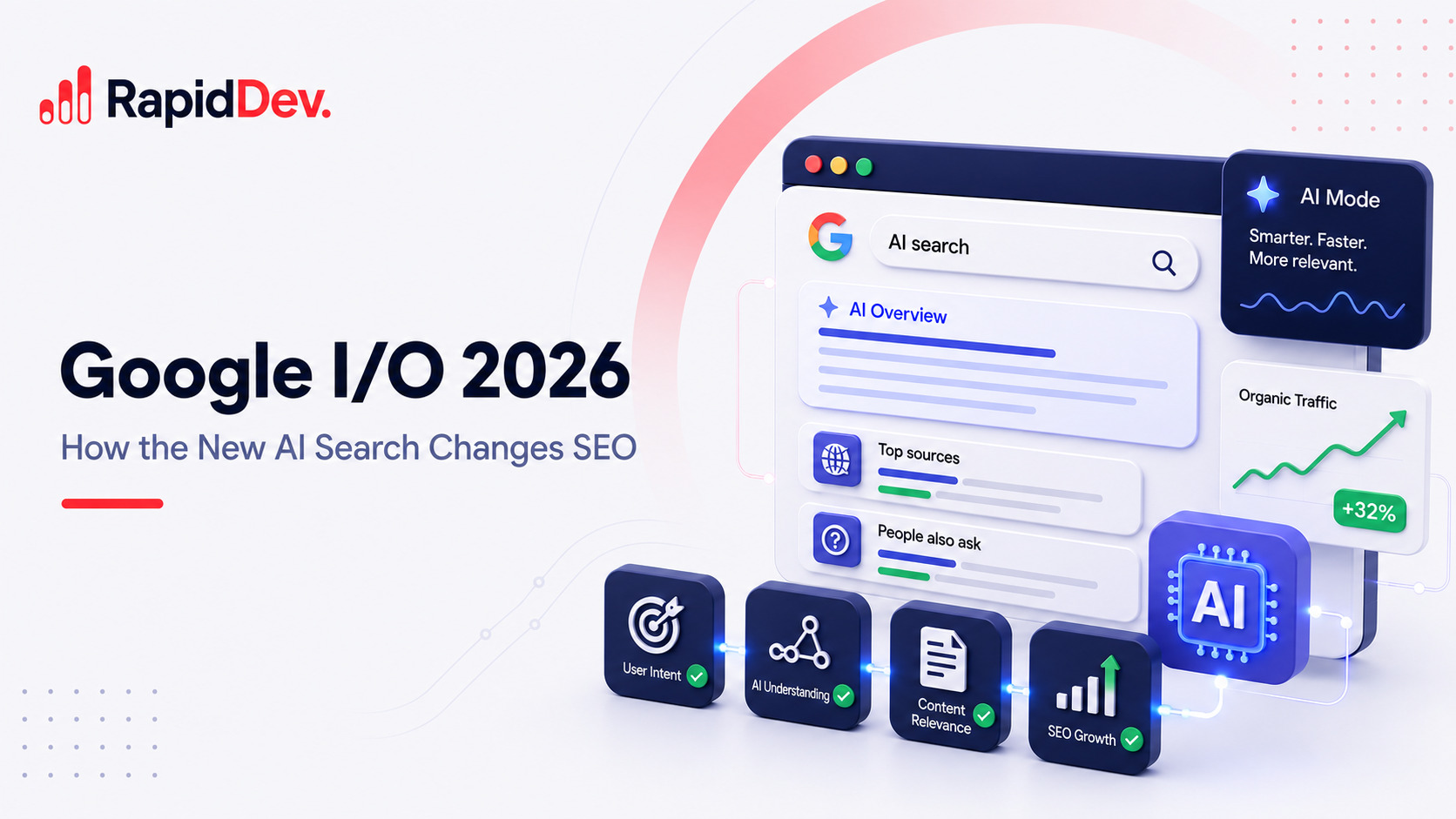
Google didn’t just ship another Search update at I/O 2026.
It changed the way search works.
The company introduced a redesigned AI-first search experience, upgraded AI Mode with Gemini 3.5 Flash, and unveiled persistent “search agents” that can monitor topics in the background without users needing to search repeatedly.
For anyone running a business online, this matters immediately.
The old SEO playbook ranks higher, gets clicks, drives traffic and is starting to break apart. More users are getting answers directly inside AI-generated search experiences before they ever reach a website.
That doesn’t mean SEO is dead. But it does mean the definition of visibility is changing fast.
If your company depends on search traffic, brand discovery, or inbound acquisition, you now need to think beyond rankings alone. Generative engine optimization, AI search visibility, and AI citation strategy are becoming part of the same conversation.
Here’s what Google actually announced at I/O 2026, what it changes about SEO, and which KPIs teams should start paying attention to now.
What Google Changed at I/O 2026: The Shifts that Affect Your Business
The Search Box Was Completely Rebuilt
One of the biggest announcements at I/O 2026 was surprisingly simple: Google rebuilt the search box itself.
According to Google's official announcement, this is the first major redesign of the search experience in more than 25 years.
The difference is immediately noticeable. Search is no longer built around short keyword fragments. Users can type full thoughts, layered questions, or highly specific requests in natural language.
And Google isn’t just autocompleting words anymore. The system actively tries to understand intent before the user finishes typing.
That shift matters because it changes what optimization looks like. Traditional keyword targeting still matters, but content built only around exact-match phrases will struggle in a conversational search environment.
AI Mode Now Runs on Gemini 3.5 Flash
Google also confirmed that AI Mode is now powered by Gemini 3.5 Flash.
This is a bigger shift than it sounds.
Earlier search AI systems mostly summarized information. Gemini 3.5 Flash is designed to reason through multi-step tasks, maintain context, and synthesize information across sources over longer interactions.
Google shared two numbers during the keynote that explain the scale of this transition:
- AI Mode now has more than 1 billion monthly users
- AI Overviews now reach more than 2.5 billion monthly active users and are available in over 200 countries and territories
In practice, AI-powered experiences are increasingly becoming the primary interface through which users interact with search.
Search Agents Might Be the Most Important Change
The most significant announcement from an SEO perspective wasn’t the new interface. It was Google’s introduction of persistent information agents.
As PPC.land explained in its “search changes SEOs did not expect” analysis, these agents continuously monitor topics on a user’s behalf.
Instead of repeatedly searching for things like:
- apartment listings
- competitor pricing
- funding news
- product launches
users can now tell Google what they care about once and receive ongoing AI-generated updates automatically.
That changes the entire rhythm of search.
For years, businesses competed every time someone opened Google and typed a query. Now many users may never perform those searches manually again. Their agents will do the monitoring for them.
Which raises a difficult question for brands:
If your company isn’t included in those synthesized AI updates, are you still visible at all?
AI Overviews Are Now the Default Experience
Google also made it clear that AI Overviews are no longer a limited experiment.
The company says AI-generated search experiences now reach users across nearly 200 countries on both desktop and mobile.
More importantly, the handoff between traditional search, AI Overviews, and AI Mode is becoming seamless. Users can move from a standard query into a fully conversational search flow almost instantly.
That means businesses are no longer optimizing only for blue links on a results page.
They’re optimizing for inclusion inside AI-generated answers.
What This Means for Your Search Pipeline
The easiest reaction to all of this is panic.
A lot of people immediately jumped to “SEO is over.”
That’s not what’s happening.
But the mechanics of search visibility are changing in ways that most companies haven’t fully adjusted to yet.
Ranking Alone Doesn’t Guarantee Visibility
For years, the primary SEO goal was obvious: rank higher.
But a number one ranking means less if users never scroll past the AI-generated answer sitting above it.
More users are obtaining answers directly within AI-generated search experiences, reducing the need to visit multiple websites. That creates a new challenge.
Your content no longer just needs to rank well. It needs to be selected, trusted, and cited by AI systems themselves.
That’s the core idea behind generative engine optimization: making your content useful not only for human readers, but also for AI-generated synthesis layers.
Search Queries Are Becoming More Human
People don’t interact with AI systems the same way they interacted with old-school search engines.
They ask longer questions. More specific questions. Messier questions.
Instead of:
- “best crm software startup”
They ask:
- “What CRM works best for a 15-person SaaS startup with a remote sales team?”
That sounds like a small difference, but it changes how content performs.
Thin pages built around isolated keywords are losing ground to content that answers real questions clearly and thoroughly.
The pages most likely to surface in AI search experiences are usually the ones that:
- explain concepts directly
- anticipate follow-up questions
- provide clear structure
- include trustworthy supporting information
Depth and clarity are becoming stronger advantages than keyword density.
Search Agents Change Discovery Entirely
Search agents may end up reshaping discovery more than AI Overviews themselves.
Why?
Because they remove the need for repeated searching.
If someone sets up an agent to monitor “best payroll tools for startups,” Google may continuously summarize that landscape for them without the user ever opening a traditional search result again.
That means visibility becomes persistent rather than query-based.
Brands that consistently appear inside those AI summaries gain ongoing exposure. Brands that don’t may slowly disappear from consideration altogether.
Click Behavior Is Already Shifting
Organic traffic patterns are changing because users increasingly get answers before the click.
This is especially noticeable for informational searches.
In many cases, people no longer need to visit five blog posts to understand a topic. AI-generated summaries compress that research process into a single interaction.
That doesn’t eliminate the value of SEO traffic.
But it does mean traffic alone is becoming a less reliable indicator of influence.
A company can shape buyer perception inside AI-generated answers long before a user ever lands on its website.
That’s why SEO KPIs need to evolve.
The KPIs Your Search Reporting is Missing Right Now
Most SEO reporting dashboards were built for a different version of the internet.
They still focus heavily on:
- rankings
- sessions
- clicks
- organic traffic
Those metrics still matter. But they no longer capture the full picture of visibility in AI-first search environments.
The more useful question now is:
“How often does AI surface our brand when people ask questions related to what we do?”
That requires a different set of KPIs.
A useful reference point is Lumar’s geo/aeo reporting framework, which explores how SEO measurement is shifting toward AI visibility and influence.
These metrics are emerging measurements used by AI visibility platforms such as Ahrefs Brand Radar, Profound, Semrush, Omnibound, and others.
The bigger mindset change is this:
The old model looked like:
Rank → Click → Session → Conversion
Now that path breaks constantly because users often get their answers before visiting a website.
The newer framework looks more like:
Visibility → Influence → Outcome
That’s a very different way to think about SEO performance.
Is Traditional SEO Dead?
No.
But traditional SEO by itself is no longer enough.
Google continues to recommend foundational SEO practices such as crawlability, structured data, and site architecture as part of optimizing content for AI-powered search experiences.
Things like:
- page speed
- crawlability
- structured data
- internal linking
- clean site architecture
still form the foundation.
Backlinks and domain authority still matter too because AI systems rely heavily on trust signals when deciding which sources deserve visibility.
What’s changing is the layer above those fundamentals.
The companies adapting best right now are keeping strong technical SEO practices while also actively optimizing for AI citation and AI search visibility.
As explored in how google i/o 2026 changes seo, modern search visibility increasingly depends on whether AI systems choose to reference your content directly.
SEO isn’t disappearing.
It’s expanding into something broader.
What to Do Right Now: a 3-Step Action Plan
1. Audit Your AI Visibility
Start by running your most important searches through Google AI Mode.
Look for:
- whether your content appears
- whether competitors dominate responses
- whether your brand is represented accurately
- which sources AI systems seem to trust most
Document the gaps.
Tools like Ahrefs Brand Radar and Semrush AI Overviews reporting can help automate some of this process at scale.
2. Update Your Reporting Dashboard
Most companies still report SEO performance using rankings and traffic alone.
That’s becoming incomplete.
At minimum, add:
- AI Answer Inclusion Rate
- Citation Frequency
- AI Share of Voice
And if you report upward to leadership or investors, start reframing SEO conversations around visibility and influence rather than only traffic acquisition.
This post-i/o seo action plan offers a practical example of how teams are restructuring SEO priorities after I/O 2026.
3. Rework Content for AI Consumption
AI-generated search experiences favor content that is:
- direct
- structured
- specific
- easy to verify
- easy to summarize
Review your highest-traffic pages first.
Do they answer the main question immediately?
Are headings clear and conversational?
Do pages use structured data like FAQ or Article schema?
If not, those are usually the best places to start updating.
And if you’re not sure where your visibility gaps are yet, an AI visibility audit is probably the fastest way to identify them before traffic patterns shift further.
Where Search Goes From Here
Google didn't kill SEO. It expanded It.
Despite the growing buzz around GEO (Generative Engine Optimization), AEO (Answer Engine Optimization), and AI visibility, Google continues to frame these practices as part of SEO rather than a replacement for it.
From Google's perspective, the fundamentals remain the same: create useful content, establish authority, make information accessible, and help search systems understand your pages. The difference is that content is now being surfaced not only through traditional rankings, but also through AI Overviews, AI Mode, and other generative search experiences.
In other words, SEO isn't disappearing. The places where visibility happens are expanding.
Google recently published its own guidance on optimizing content for AI-powered search experiences, reinforcing that many of the same principles that drive search performance today also influence how content is selected, summarized, and cited by AI systems.
The companies that adapt early won’t just protect their traffic. They’ll become part of the answer layer itself. And over the next few years, that distinction is going to matter more than rankings alone ever did.
If you're evaluating how AI search is affecting your visibility, traffic, and pipeline, now is the time to review your SEO strategy through the lens of AI-driven discovery. Traditional rankings remain important, but they no longer tell the full story.
At Rapid Developers, we help businesses assess their search performance, identify AI visibility gaps, and build SEO strategies designed for both traditional search results and emerging AI-powered experiences.
Learn more about our SEO Services and how we help companies stay visible in the age of AI search:
https://www.rapidevelopers.com/services/seo-services