

July 15, 2026
•
10
min read

SaaS SEO Strategy 2026: The Complete Playbook for Ranking in Google + AI Search
A practical SaaS SEO playbook for 2026: the page types that convert, the keywords worth owning, and how to rank and get cited across Google and AI search.
You probably heard that SaaS SEO in 2026 is no longer only about ranking in traditional search results. Brands now compete for visibility inside AI Overviews, conversational search engines, and answer platforms. The companies growing fastest combine strong technical foundations, product-led content, comparison pages, integration ecosystems, and entity-driven optimization to capture both search traffic and AI citations.
TL;DR: SaaS SEO in 2026 (AEO Quick Answer)
SaaS SEO in 2026 requires ranking in both Google and AI-powered search - ChatGPT, Perplexity, and Google AI Overviews. The fastest-growing companies combine technical foundations, product-led content, conversion-focused pages (alternatives, comparisons, integrations), and entity optimization. This guide covers it all.
What's different about SaaS SEO in 2026
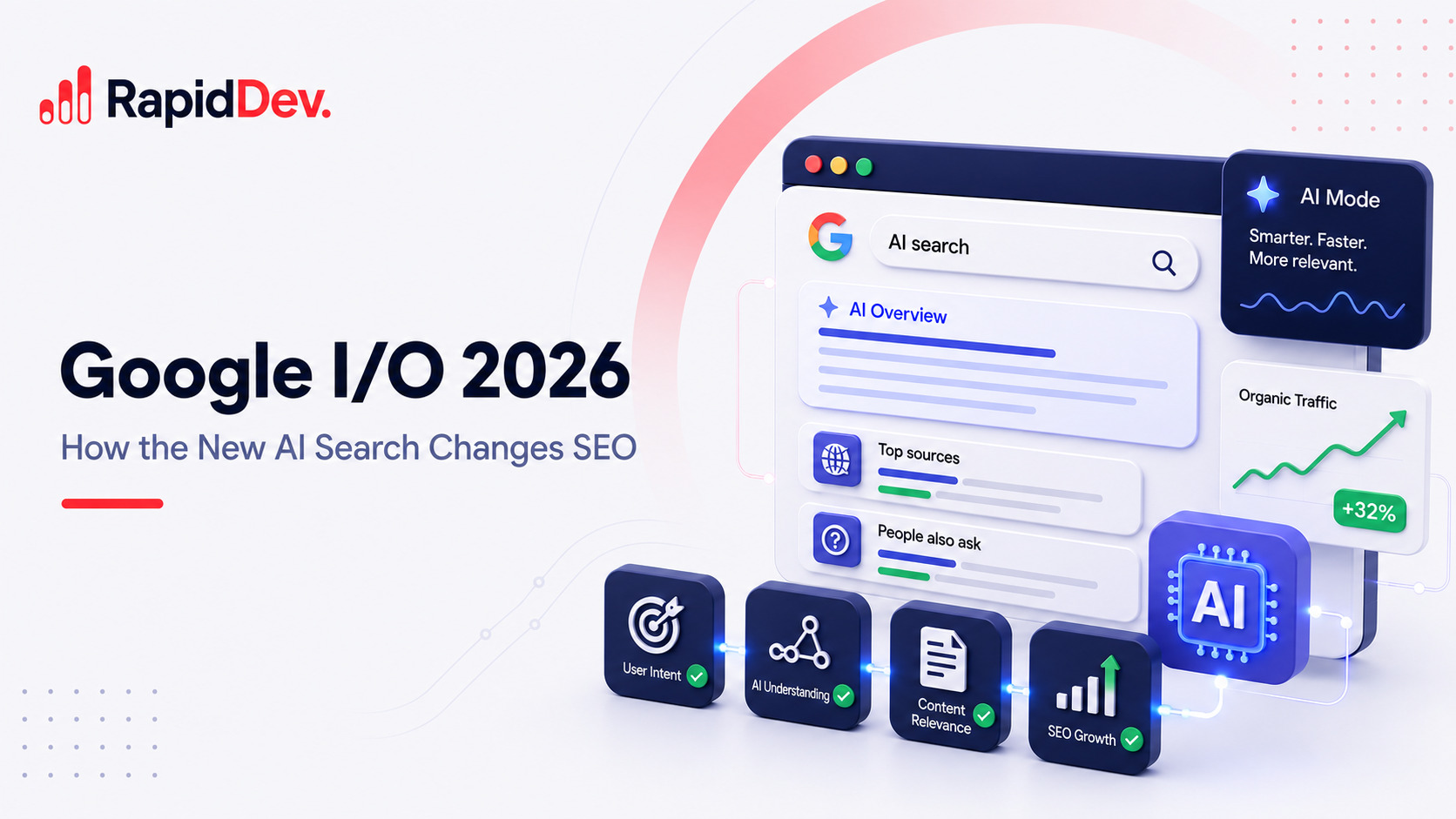
Three forces reshaped the landscape: the mainstream rollout of Google AI Overviews, the rise of answer engines (ChatGPT, Perplexity, Claude), and Google's Helpful Content Update hitting thin SaaS blogs hard. As of Q1 2026, 47% of informational queries trigger an AI Overview (BrightEdge 2026 research).
Studies suggest that a site ranking position 4 without an AI Overview citation receives roughly 35-45% fewer clicks than the same slot earned in 2023. Zero-click behavior now accounts for 58.5% of all Google searches according to SparkToro's analysis of Datos clickstream data. The goal of a 2026 SaaS content program is not just to rank — it is to be the source the answer engine quotes. This is why many brands are investing in Answer Engine Optimization for SaaS, combining entity building, structured data, and expert-led content to improve visibility across AI platforms.
The SaaS SEO Funnel: How Product-Led Content Converts
Most SaaS companies treat SEO and product as separate functions. The highest-performing ones treat SEO as a product distribution channel — building content that maps to how users discover, evaluate, and adopt software.
TOFU: Awareness and Category Education
At the top of the funnel, people are researching the problem, not shopping for a product yet. So, here they are not looking for products yet. TOFU keyword patterns: 'how to [do job the product solves]', 'what is [category]', '[problem] solution'. Conversion-to-trial is low (0.5-2%), but first-touch attribution models show TOFU drives 30-40% of pipeline for mature SaaS programs.
MOFU: Evaluation and Comparison
MOFU users know the category and are actively comparing options. This is where SaaS SEO generates outsized returns because alternatives pages, comparison pages, integration pages, and use-case pages are low-competition, high-intent, and directly tied to trial signups.
Conversion figures are directional benchmarks from aggregated agency data across B2B SaaS clients, 2024-2025. Rates vary by ACV, trial model, and audience.
BOFU: Decision and Activation
Here users are ready to try or purchase. The two highest-converting BOFU types are pricing pages (SEO-optimized, not hidden behind a 'contact sales' wall) and review-modifier pages optimized for branded + review queries. A well-structured BOFU layer can add 15-25% incremental ARR contribution in the first 12 months.
Product-Led SEO
Product-led SEO means using your product to create public pages that can show up in search results, often based on user data or what the product generates. Let’s take the most generic examples: think Figma's community files, Canva's template library, Airtable's template directory. For SaaS companies with template or integration use cases, product-led SEO can generate 30-70% of total organic traffic.
Keyword strategy and content gap analysis
SaaS keyword research maps intent to buyer stage - because a 50-search/month keyword converting at 7% outperforms a 5,000-search/month keyword converting at 0.3%. Five buckets cover the full funnel:
• JTBD keywords — outcome-focused queries ('reduce churn rate', 'automate onboarding'). High volume, low conversion, essential for topical authority and AI citation.
• Alternatives + comparison keywords — KD 2-6 average, 5-10% conversion. The search intent is clear: the user has a product category in mind and is ready to evaluate.
• Integration keywords — stack-building intent, KD 2-8, 4-7% conversion, plus automatic partner backlinks, when you list in their marketplace.
• Free-tool / calculator keywords — 8-15% conversion when gated; strong natural link magnet.
• Long-tail clusters — 'saas seo checklist' (KD 0), 'seo for saas startups' (KD 3), 'saas seo case studies' (KD 2) all share SERP overlap with the primary keyword.
For B2B SaaS SEO programs, longer sales cycles and higher ACVs make bottom-of-funnel keyword precision even more valuable than raw traffic volume.
Content gap spotted in competitor analysis:
The highest-performing SaaS brands combine them with Programmatic SEO 2026 frameworks to systematically capture long-tail demand at scale while maintaining content quality and topical relevance.
Technical SEO for SaaS: Four fixes that unlock rankings
In almost every technical audit we run, the same four issues come up - fixing them before publishing new content makes everything else perform better.
Technical debt is the hidden reason SaaS content programs underperform. Four issues account for 80% of ranking losses at audit:
• Blog on subdomain (blog.yourdomain.com) - migrate to /blog/ subfolder. Subfolders inherit root domain authority; subdomains do not.
• Client-side-only rendering - Googlebot's JS rendering is a second pass. Use SSR or SSG (Next.js, Nuxt.js) for all public-facing pages.
• Faceted navigation leaking crawl budget - canonical or noindex every filter/sort variant that adds no unique value.
• Core Web Vitals: SaaS median LCP is 3.1 s against Google's 2.5 s threshold. Async-load third-party chat scripts (Intercom, Drift) - the most common culprit.
The 4 content types that drive SaaS trial signups
Most SaaS content budgets go into blog posts - which is not wrong, but it leaves the highest-converting page types underfunded and often unbuilt.
Alternatives pages: name the competitor. Vague alternatives pages rank and convert worse on every metric. Name it, build a real feature table, add pricing transparency and a migration guide.
Comparison ('vs') pages: highest-converting content type in the SaaS funnel. Users are in final-stage evaluation — give them a verdict, not a hedge.
Integration pages: double duty — they convert stack-building users and earn followed backlinks from partner marketplaces automatically. A 50-page integration program generates 30–60 high-DR links per year with no outreach.
Use-case pages: '[Product] for [vertical]'. Low KD, 3–7% conversion, and they build the topical breadth that helps head terms rank.
Enterprise SaaS SEO
At enterprise scale, three areas demand specific attention: international SEO and hreflang across regions; subdomain sprawl fragmenting authority (product, blog, help, community often on separate subdomains); and AI search share-of-voice — tracking which competitor ChatGPT and Perplexity cite more often in your category is an emerging board-level KPI.
SaaS link building
We've heard 'write great content and links will come' more times than we can count, and in our experience, it doesn't work at the volume you need to compete on KD 20+ terms.
The highest-ROI link programs are byproducts of legitimate business activity:
• Expert sourcing (Connectively, Featured.com, Qwoted): 10-15 responses/month from a founder or SME → 3-6 DR 55-70 editorial links/month.
• Integration directories: Salesforce, HubSpot, Zapier, Slack, Shopify marketplaces each provide a followed link on approval. Target 20-30 per quarter → 80-120 links/year.
• Podcast appearances: 2–3/month → 24-36 links/year plus branded search lift.
• Original data studies: one well-distributed study earns 50-200 links in 90 days and compounds for years.
GEO and AEO: Ranking in ChatGPT, Claude, and Perplexity
Two terms worth keeping separate here, because they are not the same thing. AEO — Answer Engine Optimization — is about structuring a specific page so an LLM quotes it. GEO — Generative Engine Optimization — is the bigger question: does the AI even know your company exists as a named entity?
Entity building - The foundation of GEO
A SaaS brand with a Wikipedia page, Wikidata entry, Google Knowledge Panel, and consistent brand + category mentions across DR 70+ publications gets cited by LLMs at significantly higher rates than a brand with equivalent DR but no entity structure. Immediate actions: claim Google Business Profile, create a Wikidata entity, standardize your company-category-differentiator phrasing across all G2, Capterra, Product Hunt, and PR listings.
Structuring content for LLM citation
Three patterns LLMs preferentially extract:
- discrete Q&A pairs, self-contained at 40-80 words;
- attributed statistics with source + year;
- numbered or bulleted lists over dense prose.
FAQPage schema is mandatory on every page in this cluster.
The consistent pattern in r/SEO and r/SaaS discussions through 2025–2026: brands ranking #3 on Google that never appear in ChatGPT results for their own category. The common thread — no Wikidata entry, no Wikipedia mention, no entity recognition. The three fastest fixes: establish a Wikidata entity, earn one mention in a primary-source DR 70+ publication, and structure every FAQ as a self-contained 40–80 word block.
When to hire a SaaS SEO agency
These are the signals that are important to notice: organic traffic is flat despite consistent publishing; technical debt accumulates faster than the team can address it; or AI search generates category traffic that competitors capture, and you do not.
In our experience, the SaaS teams that get the most from an agency partnership come in with a clear attribution goal - not just 'more traffic', but 'organic needs to contribute X% of pipeline by Q3.'
A full SaaS SEO services engagement covers: technical audit and remediation, keyword strategy and content production, link acquisition, GEO and AEO optimization, and revenue attribution reporting. When evaluating the best SaaS SEO agencies, prioritize those that demonstrate SaaS-specific MRR attribution (not just traffic), technical depth beyond blog publishing, and AI search competency.
Measuring SaaS SEO in Revenue Terms
Rankings tell you where you stand, not what it is worth — the number that survives a budget review is pipeline contribution: (Organic-sourced MQLs × MQL→SQL rate × SQL→Close rate × ACV).
Many B2B marketers use a benchmark expectation of roughly 4-8× pipeline ROI per $100K invested; top-quartile programs hit 12-20× on a 24-month horizon.
Here are the three metrics to stop reporting in isolation: keyword rankings without traffic context, traffic without conversion data, and 'content published' as a proxy for output. All three erode SEO credibility with leadership faster than slow progress does.
Real results: Omi - AI wearable platform
Omi builds an open-source AI wearable for developers and makers. Great product, brutally hard audience to reach through paid channels. They needed to own search in a fast-moving niche before competitors did.
The fix: modular page templates mapped to high-intent developer and IoT queries. 3,900+ targeted pages live in under six months.
Results in that window:
- Daily clicks: 100 → 2,500+
- Total organic clicks: 204,000+
- Total impressions: 7,000,000+
- CAC reduced as owned search replaced paid dependency
The system compounds — every new Omi feature generates new indexable pages automatically, with no manual effort required.
SaaS SEO Checklist - Download Free
Use this before publishing any new content. Every item maps to a section in this guide.
SaaS SEO Checklist 2026
☐ Blog on /blog/ subfolder (not subdomain)
☐ SSR or SSG for all public-facing pages
☐ Core Web Vitals passing (LCP < 2.5s, INP < 200ms, CLS < 0.1)
☐ FAQPage + Article schema on all pillar pages
☐ Alternatives pages built for top 5 competitors
☐ Comparison ('vs') pages for top 5 head-to-head terms
☐ Integration pages for top 20 stack tools
☐ Wikidata entity created + Google Knowledge Panel claimed
☐ AI Overview citation rate tracked monthly
☐ Named author with credentials on every page
Download the full PDF version: SaaS SEO Checklist - Download Free
Frequently Asked Questions
What is SaaS SEO?
SaaS SEO optimizes a software-as-a-service company's web presence to rank in organic search and AI-powered interfaces. It differs from general SEO in its emphasis on product-led content, conversion pages (alternatives, comparisons, integrations), and technical configurations for JavaScript-heavy app architectures.
How long does SaaS SEO take?
As an illustrative benchmark, a well-executed SaaS SEO program may see target keywords reach positions 12–20 within the first 3 months, positions 6–10 and approximately 250–500 monthly organic clicks by month 6, and top-5 rankings for key pillar content with roughly 800–1,500 monthly organic clicks by month 12. These ranges are not guarantees and assume publication of 4–6 high-quality pieces per month, ongoing link acquisition, sufficient search demand, and no significant technical SEO issues.
What is the difference between SaaS SEO and B2B SEO?
B2B SEO describes SEO for any business-to-business company. SaaS SEO is a subset focused on software subscription models. SaaS companies benefit disproportionately from product-led and programmatic SEO (scalable page templates), conversion pages (alternatives, comparisons), and SaaS-specific metrics (MRR, LTV, CAC) that require more sophisticated attribution than typical B2B tracking.
What is GEO and how does it differ from AEO?
AEO structures content for LLM citation in AI responses. GEO is broader - it includes AEO but also covers entity building and brand representation in AI training corpora. AEO asks: “Will Perplexity cite this page?” GEO asks: “Does ChatGPT know who we are?
Should a SaaS blog be on a subdomain or subfolder?
Subfolder (yourdomain.com/blog/) for all new builds. Subfolders share root domain authority and pass PageRank more efficiently. The only exception: a legacy subdomain where migration engineering cost exceeds 3–6 months of effort and the DR gap is already small.
What are the most important SaaS SEO tools?
Core 2026 stack: Ahrefs or Semrush (keyword research, competitive analysis), Google Search Console (query-level performance), GA4 (traffic and conversion attribution), Surfer/Clearscope/Frase (on-page NLP), Screaming Frog or Sitebulb (technical audit), Semrush AI Toolkit (AI Overview citation tracking).
When should a SaaS company hire an SEO agency?
When organic traffic is flat despite consistent publishing, technical debt exceeds in-house capacity, or AI search generates category traffic that competitors capture and you do not. Prioritise agencies with SaaS MRR attribution experience, technical audit depth, and demonstrable GEO competency.
What content types convert best?
In order: comparison vs-pages (5-10%), alternatives pages (4-8%), integration pages (3-6%), use-case pages (3-7%), JTBD educational content (0.5-2%). The highest-ROI start: 5 alternatives pages for direct competitors — lowest KD, highest buyer intent, fastest to rank.
Does SaaS SEO work without backlinks?
For KD below 10-15, yes. For KD 20+, backlinks are necessary for top-5 positioning. Start with low-KD MOFU content (no links required), then build links to support head-term rankings as DR grows.
What is the best SaaS SEO strategy for startups?
Sequence:
1. fix technical foundation — subfolder blog, SSR, CWV;
2. publish 5 alternatives pages and 5 vs-pages for direct competitors;
3. build integration pages for top 10-20 stack tools;
4. pursue 5-10 high-DR links via expert sourcing.
This generates first-page MOFU rankings in 90-180 days.