

July 3, 2026
•
7
min read

Why More Marketing Doesn't Always Mean More Growth
Running ads, SEO, content, and email but growth is still flat? The problem usually isn't volume. Learn why an integrated marketing strategy beats more spend.
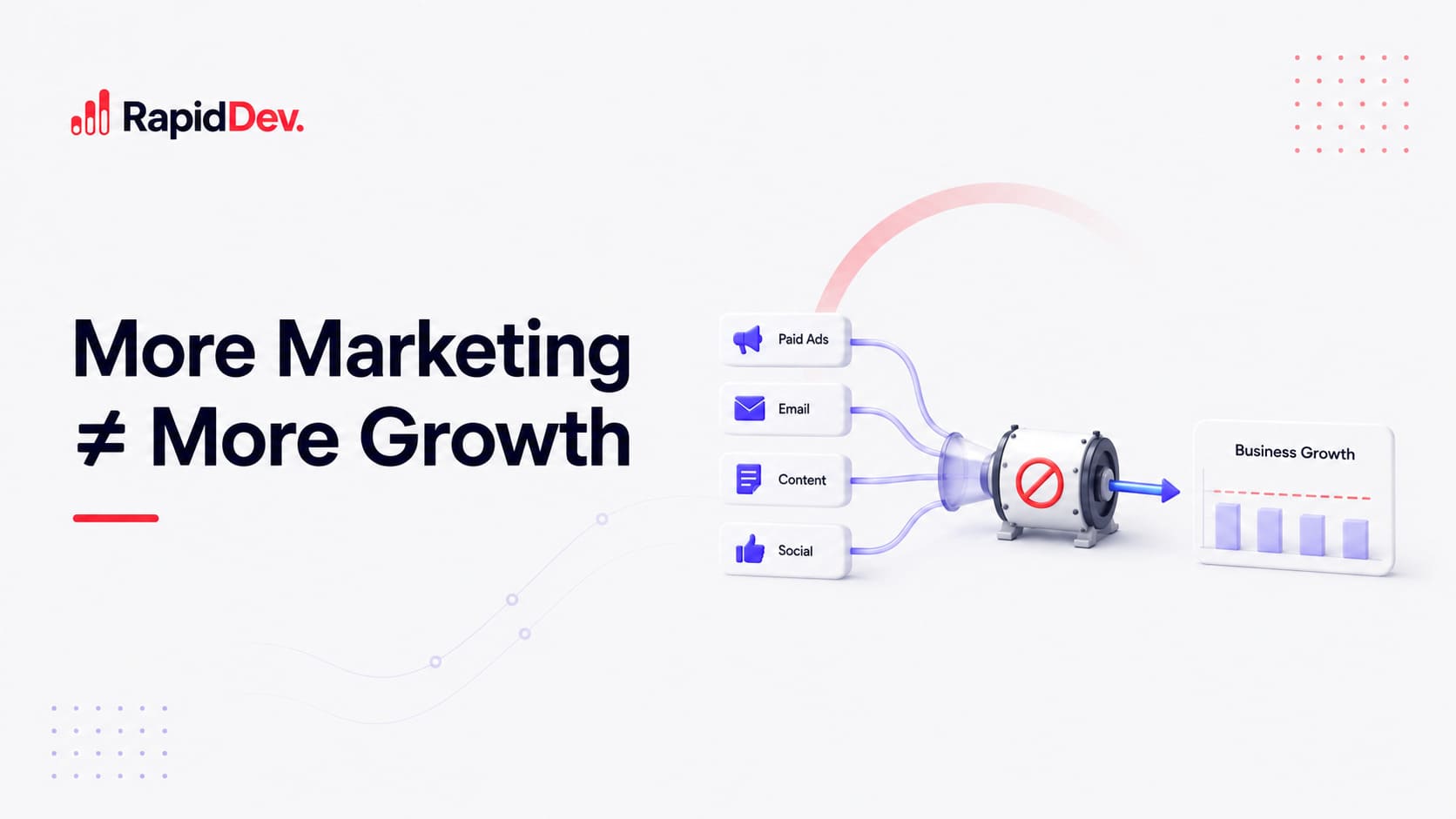
Most companies that feel stuck on growth don't have a marketing problem. They have a connection problem.
Walk into almost any growth-stage company and the setup looks the same. Ads are running. SEO is ticking along. There's a content calendar with something scheduled most weeks, and email goes out on a cadence. Every channel is doing its thing, every channel throws off numbers, and the dashboards look busy. Then you check the actual growth curve, and it's been flat for two quarters.
That's the part that drives founders a little crazy. You're clearly doing marketing, maybe a lot of it, and the effort just isn't showing up where it counts. The reflex is to add more. More budget, another channel, a fresh batch of campaigns. It rarely moves the number, because volume was never the issue. The channels are running as separate islands when they should be running as one connected system.
That's what an integrated marketing strategy actually does. It gets your channels reinforcing each other instead of each doing its own disconnected thing, so the same effort starts producing predictable growth instead of scattered noise. What follows is why isolated channels underperform, why throwing money at ads usually makes the cracks more obvious, and what an integrated marketing strategy needs in place before you scale anything.
Why individual channels stall without an integrated marketing strategy
Each channel is good at exactly one job. Ads buy attention fast. SEO compounds slowly. Content earns trust over time. Email works the people who already know you. Every one of them handles a slice of the work, and not one of them closes the loop alone. An integrated marketing strategy is what stitches those separate jobs into a single result.
The problems start when the channels never talk to each other. Your ad drives someone to a page that doesn't match what the ad promised. Your best-ranking article pulls in readers and then just... ends, with nowhere for them to go. Your email list grows every month, but nobody nudges those subscribers toward an actual decision. Each piece works on its own terms, and the whole thing still leaks like a sieve.
Sit with this one for a second: a channel doesn't produce growth. It produces a step. Growth shows up only when the steps connect into a path someone can actually walk, from the first click all the way to a signed deal. Without something tying those steps together, you don't have a journey. You have a pile of disconnected moments that each look fine in a report.
That's the reason multi-channel marketing so often disappoints. Five channels is not a system. Five channels pulling in five directions is just expensive noise. Point those same five at one clear path and they start compounding. The difference was never the channels themselves. It was the coordination between them, which is the whole job of an integrated marketing strategy.
I think about it like a relay team. You can line up five genuinely fast runners and still lose the race if the baton hits the track at every handoff. Marketing teams drop the baton constantly, and most never notice, because each runner looks quick in isolation. Nobody's watching the exchanges. An integrated marketing strategy is really just the discipline of watching the exchanges.
Why increasing your ad budget exposes the missing strategy
When growth stalls, more ad spend feels like the obvious lever. Bigger budget, more traffic, more customers. That math only works if the system underneath can convert what you send it, and that system is what an integrated marketing strategy builds. Most of the time, it isn't there yet.
So here's what really happens when you feed money into a leaky funnel. More people click. More people hit a page that doesn't quite land. More people bounce without buying. You didn't purchase growth. You purchased a bigger, pricier demonstration of the leak you already had, now running at ten times the volume. An integrated marketing strategy would have caught that leak before you paid to widen it.
A bigger budget doesn't fix vague positioning, a muddy offer, or a conversion path with a dead end in the middle. It just pushes more traffic through those same weak spots, faster, and bills you for it. The spend ends up spotlighting the cracks instead of sealing them. A funnel converting at 1% on $5,000 a month will still convert at 1% on $50,000. Without an integrated marketing strategy holding it together, you've just made the waste ten times more expensive.
This is exactly how scaling ads too early ends up slowing you down. You spend the money that should have gone into fixing the foundation, and the wave of weak results quietly teaches everyone the wrong lesson. The team decides ads don't work, when the real trouble was sitting one step downstream the whole time. Before you touch the budget, the smarter move is to build the integrated marketing strategy that can actually absorb more traffic. When the foundation is right, paid spend performs: in one real estate lead generation project, coordinated campaigns across Meta and Google Ads scaled qualified leads while beating the client's target acquisition cost, precisely because the conversion path underneath was ready for the traffic.
What to check before you scale
Scaling works when the base is solid. Before you raise spend on anything, walk through these five checkpoints. Together they form the backbone of an integrated marketing strategy, and each one is a spot where growth loves to leak.
Positioning and messaging. Can a stranger tell what you do and why it matters in the first few seconds? If the positioning is fuzzy, every channel downstream inherits the fog. The ad gets scrolled past, the article gets skimmed, the email gets archived. Sharpen the message and everything after it works harder for free.
Landing page. Does the page keep the promise the ad made? A landing page that contradicts the headline someone clicked, buries the value below the fold, or asks for a demo before it's earned any trust will bleed traffic no matter how good the ad was. This is where most paid budgets quietly go to die.
Offer clarity. Is it obvious what you're offering and why it's worth it? A muddy offer stalls even people who showed up ready to buy. Nobody purchases what they can't understand in one read, and confusion is the most expensive kind of friction there is.
Conversion path. Can someone actually get from first touch to customer without hitting a wall? Trace the real route, click by click. Nine times out of ten you'll find the broken stair: a form that never sends a confirmation, a "contact us" that goes nowhere, a step where interested people just evaporate.
Lead follow-up. What happens after someone raises their hand? A lot of companies work hard to generate a lead and then let it sit for three days. Fast, consistent follow-up tends to produce more growth than any amount of new traffic, because you're closing demand you already paid to create. It's the cheapest win on this list and the one most often skipped.
If even one of these is weak, more spend just amplifies the weakness. Fix them first and the same budget stretches a lot further.
Signs your integrated marketing strategy is ready to scale
So how do you know the foundation can take more weight? A handful of signals separate a system that's genuinely ready from one that's merely busy.
You can predict what your spend returns. Put a dollar in, and you have a rough, reliable idea of what comes back out. That predictability means the machine works, and more input should reasonably produce more output. It's the first thing a working integrated marketing strategy gives you.
Your conversion rate holds as traffic climbs. Send more visitors and the rate doesn't crater. When the funnel absorbs extra volume without falling apart, that's your green light.
Your channels feed each other. Content backs up the ads. Email re-engages the people SEO first brought in. Retargeting scoops up the ones who wandered off. When an integrated marketing strategy is genuinely working, the channels compound instead of fighting over who gets the credit. That mutual reinforcement is the clearest proof an integrated marketing strategy has actually taken hold.
You know your numbers cold. You can rattle off your cost to acquire a customer, your conversion rate at each stage, and the lifetime value of what you close. Scaling without those is gambling. Scaling with them is investing.
Leads don't slip through the cracks. Every inbound gets a fast, consistent response, and you can follow what happened to each one. When the follow-up is tight, more leads means more customers instead of more waste.
Hit most of these and you can scale with real confidence. Miss a few, and a bigger budget mostly just buys you a quicker way to lose money.
Sustainable growth comes from an integrated marketing strategy
Here's the shift that changes the whole picture. Stop thinking in channels. Start thinking in systems.
A single channel, however well you run it, is fragile. Ad costs climb, an algorithm update wipes out a chunk of your traffic, a content format gets tired, and your one growth engine coughs and stalls. A connected system holds up, because the channels prop each other up. When one dips, the others carry the weight. That's the quiet strength of an integrated marketing strategy: it turns a handful of separate bets into one durable engine, with no single point of failure that can take the whole thing down.
Sustainable growth was never about hunting for the one perfect channel or simply outspending everyone. It comes from a funnel where each piece makes the next one stronger, where traffic flows into a clear path, and where that path turns strangers into customers on a repeatable basis. Get the system right and scaling stops being scary. You've already proven the thing works. From there, you're just adding fuel. That's the same principle behind the connected platform we built for WorldVia, a host agency that had the momentum to scale but needed a unified backbone before it could actually grow into it.
That reframe matters most in the moment right before a big spend decision. The goal isn't more marketing. It's more connected marketing, which is all an integrated marketing strategy really means. Once your channels finally pull the same direction, the growth you've been chasing stops feeling like a lucky month and starts feeling like something you can count on.
See where your system is leaking
If your channels are active but the growth still feels random, the gap is almost always in how the pieces connect, not in the channels themselves. An integrated marketing strategy is usually the missing layer.
That's the work we do. At RapidDev, we map where your growth system is disconnected, find the leaks sitting between your channels, and build the connected path that turns busy dashboards into predictable growth. If you'd like a straight read on what to fix before you scale, book a free consultation and we'll help you find the constraint worth solving first.