

August 27, 2026
•
16
min read

Generative Engine Optimization Services
What generative engine optimization services actually include, how agencies price them, realistic timelines, and the deliverables to demand before you sign.
Generative engine optimization services are designed to improve how often a brand appears, gets cited, and is described in AI-generated answers across platforms such as Google AI Overviews, AI Mode, ChatGPT, Perplexity, Gemini, and Copilot.
That sounds straightforward. In practice, the market is still messy.
Some agencies are genuinely building measurement systems around AI visibility. Others have simply taken an existing SEO package, added “GEO” to the proposal, and started charging more for it.
A serious GEO engagement should begin with the questions your buyers actually ask. From there, the work should establish where your brand appears today, how competitors show up, which sources AI systems are drawing from, and what needs to change on and off your site.
You should also know what you’re paying for.
Public pricing varies widely, but focused GEO audits generally sit in the low-thousands, while broader ongoing programs can move well into five figures per month once content, technical work, competitive tracking, and digital PR are included.
Before signing anything, ask three simple questions:
What are you measuring? What are you changing? And how will I know whether it worked?
If the agency cannot answer those clearly, the label on the service does not matter much.
What Are Generative Engine Optimization Services?
Generative engine optimization, or GEO, is the work of improving a company’s visibility inside AI-generated answers.
The concept gained traction as generative search products started assembling answers from multiple sources instead of simply returning a list of links. The original research on generative engine optimization looked at how content could be made more visible inside those synthesized responses.
In practical terms, GEO work usually comes down to three things.
First, your information needs to be easy for AI systems to understand and extract.
Second, the claims you make about your business need enough supporting evidence around the web to feel credible.
Third, you need a repeatable way to measure whether your visibility is actually changing.
That last point is where a lot of GEO services fall short.
Publishing a cleaner article is not the same as improving AI visibility. A commercial GEO program should be able to show whether your company appears for important buyer questions, how often competitors appear instead, what sources are being cited, and where the largest gaps still sit.
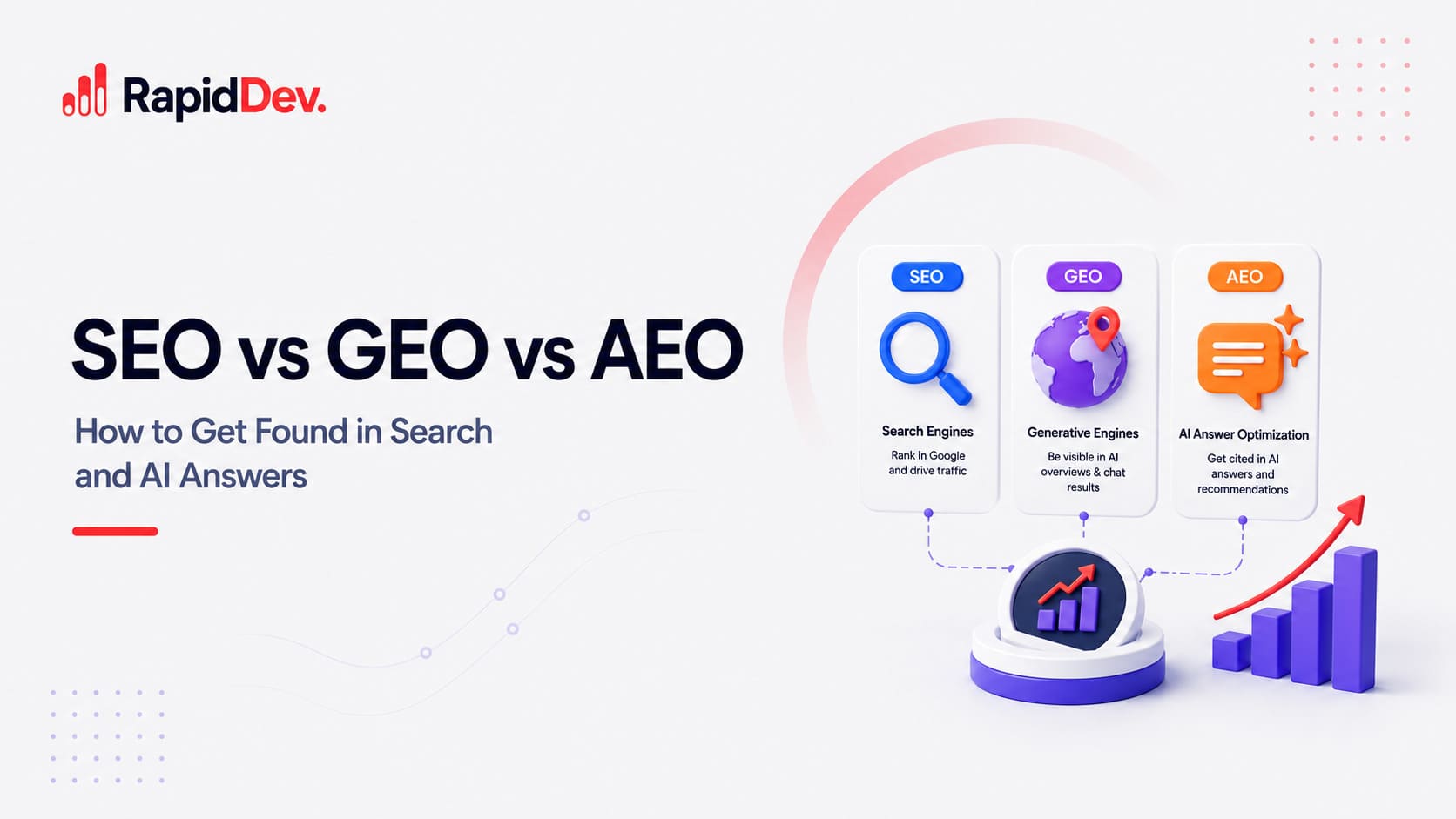
GEO vs. AEO vs. Traditional SEO: What’s the Difference?
The terms overlap, which is why vendors often blur them together.
Traditional SEO is primarily about earning visibility in search results. AEO, or answer engine optimization, focuses more heavily on becoming the direct answer to a question. GEO looks at whether your brand, content, or supporting sources appear inside a generated answer.
The key point is that GEO does not replace SEO.
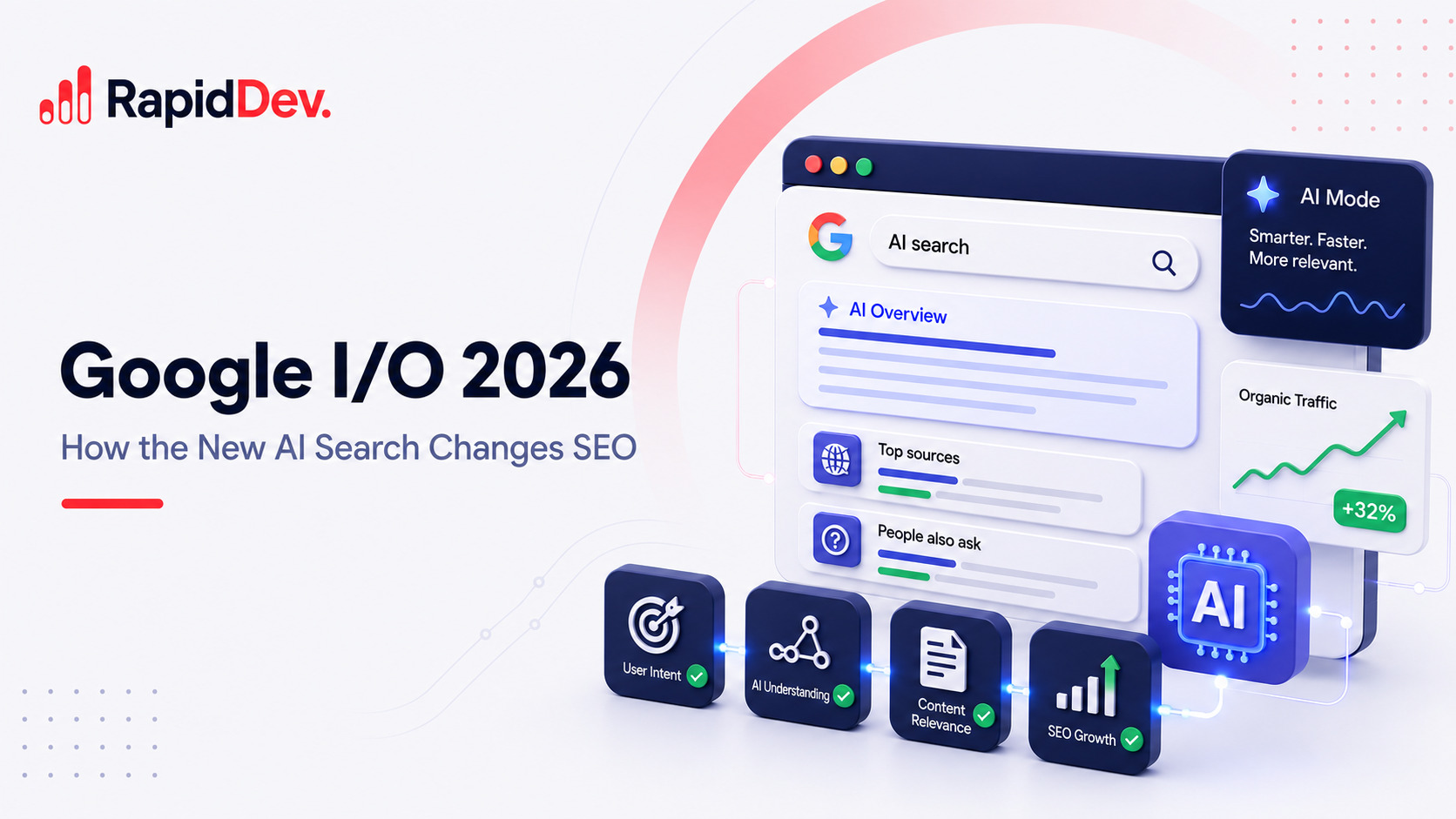
Google has been clear that its existing Search fundamentals still apply to AI Overviews and AI Mode. Pages still need to be crawlable, useful, technically sound, and eligible to appear in Search. There is no magic GEO schema that suddenly makes a page an AI citation.
That is why RapidDev approaches SEO services built as a system, not a checklist. GEO works best when the underlying search foundation is already solid.
Which AI Search Surfaces Should GEO Cover?
That depends on where your buyers actually research.
For most B2B companies, the important surfaces now include Google AI Overviews, Google AI Mode, ChatGPT, Perplexity, Gemini, and Microsoft Copilot.
You should not assume that strong visibility on one platform means strong visibility everywhere else.
Each product retrieves information differently. Different models may be involved. Citation behavior varies. The same question can produce different sources, different framing, and sometimes a completely different shortlist depending on the engine.
A good GEO report keeps those platforms separate rather than rolling everything into one opaque “AI visibility score.”
That level of detail matters because you may discover, for example, that your brand performs well in Google AI Overviews but rarely appears in ChatGPT for category-level questions. That tells you far more than a single blended percentage.
Why Did GEO Become a Separate Service Line?
Because buyer behavior changed.
Traditional search often begins with a short query such as “best AI development companies.”
Generative search invites something much more specific:
“Which AI development firms are best for a healthcare startup that needs HIPAA experience, a small internal engineering team, and an MVP within four months?”
Or:
“What are the best alternatives to X for a mid-market business, and what are the trade-offs between them?”
Those questions collapse several stages of research into one interaction.
A buyer may arrive at a shortlist before clicking on a single website.
That is what makes AI visibility commercially important.
If your company consistently appears in those answers, you may enter consideration earlier. If it never appears, you may lose the opportunity before the prospect reaches your search result, landing page, or case study.
What Is Included in a Real GEO Engagement?
A credible GEO engagement should cover research, measurement, content, technical work, authority building, and reporting.
If the entire scope is “we’ll rewrite your blogs for AI,” the service is too narrow.
Prompt-Set Definition
The first job is deciding which questions are worth tracking.
These should come from actual buyer behavior, sales conversations, search research, customer objections, comparison questions, and category discovery.
For an AI development company, the prompt set might include questions such as “What are the best AI development companies for healthcare?” or “How much does custom AI development cost?” It should also cover comparison queries, problem-led questions, purchase-intent queries, and questions where your brand competes directly with named alternatives.
The point is not to build the biggest possible list.
It is to build a prompt set that reflects the questions that could genuinely influence a buying decision.
That prompt set becomes the measurement framework for the engagement. Without it, “improving AI visibility” is almost impossible to evaluate.
Baseline Measurement
Before changing the site, measure where the brand stands.
You want to know how often your company appears, whether it gets cited, which competitors dominate the same answers, how the brand is described, and which sources the AI systems rely on.
The same prompt set should then be rerun on a consistent schedule.
Generated answers will move around. That is normal.
The value comes from looking at patterns rather than treating one ChatGPT response as a permanent ranking position.
Over time, you should be able to see whether your share of voice is improving, whether new pages are being cited, and whether the sources supporting your brand are becoming stronger.
Entity Foundations
AI systems need a reasonably consistent understanding of who your company is and what it does.
That becomes difficult when your own website calls you an AI transformation partner, an old company profile still describes you as a no-code studio, and a third-party directory uses positioning from three years ago.
A GEO engagement should review how the brand is described across your website, company profiles, relevant directories, review platforms, partner pages, press coverage, case studies, and other authoritative sources.
This is not about repeating the same keyword everywhere.
It is about making core facts consistent enough that they can be verified.
Content Restructuring for Extractability
A strong GEO page makes useful information easy to find.
That usually means getting to the answer earlier, tightening definitions, using comparison tables where they genuinely help, supporting factual claims, and replacing vague marketing statements with specific evidence.
Take a page about AI agent development.
If the first six paragraphs are broad commentary about how artificial intelligence is changing business, the reader—and any system trying to extract a useful passage—has to work much harder.
A stronger page might begin:
“AI agent development is the process of building software that can reason through a task, use tools, and take actions within defined permissions.”
Then it can expand.
The same principle applies throughout the site. Important pages should answer the core question early, use descriptive headings, support claims with evidence, and include original examples or client results where possible.
Before publishing a key commercial page, we would check that the main question is answered near the top, important terms are clearly defined, major claims are supported, headings reflect real buyer questions, and original evidence is included wherever possible. We would also look for clean internal linking, clear authorship, useful tables, and specific examples rather than generic statements.
For large sites, AI content automation can make this kind of restructuring more efficient, but the process still needs factual checks and human editorial review.
Technical Work
The technical side of GEO begins with standard search fundamentals.
Important content should be crawlable, indexable, internally linked, and available as clean HTML. Structured data should accurately reflect what users can see on the page.
Beyond that, a GEO audit may look at how different AI services access your website and whether your current crawler settings match your goals.
This area is often oversold.
For example, llms.txt gets a lot of attention. It may be useful in some emerging workflows, but it is not a universal requirement for AI visibility. Google has explicitly said that you do not need a special AI text file to appear in AI Overviews or AI Mode.
The same caution applies to crawler settings.
Controls for Google, OpenAI, Perplexity, and other platforms do not all mean the same thing. An agency should explain exactly what it is changing and why, rather than simply adding “AI crawler optimization” to a technical audit.
Digital PR and Citation Building
This is where GEO moves beyond your own website.
You cannot dictate which sources an AI system will cite, but you can improve the body of independent information available about your brand.
That may mean earning coverage in relevant industry publications, getting included in credible directories, publishing original research, contributing expert commentary, building partner references, collecting legitimate reviews, or developing case studies that third parties can reference.
This is not just link building with a new name.
The point is corroboration.
If your website says you are one of the strongest AI automation partners in your market but no independent source ever describes the company that way, the claim exists only on your site.
Third-party evidence gives AI systems, and buyers, more reason to trust it.
RapidDev’s programmatic SEO case studies show the same broader principle: visibility grows faster when content, technical structure, authority, and distribution work together.
Reporting
A monthly GEO report should tell you what changed and what the team plans to do about it.
At minimum, it should show visibility across the agreed prompt set, how often the brand appeared, citation activity, competitor share of voice, major changes in sentiment or positioning, newly cited sources, work completed on the site, and priorities for the next month.
A few screenshots can be useful examples.
They should not be the report.
One favorable ChatGPT response is not proof that visibility improved. A good report shows trends across enough prompts and enough time to support a real conclusion.
What Do Generative Engine Optimization Services Cost?
There is no standard GEO price list yet.
The market is still developing, and providers package the work very differently.
A focused audit may cost a few thousand dollars. An ongoing engagement that combines prompt monitoring, content, technical work, competitor research, and authority building may fall anywhere from roughly $3,000 to $12,000 per month. Larger, multi-market programs with significant digital PR can reach $10,000–$25,000+ per month.
Those are market reference points, not RapidDev pricing.
What you actually pay should depend on the scope.
A company tracking 30 commercial prompts in one market with ten priority pages has a very different engagement from a global brand tracking hundreds of prompts across several languages and competitors.
Price tends to rise with the size of the prompt set, number of markets, number of AI engines tracked, website size, content volume, technical complexity, reporting depth, and the amount of off-site authority work required.
Digital PR is often one of the biggest variables because earning credible third-party coverage takes considerably more time than restructuring an existing landing page.
Audit, Project, or Retainer?
You do not always need a retainer.
An audit makes sense if you first want to understand where your brand appears, where the gaps are, and what work is actually required.
A project works well when the issues are fairly contained. That might mean establishing measurement, fixing technical access, and restructuring a defined set of commercial pages.
A retainer makes more sense when the strategy depends on continuous prompt tracking, new content, ongoing page improvements, digital PR, and competitor monitoring.
If an agency pushes you straight into a 12-month retainer but cannot explain what ongoing work justifies it, that deserves a closer look.
Which GEO Pricing Models Should You Avoid?
Be cautious of agencies charging by the AI mention.
Generated answers fluctuate. Per-mention billing encourages the provider to chase easy appearances rather than commercially meaningful visibility.
A mention for “What companies have ever used Bubble?” is not worth the same as appearing for “Best AI development firms for enterprise workflow automation.”
The prompt matters.
Guaranteed placement is an even bigger red flag.
No agency controls ChatGPT, Gemini, Perplexity, or Google AI Overviews. A provider can improve the conditions that make a brand more visible. It cannot guarantee a permanent position in a generated answer.
Treat guaranteed AI placement the same way you would treat a guaranteed permanent #1 Google ranking.
How Do You Scope a GEO Engagement So It Is Accountable?
The statement of work should make the engagement easy to inspect.
Before signing, ask which engines the agency will track, how it will build the prompt set, how many prompts are included, how often those prompts will be rerun, and which competitors will be used for comparison.
You should also know what changes are actually included. Does the engagement cover technical fixes? Existing page updates? New content? Digital PR? Citation building? Entity cleanup?
Ask how the agency measures sentiment and share of voice, what you can independently verify, and what would make the team change direction after 60 or 90 days.
If the answer to most of those questions comes back to a proprietary score you cannot inspect, the engagement is too opaque.
What Should Be Included in the SOW?
At minimum, the SOW should define the prompt set, engines tracked, competitor benchmark, initial visibility baseline, technical review, content scope, entity review, reporting cadence, success metrics, and named owners.
If new pages or digital PR are part of the work, specify quantities and responsibilities.
Avoid phrases such as “ongoing GEO optimization” unless the agreement explains what that means in actual work.
How Long Does GEO Take?
You should be able to establish a baseline immediately.
From there, technical changes and content improvements can happen fairly quickly. Broader visibility gains usually take longer.
A 60–90 day window is a reasonable point to start evaluating whether meaningful movement is appearing across the prompt set. Building stronger third-party authority may take several months.
The first changes you notice are usually technical and content-related. Pages become easier to extract from. Priority questions gain better coverage. Citations may begin to shift.
Brand authority tends to move more slowly.
And because generative answers are inherently variable, expect some noise in the data. GEO is not traditional rank tracking with a fixed position from Monday through Friday.
How Can You Tell a GEO Agency From an SEO Agency With a New Label?
Ask them to show you how the work differs.
If they cannot produce a real prompt set, that is a problem.
If every deliverable looks exactly like a traditional SEO package: metadata, blog posts, internal links, rank tracking, but the proposal uses “AI visibility” language, the GEO component may be mostly packaging.
The same applies if they guarantee placements, never discuss third-party sources, or cannot explain how their reporting is generated.
You should also be able to verify at least part of what they show you.
Generated answers will vary, so perfect reproduction is unrealistic. But you should be able to take several prompts from the agency’s report, run them yourself, and broadly understand what they are measuring.
What Proof Should You Ask a GEO Agency For?
Start with the agency’s own category.
Search or ask AI platforms about the best GEO agencies, generative engine optimization companies, or AI search optimization providers.
If the agency claims deep expertise in GEO but never appears anywhere in the conversation around its own market, ask why.
Then ask for an anonymized example of a client prompt set and reporting structure.
You should be able to understand how the agency chooses questions, compares competitors, records citations, identifies source patterns, and turns that information into an action plan.
Screenshots alone are not enough.
RapidDev focuses on measurable client results rather than treating activity as proof of performance.
Should You Outsource GEO or Build It In-House?
A strong in-house SEO and content team can handle more GEO work than many agencies would like to admit.
If you already have people who understand search, content, digital PR, analytics, and technical SEO, you can build a prompt set, run baseline checks, restructure priority pages, clean up entity inconsistencies, and monitor competitors internally.
The challenge is usually scale.
Tracking hundreds of prompts across multiple engines, coordinating technical fixes, updating a large content library, and earning relevant third-party coverage can turn into a serious operational workload.
That is where an agency can add leverage.
Outside support is most useful when you need a repeatable methodology, multi-engine tracking, technical implementation, high-volume content work, digital PR, competitive intelligence, or automation without adding a large permanent team.
For companies where AI search is part of a broader shift in how the business uses AI, RapidDev’s AI strategy and consulting work can connect the marketing opportunity to the wider AI roadmap.
And if maintaining the content operation itself is becoming too manual, AI content automation can remove repetitive production work while keeping editorial review in place.
Teams building their own internal stack may also want to compare the AI SEO tools we tested on client sites before buying another platform.
FAQs
What Is Answer Engine Optimization, and Is It Different From GEO?
Answer engine optimization focuses on helping content surface as a direct answer to a question.
GEO looks more broadly at visibility inside generated responses, including whether your company gets mentioned, how it is described, and whether your own content or supporting third-party sources are cited.
There is plenty of overlap, and many agencies use the terms interchangeably.
How Much Do Generative Engine Optimization Services Cost?
Focused audits may cost a few thousand dollars. Ongoing programs often fall somewhere around $3,000–$12,000 per month, while larger multi-market or digital PR-heavy programs can reach $10,000–$25,000+.
The number matters less than the scope.
Compare exactly what the provider will measure and deliver before comparing retainers.
How Long Before We See Results?
A baseline can be established immediately, while technical and content changes can usually begin within the first few weeks.
Early visibility movement may start showing within 60–90 days. Larger authority and citation gains often need several months.
The timeline depends heavily on your starting position, competition, content quality, technical health, and the strength of third-party signals around the brand.
Can You Track Brand Mentions Inside ChatGPT?
Yes, with limitations.
You can define a repeatable set of prompts, record whether your company appears, track competitors, monitor citations, and look at changes over time.
What you cannot do is treat a ChatGPT mention like a fixed Google ranking.
Generated answers vary between sessions, users, models, and dates. The useful metric is the trend across a consistent sample.
Does GEO Replace SEO?
No.
Search fundamentals remain essential.
Strong technical SEO, useful content, crawlability, authority, and clear site structure still support visibility in traditional search and many AI search experiences.
GEO adds another layer: how your brand appears in generative answers, which sources support it, how consistently important entities are understood, and how often you are included when buyers ask high-intent questions.
If you want to see how your company currently appears across AI search and where the strongest opportunities are, you can book a free, no-obligation consultation.