

November 18, 2026
•
20
min read

RAG vs Fine-Tuning: Which One Your AI Project Actually Needs
Compare RAG and fine-tuning on cost, data needs, accuracy and upkeep, and see when to combine them. Book a free AI strategy call to choose your approach.
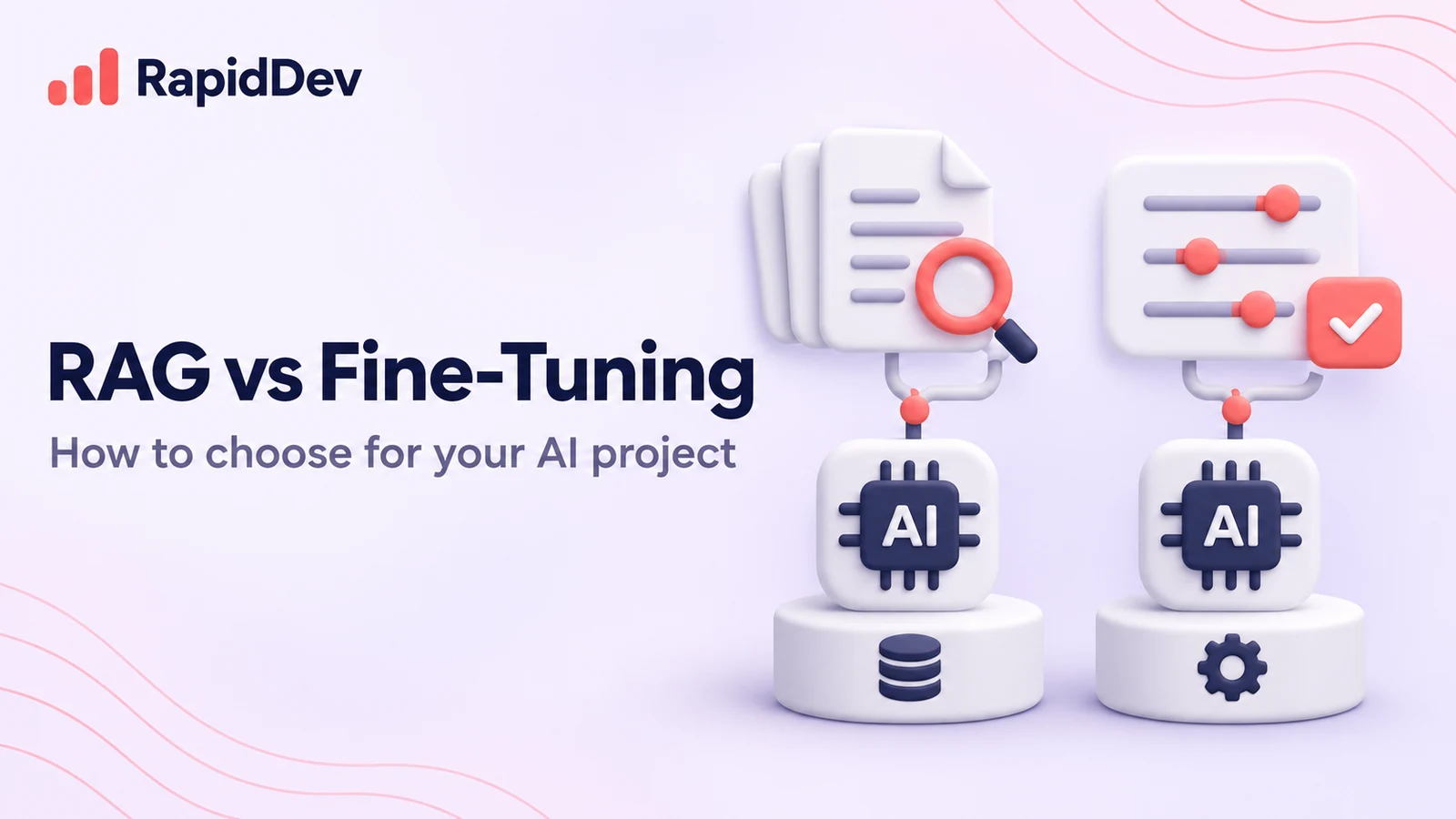
RAG gives an AI model access to external information when it answers a question. Fine-tuning trains the model to perform a task differently. Use RAG for changing information, fine-tuning for specialized behavior, and prompting for simpler tasks. RapidDev's AI app development team helps businesses choose an approach based on their data, requirements, and budget.
What is the difference between RAG and fine-tuning?
The difference is where the model gets its information and how its behavior changes.
Retrieval-augmented generation (RAG) retrieves relevant information from an external source and gives it to the model when needed. Fine-tuning changes the model's learned behavior through additional training.
Prompt engineering takes a simpler route: it uses instructions and examples to guide the model without changing its weights or building a retrieval system.
| Prompt engineering | RAG | Fine-tuning | |
|---|---|---|---|
| What it changes | Instructions and examples given to the model | Information available when the model generates an answer | Model parameters through training |
| Best for | Summaries, simple classification, formatting, straightforward workflows | Document Q&A, internal knowledge, frequently changing information | Specialized classification, consistent outputs, domain-specific behavior |
| Data needed | Clear instructions and a few representative examples | Documents, records, or other searchable information | High-quality training examples |
| Keeping information current | Update the prompt or supplied context | Update the underlying documents or index | Retraining may be needed for information learned in the model's weights |
| Initial cost | Usually lowest | Data preparation, indexing, retrieval, and integration | Training data preparation, model training, and evaluation |
| Ongoing cost | Model usage | Model usage, retrieval, storage, and maintenance | Model usage, monitoring, hosting, and possible retraining |
| Time to first version | Usually fastest | Depends on data and integrations | Depends on training data and model availability |
| Source citations | Possible when sources are supplied | Can reference retrieved documents | No built-in link to original training sources |
| Main risk | Inconsistent results or insufficient context | Poor retrieval or outdated source material | Overfitting, performance regressions, or stale learned information |
AWS's prescriptive guidance on comparing RAG and fine-tuning draws the same line: retrieval supplies outside knowledge, while fine-tuning adapts a model.
Think about three common business requirements.
If an employee asks about a vacation policy updated yesterday, the assistant needs access to the latest document. That's a RAG problem.
If a company needs to classify thousands of support tickets into a fixed set of categories, fine-tuning may be useful.
If a manager wants meeting notes summarized in a particular format, a good prompt may be enough.
The right choice becomes much clearer when you start with the job rather than the technology.
What is RAG?
Retrieval-augmented generation (RAG) lets a language model use information retrieved from external documents or databases when generating an answer.
The approach was introduced in the original RAG paper by Lewis et al. (Meta AI, 2020).
A typical RAG system searches a collection of documents, retrieves relevant passages, and supplies them to the model along with the user's question.
The model then uses that information to prepare its answer.
Because the documents remain outside the model, they can be updated without retraining it.
That's useful for company knowledge bases, product documentation, internal policies, and other information that changes regularly.
RAG can also provide references to the documents used in an answer, making the result easier to check.
It isn't foolproof. If the system retrieves the wrong passage or misses an important document, the answer may still be incorrect.
Good retrieval and proper testing matter just as much as the model itself.
What is fine-tuning?
Fine-tuning is the process of training an existing AI model on additional examples so it performs a particular task or follows a preferred response pattern more consistently.
Rather than repeatedly explaining how the model should behave, you provide examples that demonstrate the expected result.
A company might fine-tune a model to categorize customer complaints, extract information into a specific structure, or use specialized industry terminology.
The model learns patterns from those examples.
What does fine-tuning help with?
Fine-tuning is most useful when the task is clearly defined and repeated often.
Consider an insurance company that receives thousands of customer messages.
Each message needs to be assigned to a category such as claims, billing, policy changes, or cancellations.
A general-purpose model may already do this reasonably well. But if the company needs more consistent classifications at scale, fine-tuning could be worth testing.
The same applies to applications that produce structured records for other software.
Training may improve consistency, although the application still needs to validate the output before using it.
What fine-tuning doesn't solve
Fine-tuning isn't a good replacement for a searchable knowledge base.
Suppose your company updates product prices every week.
You could train a model on the catalog, but that information would quickly become outdated.
The model might also struggle to distinguish between facts it learned during training and information that has since changed.
A database or retrieval system is better suited to keeping prices and availability current.
Do you have to retrain the entire model?
No.
Parameter-efficient methods can adapt models without updating every parameter.
One example is LoRA (Low-Rank Adaptation), which freezes the original weights and trains small added matrices instead; the LoRA paper reports 10,000 times fewer trainable parameters than full fine-tuning of GPT-3 175B.
This can make fine-tuning more practical, particularly for suitable open-weight models.
It doesn't remove the need for good training data, testing, or infrastructure.
And not every commercial model supports fine-tuning.
Provider offerings change. OpenAI, for example, is winding down its fine-tuning platform: its OpenAI model optimization docs say it is no longer open to new users, and existing fine-tuned models stay available only until their base models are deprecated. Check current provider support before you plan a project around fine-tuning a specific model.
Where does prompt engineering fit?
Prompt engineering is usually the best place to start because it lets you test a model's capabilities without building additional infrastructure.
A prompt can explain the task, provide examples, define the expected format, and tell the model how to handle uncertainty.
For many applications, that's enough.
When is prompting sufficient?
Prompt engineering works well for tasks such as summarizing documents, rewriting content, extracting information from short texts, or producing structured drafts.
It can also work for straightforward classification.
Imagine you need to sort customer emails into five categories.
You could give the model the category definitions, a few examples, and instructions to return the result in a specific format.
If the output is accurate enough and the cost is reasonable, you may not need anything more.
When should you consider something else?
Problems usually emerge when the model needs information that isn't in the prompt or struggles with a repeated task despite clear instructions.
Those are different issues.
If the model doesn't have access to the right information, RAG may help.
If it has the information but repeatedly makes the same kind of mistake, fine-tuning may be worth exploring.
Sometimes the problem is simply that the instructions are unclear.
Adding a retrieval system or training pipeline won't fix a poorly defined task.
When should you use RAG?
RAG makes sense when your application needs information that changes, comes from external sources, or must be traceable to a particular document.
It's especially useful for applications built around company knowledge.
Internal knowledge assistants
Most companies have information scattered across documents, shared drives, knowledge bases, and internal systems.
Employees need answers, but finding the right document can take longer than the question itself.
A RAG assistant can search those materials and prepare an answer using the relevant information.
For example, an HR assistant could retrieve the current vacation policy and explain how employees request time off.
It could also reference the section of the policy supporting the answer.
When the company updates the policy, the underlying information can be refreshed without retraining the model.
The system still needs proper permissions. An employee asking a question shouldn't gain access to confidential documents they wouldn't otherwise be allowed to see.
Customer support and technical documentation
Software companies regularly update features, integrations, and troubleshooting instructions.
A support assistant needs access to the latest documentation rather than relying on information learned during the model's original training.
RAG can retrieve the relevant instructions and use them to answer customer questions.
It should also recognize when the documentation doesn't contain an answer.
Telling a customer that an issue needs further investigation is better than inventing a solution.
Document-heavy workflows
RAG can help employees locate and compare information across large document collections.
In underwriting, for example, teams may need to review applications, bank statements, property records, and internal guidelines.
That spread of sources is typical of AI document processing in underwriting: the supporting evidence sits across several documents, so the system has to find it before anyone can review it.
Retrieval can help surface supporting evidence, while extraction, validation, and business rules handle other parts of the process.
Not every document workflow needs RAG.
If the job is simply to extract a few fields from one uploaded PDF, direct document processing may be the simpler solution.
Regulated and auditable answers
RAG is useful when people need to verify where an answer came from.
A compliance assistant might retrieve the relevant section of an internal policy or regulatory document.
The user can then review the original material.
That doesn't make every RAG answer automatically trustworthy.
The application still needs to check that the cited passage supports the claim and that the document is current.
When should you fine-tune?
Fine-tuning is worth considering when the model has the information it needs but doesn't perform a repeated task consistently enough.
The strongest candidates are usually narrow, measurable tasks with good training examples.
High-volume classification
Suppose a company processes thousands of customer messages each day.
Each message needs a category, priority level, and destination team.
A general-purpose model may handle this well, but a smaller fine-tuned model could potentially deliver comparable results at a lower operating cost.
That needs to be tested, not assumed.
The comparison should include accuracy, latency, inference costs, and the consequences of incorrect classifications.
Structured output
Some applications need to turn unstructured text into records that other systems can process.
For example, a model might extract information from customer requests and produce a specific JSON structure.
Fine-tuning can improve consistency when prompting and schema constraints aren't enough.
But the application should still validate every output.
Even a well-trained model can produce an invalid field or misunderstand an unusual input.
Specialized terminology and tone
Fine-tuning may also help when an application needs to use specialized terminology or follow a particular writing style.
A company with a large collection of approved communications might use those examples to train a model on its preferred tone and structure.
Still, prompting should come first.
Many style requirements can be handled with clear instructions and a few examples, without the expense of training.
When fine-tuning isn't worth it
Fine-tuning won't solve every model problem.
It won't keep a product catalog current, repair inconsistent business rules, or compensate for poor training examples.
If employees disagree about how customer complaints should be classified, the model will learn from those inconsistencies.
The process needs to be clear before the training begins.
Can you combine RAG and fine-tuning?
Yes. RAG and fine-tuning can work together when an application needs both current information and specialized behavior.
RAG supplies the information. Fine-tuning helps the model work with it in a particular way.
An example of a hybrid approach
Consider a financial services company building an assistant that reviews internal policies and prepares structured assessments.
The policies change regularly, so the assistant needs retrieval.
The company also wants every assessment to follow a specific format and use established terminology.
A hybrid system could retrieve the latest documents and use a fine-tuned model to prepare the assessment.
Validation and human review would still be needed, particularly for decisions with financial or regulatory consequences.
What is retrieval-augmented fine-tuning?
Researchers have also explored training models to work more effectively with retrieved documents.
One example is RAFT: Adapting Language Model to Domain Specific RAG.
RAFT trains models to answer questions using relevant documents while learning to distinguish useful evidence from distracting material.
It's an interesting approach for specialized applications, but it doesn't mean every RAG project needs fine-tuning.
A capable general-purpose model with a well-designed retrieval system may already perform well enough.
How does RAG work with AI agents?
An AI agent may need to consult company documentation before taking action.
For example, a support agent could retrieve the current refund policy before preparing a return request.
If several applications need access to the same documents, teams can expose retrieval through a shared tool interface.
One option is to build an MCP server for RAG, allowing compatible agents to query the same document collection.
The agent still needs permissions and business rules governing what it can do with that information.
Finding a policy doesn't automatically authorize the agent to issue a refund.
What do RAG and fine-tuning cost?
RAG and fine-tuning have different cost structures, and neither comes with a standard price.
RAG requires data preparation, retrieval infrastructure, and ongoing maintenance. Fine-tuning involves preparing training examples, running training jobs, evaluating the model, and potentially maintaining specialized hosting.
The final cost depends on the size and complexity of the application.
What drives RAG costs?
Data preparation. Documents may need cleaning, formatting, deduplication, and metadata before they can be searched effectively.
Embeddings and indexing. Many systems convert text into vector representations for semantic search. Others combine vector and keyword retrieval.
Storage and retrieval. Indexed information needs to be stored and retrieved efficiently.
Integrations. Connecting internal repositories, databases, and business applications can require custom development.
Model usage. Retrieved passages add context to model requests, which can increase token consumption.
Testing and maintenance. Teams need to monitor retrieval quality, document updates, permissions, and answer accuracy.
A small assistant connected to a clean document collection will be much simpler than an enterprise search system spanning several departments and permission levels.
What drives fine-tuning costs?
Training data. Collecting, labeling, cleaning, and reviewing examples can be one of the most time-consuming parts of the project.
Training runs. Costs depend on model size, dataset size, training method, and infrastructure.
Evaluation. The model needs to be tested on examples it hasn't seen during training.
Hosting and inference. Depending on the model, you may need a managed endpoint or dedicated infrastructure.
Retraining. Changes in requirements or input patterns may call for additional training.
Monitoring. Performance can change as real-world inputs evolve, so the team needs to watch for errors and regressions.
Is RAG cheaper than fine-tuning?
Not necessarily.
RAG can be more practical when the information changes frequently, since you can update the source data without retraining the model.
Fine-tuning may make financial sense for high-volume, repetitive tasks, particularly when a smaller adapted model performs well.
But a complicated retrieval system with multiple integrations can be expensive to maintain.
And a fine-tuning project can become costly if the training data needs extensive preparation or the results require repeated experiments.
The comparison should include the full cost of building and running the application.
Don't forget model and agent costs
Model pricing changes, and different providers charge differently for inference, training, and hosting.
Check current model limits and pricing before preparing a budget.
If the model is part of an AI agent, you'll also need to account for integrations, workflow orchestration, permissions, testing, and monitoring.
Integrations, orchestration and monitoring make up a large part of what AI agent development costs, often more than model usage itself.
The cheapest model isn't always the cheapest application. If it needs more retries or manual corrections, those costs add up.
How do you decide between RAG, fine-tuning, and prompt engineering?
Start with the simplest approach that can do the job reliably, then add retrieval or training when testing shows a clear reason to do so.
The decision should come from the business requirement, not a preference for a particular technology.
| Business scenario | Recommended approach | Why |
|---|---|---|
| Support assistant answering questions about internal policies | RAG | Policies change, and answers should reference current documents |
| Consistent brand voice or specialized output format | Prompt engineering first; fine-tuning if needed | Instructions may be sufficient, but training can help with persistent inconsistencies |
| High-volume customer message classification | Fine-tuning a smaller model, if testing supports it | May improve consistency or reduce cost at scale |
| Product assistant using frequently changing prices and availability | RAG or direct API retrieval | Product information needs to remain current |
| Compliance assistant that must cite approved documents | RAG | Answers need traceable evidence |
| Domain-specific assistant requiring current documents and specialized outputs | Hybrid RAG and fine-tuning | Combines retrieval with task-specific behavior |
| Summarizing a document supplied by the user | Prompt engineering | The information is already available |
| AI agent following internal procedures | RAG with controlled tool integrations | The agent needs current instructions and access to approved systems |
Define the task
"Build an AI assistant" isn't specific enough to guide an architecture decision.
"Answer employee questions using the current HR policy and cite the relevant section" is much clearer.
So is "classify incoming customer messages into eight categories with an acceptable error rate."
You need to know what success looks like before choosing the technology.
Test a basic version
Start with a capable model and a carefully written prompt.
Use examples that reflect the work the application will actually perform.
If the model already meets your requirements, you may not need anything else.
If it struggles, look at the reason before adding complexity.
Add retrieval if information is missing
If the model needs external knowledge, test a small retrieval system.
Check whether it finds the right documents and whether the answers accurately reflect them.
Poor retrieval can't be fixed simply by switching to a more powerful model.
Consider fine-tuning if behavior is inconsistent
If the model has the necessary information but repeatedly struggles with the same task, prepare a small fine-tuning experiment.
Keep evaluation examples separate from the training data.
Compare the results with your original model on accuracy, latency, and cost.
The fine-tuned version should earn its place in the architecture.
Test the complete workflow
A good model response isn't enough.
For RAG, test retrieval relevance, answer accuracy, citation quality, and how the system handles missing information.
For classification, measure performance across categories and examine costly mistakes.
For agents, test failures in connected systems and unexpected user requests.
This is the hard part of AI implementation: making sure the system works reliably outside a controlled demo.
Compare the long-term cost
Include development, infrastructure, model usage, testing, maintenance, and human oversight.
The technically most sophisticated option isn't necessarily the best investment.
If you're weighing several approaches, book a free AI strategy call and bring an example of the task you want to automate.
A concrete use case makes it much easier to compare the options.
How does RapidDev make this decision on client projects?
RapidDev, an AI development and integration company, approaches RAG and fine-tuning as implementation choices, not products to recommend regardless of the problem.
The first question is what the application needs to accomplish.
A client may initially assume it needs a fine-tuned model because the application will use internal documents.
But if those documents change regularly and users need source-backed answers, retrieval may be the more practical approach.
Another company may ask for RAG when the real requirement is a narrowly defined classification task.
In that situation, prompting or fine-tuning may be a better fit.
Understanding the workflow
The first step is looking at how the task is handled today.
Who uses the application? What information do they need? Where does that information live? What happens if the system makes a mistake?
An internal knowledge assistant has different requirements from a financial document classifier.
An agent that can update customer records needs controls that a read-only assistant doesn't.
These details affect the architecture from the beginning.
Reviewing the available data
For RAG, the team needs to understand the document collection, update frequency, permissions, and retrieval requirements.
For fine-tuning, it needs to evaluate the quality and consistency of training examples.
Sometimes the biggest obstacle has little to do with the model.
The company may have outdated documents, inconsistent labels, or business rules that aren't clearly defined.
Those issues need attention before development can deliver reliable results.
Testing the alternatives
A useful proof of concept compares practical options rather than assuming one approach will win.
That may mean testing a prompt-based baseline against a retrieval system or comparing a general-purpose model with a fine-tuned smaller model.
The results should be evaluated against the same requirements.
Accuracy matters, but so do response time, traceability, maintenance, and cost.
Preparing for production
Once the approach is selected, the work extends beyond model configuration.
RAG systems need indexing, permissions, monitoring, and a reliable way to keep source information current.
Fine-tuned models need performance monitoring and a process for updating training data when requirements change.
Both need proper integration with the applications and workflows people already use.
The objective is a system the business can depend on and maintain, not simply a demonstration that the technology works.
FAQs
Is there anything better than RAG?
Yes, depending on what you're trying to do.
If all the relevant information fits in the model's context, direct prompting may be simpler.
If you need an exact value from a database, a query or API call may be more reliable than semantic retrieval.
Fine-tuning can also be a better choice for specialized classification or consistent behavior.
RAG is useful, but it isn't the answer to every AI problem.
Is fine-tuning debunked?
No. Fine-tuning remains useful for adapting models to specialized tasks and response patterns.
What has changed is the number of problems that capable general-purpose models can handle without additional training.
Better prompting and retrieval methods have made fine-tuning unnecessary for some applications.
It still makes sense when testing shows a meaningful improvement in accuracy, consistency, speed, or cost.
How does RAG differ from prompt engineering and fine-tuning?
Prompt engineering changes the instructions and examples given to a model.
RAG retrieves external information and adds it to the model's context when needed.
Fine-tuning changes the model's learned behavior through additional training.
Prompting is usually the simplest starting point. RAG helps with external knowledge, while fine-tuning helps with specialized behavior.
The approaches can also be combined.
How much data do you need to fine-tune an LLM?
There's no universal minimum.
The amount depends on the model, task complexity, training method, and quality of the examples.
A narrow classification task may require fewer examples than a complex domain-specific application.
A smaller, carefully reviewed dataset can be more useful than a large collection of inconsistent examples.
Start with representative data, test the result, and add examples where performance needs improvement.
Can you use RAG and fine-tuning together?
Yes.
A hybrid system can retrieve current information through RAG while using a fine-tuned model for specialized tasks.
For example, an assistant might retrieve the latest financial policies and use an adapted model to prepare assessments in a required format.
Combining the two adds complexity, so the improvement should be demonstrated through testing.
Many applications work well with RAG and a general-purpose model without any fine-tuning.
When the answer is a mix of both, our AI app development team scopes the retrieval layer and the model together, so neither one is built around the wrong assumption.
To discuss your project, book a free AI strategy call and tell us what you're trying to build.