

June 22, 2026
•
14
min read

Prompts Are Easy. The Rest of AI Implementation Is Hard.
Prompt engineering is just 10% of AI implementation. Learn the 5 pillars—data, automation, integrations, UX, and adoption—that move AI from experiments to production.
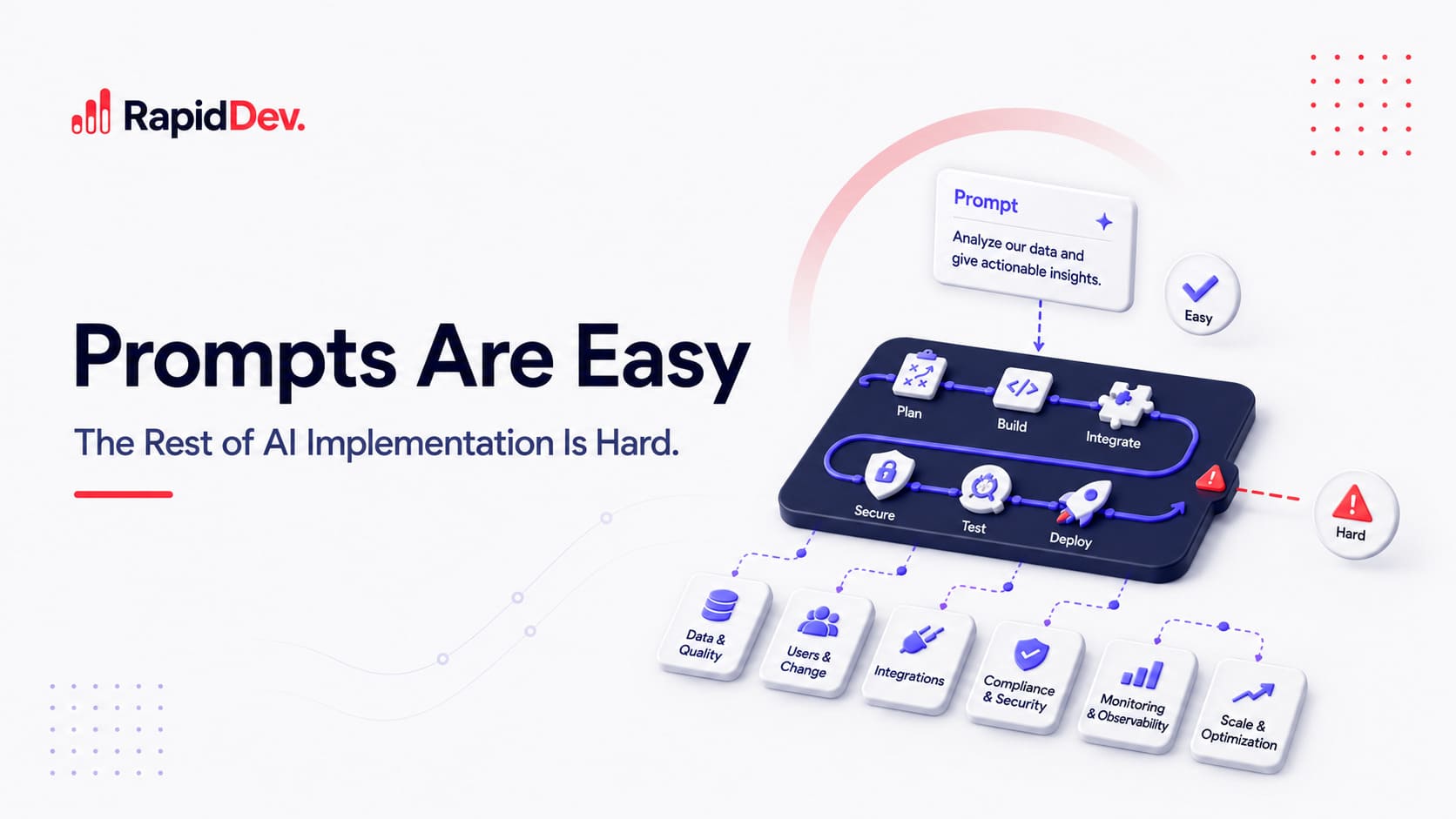
A lot of people can write a sharp ChatGPT prompt now. They can spin up a quick Lovable app, run a Claude workflow, automate a couple of email replies. None of that has changed how their business actually works.
That's the part nobody warns you about. Good prompts are easy to write, easy to demo, and easy to mistake for progress. The hard work, the work that moves revenue and changes how a team operates day to day, lives somewhere else entirely. It involves data pipelines, messy integrations, error handling, and the unglamorous business of getting people to change their habits. None of it photographs well on Twitter, and almost none of it is what most people mean when they say AI implementation.
This piece is about what real AI implementation looks like, why so many promising pilots quietly die before they ship, and how to get from a clever prompt to a system your business actually depends on. If you've been running experiments for months without much to show for it, the gap you're feeling is real, and there's a way across it. The good news, sort of, is that the path to AI implementation is well-trodden by now. The companies who got there first left a map.
At RapidDev, we help companies cross it. We take AI ideas and ship them as integrated, working systems in four to eight weeks. Book a call if you'd rather skip the trial and error, or see how our AI adoption and transformation work helps teams move past pilots.
TL;DR
AI experimentation looks like good prompts, isolated tools, and people opening tabs to use them. AI implementation looks like clean data feeding the model, automation that finishes the task, integrations into the systems your team already uses, a user experience that doesn't get in the way, and actual adoption across daily workflows. Most projects stall between a working pilot and a deployed system because teams treat AI as a feature, not as a layer. The companies winning with AI right now do roughly 10% prompt work and 90% AI implementation work.
The AI experimentation trap, and why so many pilots stall
Roughly 48% of AI projects ever reach production. Of those that do, a meaningful share never deliver measurable business value. So about half the work dies in the experimentation phase, and a chunk of the rest dies shortly after.
The pattern is so consistent it's almost a cliché. A team picks a use case. Somebody on the team writes a great prompt, wires up a quick interface, and demos it on a Friday. The room is impressed. A pilot user volunteers. Two months later, the project has a Notion doc with seventeen open questions, and nobody can quite explain why it isn't running yet. The team has done a lot of AI work; they just haven't finished an AI implementation.
There are two forces pulling teams into this trap. The first is the dopamine of experimentation itself. Prompting feels productive. You type something, the model produces something, and you're done in fifteen seconds. Real AI implementation, by contrast, looks like staring at a Postgres schema for a week, arguing with the InfoSec team about API tokens, and refactoring a workflow document that nobody wants to touch.
The second force is internal pressure to look busy with AI. Leadership wants visible activity. So teams ship demos that wow a board deck but never quite make it into the operating cadence. The demo earns goodwill for a quarter or two. Then someone asks what changed in the actual numbers, and the honest answer is "not enough," and the budget gets quietly redirected.
Escaping the trap means changing the question you're asking. Stop asking what a prompt can do. Start asking what workflow a system could own, end to end, without anyone supervising it.
What AI implementation actually means
Most people use the term loosely, so it's worth being precise. AI implementation is the practice of embedding artificial intelligence into the operational fabric of a business, so the model touches your data, talks to your tools, and finishes real work without a human driving every step.
When somebody asks how to implement AI in their company, they're usually looking for a tool recommendation. The honest answer is less satisfying. AI implementation in business is mostly plumbing. It's data flows, authentication, retries, audit trails, and the careful design of where the model fits inside a process that already exists.
A ChatGPT subscription isn't AI implementation. A Slack bot that answers questions isn't either. An internal wrapper around the OpenAI API, even a polished one, is still an experiment dressed up nicely. These tools have value, but they don't change how the business runs.
A real implementation feels different. There's data moving in the background. Triggers fire when an event happens. Outputs become real changes in real systems. People rely on it the way they rely on payroll or email, and would notice fast if it broke.
The shift, plainly, is from AI as something you open to AI as something that runs. That distinction sounds modest. In practice it determines whether you have a productivity hobby or an operating advantage.
The five things real AI implementation needs
Every successful AI implementation we've seen rests on the same five components. The order matters less than the completeness. Miss one and the system either fails to ship or quietly fades from use after launch.
High-quality data is the foundation
A model is only as smart as the information you give it. Bad data turns a capable model into a confident liar, which is worse than no model at all. This is the part of AI implementation that gets the least attention and causes the most failures.
Take a sales team that wants an AI assistant to summarize deals. If the CRM is half-empty, close dates are inconsistent, and half the reps log calls in their own spreadsheet, the assistant has nothing meaningful to work from. The output will be technically fluent and substantively wrong. People will use it once, get burned, and never trust it again.
Good data infrastructure means clean schemas, validation, and lineage you can audit. It means connecting the right sources, your CRM, your product database, your support tickets, your billing system, into a form the model can consume. McKinsey's research on AI ROI found that the organizations capturing the most value had already standardized their core workflows before bringing AI in. They cleaned the house first. The companies that skipped this step usually ended up rebuilding from scratch a year later. Data is the part of AI implementation that doesn't impress anyone in a meeting, and that's exactly why it's often the difference between a system that works and one that doesn't.
Process automation closes the loop
A model that gives you an answer and stops there is a smarter calculator, not a transformation. You still have to act on the output, which means you've moved the bottleneck from thinking to clicking.
AI automation closes that loop. Instead of suggesting a reply, the system drafts it, sends it to the right person for a one-second approval, and posts it. Instead of flagging an invoice anomaly, it adjusts the ledger entry, logs the change, and pings the controller. The unit of value goes from "an idea about what to do" to "a task that's done." This is the heart of what AI automation services deliver: workflows that finish, not just suggest.
Prompt engineering does have a place here. It's the moment inside the larger flow where the model makes a decision. But the decision is one node in a graph that includes the trigger, the data fetch, the integration calls, the error path, and the confirmation. Treating the prompt as the whole system is like treating the recipe as the dinner.
System integrations decide where AI can show up
Your team doesn't live in a separate AI portal. They live in Slack, HubSpot, Linear, Notion, Postgres, GitHub, Stripe. AI integration is what determines whether your model shows up in the place where work actually happens, or in some side-tab nobody opens.
Picture an AI agent that reads a Linear ticket, pulls relevant context from the GitHub repo, drafts a solution, and opens a pull request. That whole sequence requires three connections, careful auth, and a sane error path when one of them fails. It's not hard in principle, but it's tedious in practice, and the tedium is exactly why most teams skip it.
Integration work has a way of being underestimated until you're in the middle of it. APIs change. Tokens expire. Webhooks fail silently at 2 a.m. Modern protocols like MCP help by giving models a standard way to talk to external systems, but somebody still has to design the connection, handle the edge cases, and keep the lights on. This is engineering work, and it's the unglamorous heart of every serious AI implementation. Skip it and the AI implementation looks great in a demo and never quite makes it into the operating rhythm of the business.
User experience decides whether anyone uses it
A powerful AI with a clunky interface gets quietly abandoned in two weeks. Your users are busy, and they'll route around friction. Every time.
Good AI UX feels obvious. The input is quick. The output is where you expected it. When the model is wrong, you can fix it in one click without losing context. The user doesn't need a tutorial, and they don't have to think about whether to use the tool, because using it is faster than not using it.
The contrast matters. A deal-summary AI that lives in a standalone dashboard, behind a login the rep has to remember, will be used in week one and forgotten by week three. The same model, embedded inside the Salesforce account view where reps are already working, becomes part of the day inside a month. Same intelligence, different design, opposite outcomes.
There's a hidden cost to bad UX, too. When your tool is painful, people quietly switch to ChatGPT in a browser tab. Now your data is leaking, your governance is gone, and the internal system you spent six months building is gathering dust while everyone uses the consumer product anyway. The AI implementation exists on paper and nowhere else.
Adoption is the people problem, and it's the biggest one
The most common reason an AI implementation fails has nothing to do with technology. The system works. The integrations hold. People keep doing things the old way anyway. We've seen polished AI implementations sit unused for months while the team kept emailing each other spreadsheets.
Adoption breaks for human reasons. The training never happened, so most of the team doesn't know the tool exists. There's no champion inside the department, so usage fizzles after the launch email. Or the incentives don't line up, so the tool feels like extra work instead of less.
What actually works is starting narrow. Pick one team, roll the system out to them, and check the usage dashboard daily for two weeks. If people come back without being asked, you have something sticky and you can expand. If they don't, you learn cheaply and you fix the design before scaling the problem.
Change management belongs in the build budget, not in a separate slide at the end. The smoothest AI adoption stories we've worked on planned the rollout with the same care as the code. People don't change their habits without a reason, and giving them a reason is part of the build. It's also why we treat AI adoption and transformation as its own discipline, with rollout planning, training, and change management built in rather than bolted on.
Experimentation versus implementation, plainly
Crossing the line from experiment to implementation changes almost every dimension of how AI shows up. The contrast below is the one we draw on a whiteboard with new clients.
The right column has nothing to do with better prompts. It's about data, automation, integration, ownership. That's what separates the companies seeing real returns from the ones still demoing.
The mental shift is from "AI helps me" to "AI runs this." The questions change once you make it. You stop asking how to phrase a request and start asking how a workflow can run itself, reliably, every time, without you in the loop.
Why the gap matters more this year than last
The pressure to cross this gap keeps building. Competitors that reach real AI implementation pull ahead on speed and cost, while teams stuck in pilot mode burn months on demos that look great and ship nothing. It's the exact divide we wrote about after ClawCon Boston, where AI moved from ideas to execution: most companies are still exploring, while a smaller group is already building real business impact. Customers notice the difference, even if they can't name it. A company running integrated AI responds faster, makes fewer mistakes, and scales without adding headcount. That advantage compounds quarter over quarter, and the gap between companies with real AI implementation and companies still experimenting widens fast. The cost of staying in experimentation mode isn't only wasted effort. It's ground lost to everyone who finished their AI implementation while you were still iterating on prompts.
A five-step path from prompt to production
Knowing the components is one thing. Sequencing them in the right order is another. Here's the path we follow on most AI implementation projects.
1. Find a workflow that's already painful
Don't start with the model. Start with a process your team grumbles about. Look for the repetitive, high-volume tasks that eat hours every week. The pain gives you a clear target and an obvious way to measure success later. Common candidates: support ticket triage, lead enrichment, invoice classification, onboarding emails, contract review, weekly reporting.
2. Map the data and integrations you'll need
Before writing a line of code, trace the workflow from trigger to result. What data does it touch? Which systems have to connect? Which user will see the output? Sketch the whole thing on one page. This map exposes the real scope and saves you from mid-build surprises, like discovering on week three that the data you need lives in a vendor system without an API.
3. Build the smallest end-to-end version
The temptation is to scope ambitiously. Resist it. Ship the thinnest version that runs the workflow end to end, even if it only handles the simplest case. A skinny system that works will teach you more in a week than a thick one will in three months. You can always add branches, but you can't learn anything from a half-built pipeline.
4. Embed it where your team already works
Take the working system and put it inside the tools people already use. If support lives in Intercom, the AI belongs in Intercom. If sales lives in HubSpot, the AI belongs there. Meet people where they are and adoption follows. Force them into a new app and they'll find a way around it.
5. Measure, iterate, and expand
Track usage from day one. Watch whether people return, where they drop off, what they ask for that the system doesn't do. Improve the rough edges, then expand to the next workflow. One proven win turns into a sequence of them, and a sequence of wins is how a company actually moves through an AI transformation.
Five ways AI implementation goes sideways
Even with a clear plan, teams hit the same handful of traps. Knowing them ahead of time saves a quarter or two.
Starting with the model instead of the problem. A new model comes out and the team goes hunting for a use case to justify it. This always produces interesting demos and rarely produces business impact. Pick the problem first. The model is the easiest decision you'll make.
Underestimating the integration tax. Connecting AI to your systems brings authentication, rate limits, error handling, schema drift, and webhook reliability. None of it is exotic, but all of it takes time. Budget for it honestly and your timeline holds.
Skipping change management. A tool nobody uses delivers zero value, no matter how good the technology is. Plan the rollout with the same rigor as the build, and pick a champion inside the team who actually wants the thing to succeed.
Building too big, too soon. The first release should solve one specific problem cleanly. Giant scope on day one usually means a year of refactoring and a tool that's good at nothing in particular. Ship small, learn fast, then expand.
Confusing prompt engineering with strategy. Prompting is a real skill, and it matters. But a sound AI implementation strategy accounts for data, integrations, UX, and adoption, not only wording. The companies that mistake prompt craft for strategy are the ones still experimenting next year.
How RapidDev builds AI implementations that stick
We don't sell prompt libraries. We ship production systems. That's the simplest way to describe how we work with companies on AI implementation.
The cadence is built for speed without skipping the parts that matter. Discovery is about a week. We sit with the team, find the painful workflow, map the data, and identify the systems that have to connect. The MVP build runs three to four weeks and produces a working version that runs end to end. The last two to three weeks are integration and adoption, where we wire the system into your existing stack and make sure your team is actually using it before we walk away.
The shape of what you get depends on what you need. We handle AI product development for companies launching customer-facing tools, AI automation for back-office work that eats hours, internal tools that pay for themselves in saved time, and custom software when off-the-shelf doesn't fit your actual workflow. Everything connects to the tools you already pay for, so nothing ends up living in an island.
A concrete example. A SaaS founder came to us drowning in support tickets, with the team spending most of their day classifying and routing. We didn't hand them a prompt library. We built an AI implementation that read incoming tickets, classified them by topic and urgency, routed each one to the right person, and drafted a first response. The team reviewed and sent. Tickets started closing about 40% faster, the queue stopped feeling like an emergency, and the team got their afternoons back.
That's the shape of a real AI implementation. Not a clever demo, a measurable change in how the work happens. We've done the same on bigger systems too, like rebuilding a company's accounts payable as a self-improving AI workflow. If you've experimented long enough and want to ship something that actually runs, book a call with RapidDev. We'll get you to production in four to eight weeks.
Frequently asked questions
What's the difference between AI experimentation and AI implementation?
Experimentation is the manual use of AI tools, writing prompts, testing ideas, running one-off tasks in a browser. AI implementation is embedding the model into your data, your systems, and your daily workflows, so it does real work without anyone driving each step. Experimentation explores what's possible. Implementation delivers ongoing business value.
How long does AI implementation take?
A focused first system usually takes four to eight weeks. That includes discovery, building the end-to-end version, connecting your systems, and driving adoption. Larger AI transformation efforts roll out in waves, with each new workflow building on the foundations of the last.
How much does AI implementation cost?
It depends on scope and the integrations involved, but a targeted implementation costs less than most companies expect, especially measured against the hours it saves over a year. The bigger risk isn't overspending. It's spending months in experimentation mode and never reaching anything that ships.
Do I need to be technical to implement AI in my business?
No. You need to understand your workflows and where the pain is. The technical work, data pipelines, integrations, error handling, is what a build partner handles. Your job is knowing the business problem clearly. Theirs is shipping the system that solves it.
Is prompt engineering still useful?
Yes. Prompting is a real craft and it matters inside any AI system. It's one node in a larger workflow, though, not the whole strategy. A great prompt sitting outside a real system rarely creates lasting value. The same prompt inside an integrated, automated, adopted workflow becomes a piece of working machinery that runs every day.
Where should a company start with AI implementation?
Pick one painful, repetitive workflow that wastes real hours every week. Map the data and systems it touches. Build the smallest version that runs end to end. Embed it where your team already works. Measure adoption. Expand only when the first win is sticky. Small, proven wins beat ambitious plans that never reach production.
Past the demo
Prompts are a fine place to start. They're not a place to finish. The companies pulling ahead right now are the ones doing the rest of the work, the data, the integrations, the design, the rollout. That's what AI implementation actually is. It's the work that doesn't make a great demo but does change the business.
If you've been experimenting for a while and you want to ship something that actually runs, RapidDev can help. We turn AI ideas into integrated, adopted, production systems in four to eight weeks.
Book a call and we'll map out your first implementation together.