

November 18, 2026
•
27
min read

AI in Logistics and Supply Chain: Use Cases, Data Needs and Costs
AI use cases that work in logistics and supply chain today, the data each needs and what drives cost. Book a free AI strategy call to scope a pilot.
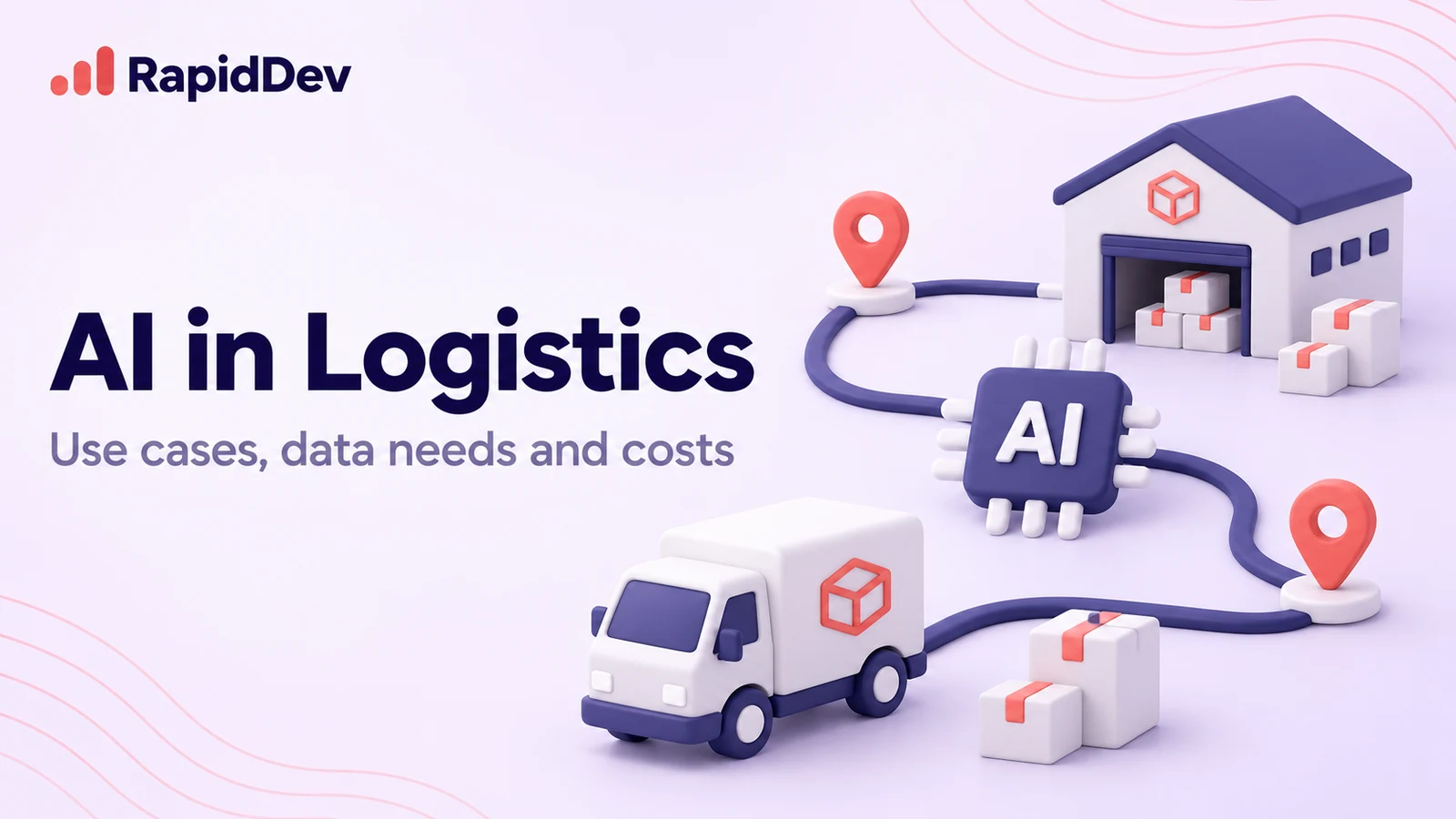
AI in logistics helps companies forecast demand, plan routes, predict delivery times, process freight documents, and manage shipment exceptions. The most practical projects use data already available in transportation, warehouse, and ERP systems. AI automation services can connect these systems, reduce manual work, and help logistics teams respond faster when something goes wrong.
How is AI used in logistics and supply chain?
AI is used in logistics and supply chain management to improve forecasting, transportation planning, warehouse operations, inventory decisions, document handling, and shipment visibility. McKinsey's 2021 analysis of the AI supply-chain revolution found that early adopters had cut logistics costs by 15% and inventory by 35%; treat those as early-adopter results from 2021, not a benchmark for every company.
The applications fall into three broad areas: planning, daily operations, and exception management.
Planning demand, inventory, and transportation
Supply chain planning involves balancing customer demand, inventory availability, transportation capacity, and supplier lead times.
AI can analyze historical orders, seasonal patterns, delivery performance, and other relevant information to help planners make better decisions.
For example, a distributor may use demand forecasting to estimate which products will be needed at each warehouse over the coming weeks.
A transportation team might use route optimization to compare delivery sequences based on distance, vehicle capacity, delivery windows, and expected traffic.
These tools don't eliminate uncertainty. They help teams work with more information than they could reasonably analyze manually.
Supporting warehouse and transportation operations
Warehouses and transportation networks generate large amounts of operational data.
Warehouse systems record stock locations, picking activity, inventory movements, and order fulfillment. Transportation platforms track shipments, carriers, appointments, and delivery status.
AI can use that information to recommend better picking sequences, identify potential bottlenecks, and predict when shipments may arrive.
It can also help employees retrieve information that would otherwise require checking several systems.
Handling exceptions before they escalate
Exception management is one of the most useful applications of AI in logistics.
A delayed shipment, missing document, or inventory discrepancy often requires several people to coordinate a response.
AI can monitor incoming data, flag unusual situations, and prepare the information employees need to act.
A dispatcher might receive an alert that a delivery is likely to miss its appointment window, along with the affected order, customer contact, carrier details, and available options.
Instead of discovering the problem after a customer calls, the team can address it earlier.
The same approach applies to supply chain disruptions involving suppliers, warehouse capacity, or changing customer demand.
Which AI use cases in logistics and supply chain work today?
The most established logistics AI applications include forecasting, route optimization, document processing, inventory analysis, and shipment monitoring. More autonomous workflows are emerging, particularly those that coordinate actions across several systems.
The table below compares ten AI in supply chain examples by the data they need and whether they make sense as a first project.
| Use case | What AI does | Data needed and history | Systems involved | Maturity | Quick win? |
|---|---|---|---|---|---|
| Demand forecasting | Predicts demand by product, location, or period | Sales and order history; ideally 12–24 months where seasonality matters | ERP, WMS, planning tools | Established | Yes, with clean data |
| Route planning | Recommends delivery routes based on constraints | Stops, delivery windows, capacity, distances, current traffic; historical trips help evaluation | TMS, routing tools, telematics | Established | Yes, for defined routes |
| ETA prediction | Estimates arrival times and flags likely delays | Shipment milestones, timestamps, GPS, route and carrier history; several months may be useful | TMS, telematics, carrier APIs | Established | Conditional |
| Warehouse slotting and picking | Recommends stock locations and picking sequences | SKU dimensions, locations, order frequency, pick history; several months of representative activity | WMS, ERP | Established | Conditional |
| Inventory optimization | Recommends stock levels and replenishment decisions | Demand history, lead times, inventory movements, stockouts; ideally enough history to capture seasonality | ERP, WMS, planning tools | Established | Yes, with reliable records |
| Freight document processing | Extracts and checks information from bills of lading, delivery notes, and customs forms | Representative documents and validation rules; extensive historical data may not be needed | TMS, ERP, document systems | Established | Yes |
| Freight bill audit | Compares carrier invoices against agreed rates and shipment records | Freight invoices, rate cards, contracts, shipment records; representative exceptions | TMS, ERP, finance systems | Established | Yes |
| Carrier and customer messaging | Drafts updates, reminders, and routine responses | Current shipment status, contacts, approved message templates | TMS, CRM, email, telephony | Established for drafting; autonomous communication is emerging | Yes |
| Exception management | Detects delays or missing milestones and suggests responses | Shipment events, milestone history, business rules, available alternatives | TMS, WMS, telematics, ERP | Established for alerts; agent-led resolution is emerging | Yes, with clear rules |
| Supplier risk monitoring | Flags supplier performance changes and possible disruptions | Delivery history, supplier records, approved external information; several months or more for trend analysis | ERP, supplier platforms, external feeds | Mixed | Conditional |
Historical data ranges are planning guidelines, not technical minimums. Some applications can start with much less data, while others need several years to capture seasonal or unusual events.
Demand forecasting
Demand forecasting helps logistics and supply chain teams estimate what customers will need, where, and when.
Traditional forecasting often relies on historical averages or manually adjusted spreadsheets.
AI models can incorporate additional patterns, including seasonality, customer ordering behavior, promotions, and changes in demand across locations.
For a distributor operating several warehouses, more accurate forecasts may help reduce stockouts and unnecessary transfers between facilities.
However, better predictions only matter if they lead to better decisions.
A forecast that doesn't influence purchasing, replenishment, or warehouse planning won't create much operational value.
A supply chain optimization tool can connect forecasting with inventory and network planning, provided the underlying business constraints are accurately represented.
Route planning and optimization
Route optimization helps transportation teams determine how deliveries should be grouped and sequenced.
The calculation involves more than finding the shortest distance.
Vehicle capacity, delivery appointments, driver hours, customer requirements, loading restrictions, and expected traffic can all affect the result.
AI and optimization algorithms can compare route options and recommend changes when conditions shift.
For example, a regional distributor may need to adjust deliveries when a customer changes an appointment or a vehicle becomes unavailable.
The system can propose an alternative route for dispatchers to review.
Route optimization is already an established technology. A company doesn't necessarily need a custom generative AI application to benefit from it.
ETA prediction
Estimated arrival times are only useful when they reflect what's happening on the road.
Static calculations based on distance and average speed may miss congestion, loading delays, driver stops, and carrier-specific patterns.
AI can combine historical shipment data with current tracking information to produce more accurate arrival estimates.
A logistics team can then identify shipments likely to miss their delivery windows and notify customers earlier.
The challenge is data coverage.
If GPS updates are inconsistent or carriers report milestones differently, ETA predictions may be unreliable.
A pilot should compare predictions against actual arrival times across different routes, carriers, and operating conditions.
Warehouse slotting and picking
Warehouse slotting determines where products should be stored.
Frequently picked items may be placed closer to packing areas, while bulky or slow-moving products may need different locations.
AI can analyze order frequency, product dimensions, picking patterns, and warehouse constraints to recommend changes.
Picking optimization can also suggest more efficient sequences for collecting items.
The value depends on warehouse layout, order profiles, labor practices, and how often demand patterns change.
For a small warehouse with stable operations, conventional WMS rules may already be sufficient.
Larger or more variable operations may have more to gain from advanced optimization.
Inventory optimization
Inventory planning involves balancing service levels with storage costs and working capital.
Holding too much inventory ties up cash and warehouse space. Holding too little creates stockouts, emergency shipments, and dissatisfied customers.
AI can analyze demand, supplier lead times, and replenishment patterns to recommend stock levels.
Forecasts only pay off when they drive inventory optimization across multiple warehouses or distribution locations.
But the model needs accurate information about inventory movements, lead times, and product availability.
If stock records are unreliable, the recommendations will be unreliable too.
Freight document processing
Logistics teams handle bills of lading, proof-of-delivery documents, commercial invoices, customs forms, and other shipping records.
These documents often arrive in different formats and require employees to copy information into transportation or ERP systems.
AI can extract shipment references, addresses, quantities, dates, and other relevant fields.
Bills of lading and customs forms are a good fit for AI document processing, because they carry the same fields even when layouts vary: extract the fields, check them against the shipment record and flag what doesn't match.
For example, a document processing system might compare a bill of lading with the corresponding shipment record and highlight missing or inconsistent details.
Customs and regulatory documents require particular care. Extracted information should be validated before submission, and responsibility for compliance remains with the appropriate professionals.
Freight bill audit
Freight invoices can contain incorrect rates, duplicate charges, accessorial fees, and discrepancies between billed and agreed services.
Checking these manually can be time-consuming, especially when a company works with several carriers.
An automated freight audit can extract invoice details, compare them with contracts and shipment records, and flag charges that need investigation.
The workflow resembles AI invoice processing: extract the data, match it against trusted records, and route exceptions for review.
The financial benefit should be measured through verified overcharges recovered or avoided, as well as reductions in processing effort.
A flagged discrepancy isn't automatically a valid claim against the carrier.
Carrier and customer messaging
Dispatchers and customer service teams spend a considerable amount of time answering status questions and requesting updates.
AI can draft shipment notifications, delivery reminders, and routine responses using current tracking information.
Some operations also use voice AI agents for carrier check calls or status updates.
These systems can handle predictable conversations, but noisy environments, unclear responses, language differences, and unusual situations can create problems.
Most of the work in a customer tracking assistant is conversational AI design, not the model: every answer has to come from live shipment data, not from what the model guesses.
A customer asking "Where is my order?" expects an accurate status and a useful next step, not a generic response.
When shipment information is missing or contradictory, the assistant should acknowledge the uncertainty and route the request to a person.
Exception management
Shipment exceptions include late pickups, missed delivery appointments, missing tracking updates, damaged freight, and unexpected changes in route or capacity.
AI can monitor shipment events and identify situations that require attention.
A system might detect that a carrier hasn't reported a pickup milestone, check the expected schedule, and prepare a follow-up.
More advanced workflows can suggest alternative arrangements based on available carriers, customer requirements, and delivery deadlines.
For a first project, the goal should be faster detection and better coordination rather than fully autonomous decision-making.
Supplier risk monitoring
Supplier performance affects inventory availability, production schedules, and transportation planning.
AI can help identify patterns such as increasing lead times, repeated late deliveries, or changes in order fulfillment.
External information may also provide useful signals, although it needs verification.
A supplier risk alert should prompt investigation, not automatically trigger a supplier change.
Procurement teams remain responsible for evaluating alternatives, commercial terms, and supplier relationships.
What data does each logistics AI use case need?
Logistics AI needs accurate records of orders, shipments, inventory, and operational events. The amount of historical data depends on the problem: document extraction may need only representative samples, while demand forecasting and ETA prediction need enough history to capture meaningful patterns.
A common mistake is assuming that having years of data means the company is ready for AI.
A transportation business might have five years of shipment records but inconsistent delivery timestamps. A warehouse may track every inventory movement but use different product identifiers across systems.
Before starting a project, examine the data behind the process.
Demand and order history
Demand forecasting generally needs historical orders, product identifiers, quantities, dates, and delivery locations.
If demand follows seasonal patterns, 12–24 months of data can provide a useful starting point. Longer histories may help, provided they still reflect current business conditions.
Historical records also need context.
A sudden drop in orders might reflect lower demand, or it might result from a stockout. A large order could represent a recurring customer requirement or a one-time event.
Without that context, a forecasting model can learn misleading patterns.
Shipment and tracking data
ETA prediction and exception monitoring depend on shipment milestones.
Useful records include pickup times, departures, arrivals, delivery appointments, GPS updates, carrier identifiers, and actual delivery times.
The data should distinguish between planned and actual events.
For example, a scheduled pickup at 9 a.m. is not evidence that the truck arrived at 9 a.m.
If carriers provide inconsistent updates, the first improvement may involve standardizing how shipment events are recorded.
Warehouse and inventory records
Warehouse optimization requires information about stock locations, inventory movements, product dimensions, order frequency, and picking activity.
The quality of location data is especially important.
A system cannot reliably recommend better storage locations if the WMS doesn't accurately reflect where products are stored.
For inventory planning, supplier lead times, replenishment rules, and stockout history also matter.
Freight documents and contracts
Document processing and freight audit projects need a different type of preparation.
The team should collect representative bills of lading, carrier invoices, proof-of-delivery documents, rate agreements, and examples of common exceptions.
A useful sample includes documents that are difficult to process, not just clean digital PDFs.
Scanned pages, handwritten notes, inconsistent layouts, and missing references should all be considered.
For freight audit, the system also needs access to the applicable rates and contract terms. Extracting invoice information accurately is only half the job.
How much data is enough?
There is no universal minimum.
A document extraction pilot may work with a relatively small but representative collection of files. An ETA model may need thousands of completed shipments across relevant routes and carriers.
Forecasting requires enough observations to distinguish recurring demand patterns from random variation.
The right question is whether the available data represents the situations the system will encounter in production.
Before investing in development, review completeness, consistency, accessibility, and whether the required outcomes are recorded.
How does AI connect to your TMS, WMS, and ERP?
Logistics AI connects to transportation, warehouse, and enterprise systems through APIs, integration platforms, scheduled data exchanges, and EDI messages. These connections are often the most demanding part of implementation because the AI application needs reliable information from several systems at once.
A model can produce excellent predictions in testing and still be useless if it can't retrieve current shipment information or deliver its recommendations to employees.
Transportation management system integration
The TMS typically manages shipment planning, carrier assignments, freight rates, and transportation events.
An AI application might retrieve active shipments, compare expected and actual milestones, and identify deliveries likely to be late.
It could then send an alert to a dispatcher or update a dashboard.
The integration needs to handle inconsistent carrier updates, missing events, and changes in shipment status.
It also needs a clear distinction between reading information and modifying records.
For an initial project, generating recommendations without automatically changing carrier assignments or shipment instructions is often the safer approach.
Warehouse management system integration
A WMS manages inventory locations, receiving, picking, packing, and warehouse movements.
AI can use this information to support slotting recommendations, labor planning, and inventory analysis.
But the data must be current.
A recommendation based on yesterday's inventory position may be unsuitable for a warehouse where stock changes continuously.
The required update frequency depends on the application. A weekly slotting analysis may not need real-time data, while an exception alert about an urgent order probably does.
ERP integration
ERP platforms hold information about orders, purchasing, products, customers, suppliers, and financial transactions.
Connecting AI to ERP data helps link operational recommendations with business requirements.
For example, a shipment exception system might need to identify the customer affected by a delay, retrieve the order's promised delivery date, and determine whether the shipment is associated with a priority account.
An inventory planning application may need purchasing and sales data to produce useful replenishment recommendations.
EDI and carrier integrations
Many logistics companies exchange information through electronic data interchange rather than modern APIs.
EDI is used for documents and events such as purchase orders, shipping notices, invoices, and transportation status updates.
The GS1 EDI standards define common message sets, such as EANCOM and GS1 XML, for orders, despatch advice and invoices, which gives an AI system a predictable structure to read.
However, standardization doesn't eliminate integration work.
Different partners may use different message formats, implementation guidelines, identifiers, and update schedules.
An AI system needs a consistent internal representation of that information before it can analyze events reliably.
What if your systems are old?
A legacy TMS or WMS doesn't automatically rule out AI.
Some older platforms support scheduled exports, database views, EDI, or middleware integrations.
A practical first project might use approved read-only extracts rather than attempting to modify the original software.
The limitations should be clear from the beginning.
If data is updated only once a day, the system may support planning and reporting but not real-time shipment intervention.
For mid-sized logistics businesses, a reliable integration with an older system can be more valuable than an ambitious application that depends on unavailable real-time data.
How much does AI in logistics and supply chain cost?
The cost of logistics AI depends on data preparation, system integrations, software development, hosting, monitoring, and employee training. Projects involving several carriers, warehouses, or legacy systems generally require more work than a contained document processing or reporting application.
There isn't a useful universal price for logistics AI.
Two companies may want the same feature but face very different implementation costs because their systems and data are different.
Data cleanup
Data preparation can involve standardizing carrier names, resolving duplicate shipment records, correcting timestamps, and mapping product or location identifiers.
The more inconsistent the information, the more work is needed before the application can produce reliable results.
System integrations
Connecting a modern cloud-based TMS with a documented API may be relatively straightforward.
Integrating an older warehouse platform, multiple carrier EDI feeds, and a customized ERP can be considerably more complicated.
The project may require middleware, data transformation, authentication, error handling, and monitoring.
Integration costs also continue after launch when systems or partner interfaces change.
Development and infrastructure
Costs vary according to the type of application.
A document extraction workflow may involve an existing AI model, validation rules, and an interface for reviewing exceptions.
A custom ETA prediction service may require historical data pipelines, model training, continuous updates, and performance monitoring.
An agent that coordinates actions across several systems adds permissions, workflow logic, approval handling, and audit requirements.
Hosting and model usage should be included in the operating budget.
Dispatcher and warehouse employee training
Employees need to understand what the system does, how reliable its outputs are, and when to override a recommendation.
Dispatchers may need training on interpreting ETA alerts.
Warehouse managers may need to understand why a slotting recommendation was generated.
Customer service teams need clear procedures for handling incorrect or incomplete AI-generated responses.
Training isn't an optional expense. It affects whether the system produces any operational value.
How should you measure ROI?
Start with the current cost of the process and compare it with the cost and performance after automation.
| Use case | Primary metric | Supporting measures |
|---|---|---|
| Route optimization | Transportation cost per delivery | Miles driven, vehicle utilization, on-time delivery |
| ETA prediction | Arrival prediction error | Late-delivery detection rate, customer escalations |
| Warehouse optimization | Picking time per order | Travel distance, pick accuracy, orders per labor hour |
| Inventory optimization | Inventory carrying cost | Stockouts, turnover, service levels |
| Freight document processing | Handling time per document | Extraction accuracy, exception rate |
| Freight bill audit | Verified overcharges recovered or avoided | Audit time, billing discrepancies |
| Customer communication | Time to resolve tracking inquiries | Response accuracy, escalations, customer satisfaction |
| Exception management | Time from exception detection to action | Missed appointments, recovery costs |
Avoid treating every saved hour as a direct cash saving.
If a dispatcher saves five hours per week, the benefit may be additional capacity rather than reduced payroll.
Similarly, identifying a possible freight overcharge doesn't create financial value until the discrepancy is verified and the company avoids or recovers the charge.
A sound business case includes implementation expenses, recurring costs, and a conservative estimate of the improvement the team can realistically achieve.
Where should you start with AI in logistics?
Start with a recurring logistics problem that has measurable costs, accessible data, and a clear process owner. For many mid-sized operations, freight document processing, exception alerts, and routine customer communication are more practical first projects than rebuilding transportation planning from scratch.
Identify the operational bottleneck
Look for work that consumes time or creates repeated disruptions.
Examples include dispatchers manually checking shipment status, employees copying freight document details into a TMS, or finance teams reviewing carrier invoices line by line.
Choose one workflow rather than trying to automate the entire supply chain.
Establish the baseline
Measure the current workload and performance.
For freight documents, record monthly volume, average handling time, and correction rates.
For shipment exceptions, measure how long it takes to detect a delay and how quickly the team responds.
For customer tracking inquiries, record call or email volume and average resolution time.
These figures provide the basis for evaluating the pilot.
Check data availability
Determine where the required information lives and how it can be accessed.
Confirm whether the TMS, WMS, ERP, carrier portals, or EDI feeds contain the necessary records.
Check for missing milestones, duplicate shipments, inconsistent identifiers, and outdated information.
A pilot shouldn't depend on data the business cannot retrieve reliably.
Define success and failure
Set one primary success metric.
For a document processing pilot, that might be average handling time per document, with accuracy and exception rate as safeguards.
For exception management, it might be the time between a delay becoming detectable and a dispatcher receiving a useful alert.
Also define unacceptable errors.
A customer notification system that frequently reports incorrect delivery dates may create more work than it saves.
Test a limited workflow
Choose a manageable group of shipments, customers, carriers, or document types.
Run the system alongside the existing process where practical.
Include difficult cases: missing tracking events, changed appointments, duplicate records, and inconsistent carrier messages.
Keep employees responsible for decisions that affect customer commitments, carrier assignments, or additional spending.
Review the results
Compare the pilot with the baseline.
Did employees spend less time on the task? Were errors reduced? Did the team respond to exceptions faster?
Include the cost of human review and corrections.
If the results justify expansion, document the integration, training, and monitoring work required before a wider rollout.
A pilot that reveals unreliable data or a poor technology fit can still be useful if it prevents a larger investment in the wrong solution.
What about AI agents in the supply chain?
Agentic AI in the supply chain means AI agents that monitor logistics events, gather information from connected systems, prepare communications, and coordinate follow-up tasks. Their strongest near-term applications involve exception handling and administrative workflows rather than making unrestricted transportation or purchasing decisions.
Consider a shipment that is likely to miss its delivery window.
An exception-management agent could:
- Detect the likely delay from tracking data.
- Retrieve the affected order and customer details.
- Check the delivery appointment and relevant carrier information.
- Prepare a customer notification.
- Identify possible rebooking options.
- Present the options to a dispatcher for approval.
- Record the approved action and update the relevant systems.
This reduces the time employees spend moving between applications.
It doesn't require giving the agent complete authority over transportation decisions.
What can agents handle independently?
Routine, low-risk activities may be suitable for greater automation.
Examples include gathering shipment information, preparing internal alerts, drafting status updates, and creating follow-up tasks.
The appropriate level of autonomy depends on data reliability and the consequences of a mistake.
Which actions need approval?
Changing carriers, committing to additional freight charges, altering contractual delivery commitments, or modifying sensitive customer records should follow established authorization rules.
Agents need defined permissions, audit logs, and a clear way for employees to intervene.
The system should also know when to stop.
If two data sources disagree about a shipment's location, the agent should flag the conflict rather than confidently reporting an unverified status.
Autonomous vehicles and delivery drones are separate, hardware-intensive transportation technologies; RapidDev's logistics work focuses on software automation, integrations, analytics, and AI agents rather than developing autonomous vehicles.
What goes wrong with logistics AI?
Logistics AI projects run into trouble when data is incomplete, integrations are unreliable, business rules are poorly defined, or the system is allowed to act on information that hasn't been verified.
Inconsistent shipment data
Carriers may report events at different times or use different status codes.
A shipment may appear delayed because the tracking feed hasn't updated, even though the truck is moving normally.
Without careful handling of missing and delayed information, AI can generate unnecessary alerts or incorrect predictions.
Disconnected systems
A tracking assistant cannot answer customer questions accurately if it lacks access to the latest shipment status.
An exception agent cannot recommend a useful alternative if it doesn't know the delivery requirements or available carrier options.
The system needs the right information at the right time.
Incorrect recommendations
An ETA model may underestimate delays. A route optimizer may overlook a delivery restriction. A document extraction system may misread a shipment reference.
These errors should be measured during testing.
High-impact decisions require validation and appropriate human oversight.
Poor exception handling
Logistics rarely follows a perfectly predictable sequence.
Trucks arrive early or late. Warehouses change appointments. Carriers miss updates. Customers revise delivery requirements.
An application that works only when every event occurs as expected won't be reliable in daily operations.
Test unusual situations before deployment.
Security and confidentiality
Transportation and supply chain systems contain customer addresses, shipment details, commercial rates, contracts, and other sensitive information.
AI applications should have access only to the data needed for their assigned tasks.
External services need appropriate security reviews, and organizations should understand where information is processed and retained.
Employees don't trust the system
Dispatchers and warehouse employees know when recommendations don't reflect operational reality.
If the application regularly produces impractical suggestions, employees will stop using it.
Involve experienced staff in testing and give them a way to correct errors.
Their feedback can reveal missing business rules that aren't obvious from the data.
No plan for ongoing maintenance
Carrier integrations change. Routes change. Customer requirements change. Warehouse processes evolve.
An AI application needs monitoring, support, and periodic review.
The project should have an owner responsible for keeping it reliable after launch.
How does RapidDev build logistics automation?
RapidDev, an AI development and integration company, helps logistics and supply chain businesses automate repetitive workflows, improve access to operational information, and connect AI applications to existing business systems.
The work begins with a specific problem.
A transportation company may need better shipment exception alerts. A distributor may want to improve demand forecasting. A freight operation may spend too much time checking carrier invoices. A customer service team may be overwhelmed by tracking inquiries.
Each problem requires a different combination of data, integrations, workflow rules, and employee oversight.
RapidDev's software development work can cover:
Workflow assessment. Reviewing existing processes, identifying bottlenecks, and establishing measurable goals.
TMS, WMS, and ERP integrations. Connecting AI applications to shipment records, inventory information, orders, and operational events.
Freight document processing. Extracting information from shipping documents and routing incomplete or inconsistent records for review.
Freight bill audit. Comparing invoices with rate agreements and shipment information to identify discrepancies.
Forecasting and planning tools. Building applications that use historical demand and operational data to support inventory and transportation decisions.
Shipment exception management. Monitoring events, preparing alerts, and helping dispatchers coordinate responses.
Customer tracking assistants. Providing shipment information through conversational interfaces connected to approved data sources.
AI agents. Coordinating defined tasks across systems while respecting permissions and approval requirements.
Testing and monitoring. Evaluating accuracy, processing time, reliability, and operating costs before and after deployment.
Not every logistics problem requires a custom AI model.
Existing software may already provide useful forecasting, route optimization, or tracking capabilities.
In other cases, the missing piece is an integration that allows systems to exchange information reliably.
RapidDev focuses on building the software and connections needed to make those workflows work together.
For mid-sized logistics companies, a useful first result might be fewer hours spent processing freight documents, faster detection of delayed shipments, or fewer routine customer calls.
Those improvements provide a measurable basis for deciding what to automate next.
FAQs
Where is AI used in transportation?
AI is used in transportation for route optimization, ETA prediction, fleet analytics, shipment monitoring, freight auditing, and customer communication.
Transportation companies use historical and current data to identify delays, compare routes, and improve operational decisions.
Many applications work with existing TMS, telematics, and carrier information without requiring autonomous vehicles.
What do AI warehouses do?
AI-enabled warehouses use data analysis and automation to improve inventory placement, picking efficiency, labor planning, and order fulfillment.
AI can recommend better product locations, forecast workload, and identify operational bottlenecks.
Some warehouses also use robotics and computer vision, but those technologies aren't required for every AI project.
A warehouse can benefit from AI using data already available in its WMS.
How much historical data do you need for demand forecasting?
The amount depends on demand patterns, forecasting frequency, and product variability.
For products with seasonal demand, 12–24 months of reliable history can be a useful starting point. Longer histories may help when patterns repeat over several years.
Products with limited history may require simpler forecasting methods or additional information.
Data quality and relevance matter more than the number of records alone.
Can AI work with an old TMS or WMS?
Yes, provided the system offers a reliable way to access the necessary information.
Older platforms may support scheduled exports, database views, EDI, or middleware integrations even when modern APIs aren't available.
The integration method determines what the AI application can do.
For example, daily exports may support reporting and forecasting but won't be sufficient for real-time shipment alerts.
Will AI replace dispatchers?
AI can automate parts of dispatch work, including status checks, routine communications, and exception alerts.
But dispatchers handle situations that require judgment, negotiation, operational knowledge, and coordination with drivers, carriers, warehouses, and customers.
The more likely outcome is a change in how dispatchers work, with less time spent gathering information and more time available to resolve problems.
Document processing and exception alerts are where our AI automation services start for logistics teams, because both run on data already sitting in your TMS and shipping documents.
To evaluate which opportunities make sense for your business, book a free AI strategy call and discuss your data, integrations, and first-project priorities.