

November 18, 2026
•
22
min read

AI Agents for Ecommerce: Support, Merchandising and Post-Purchase Automation
How ecommerce brands use AI agents for support, merchandising and post-purchase work. Book a free AI strategy call to scope your first agent.
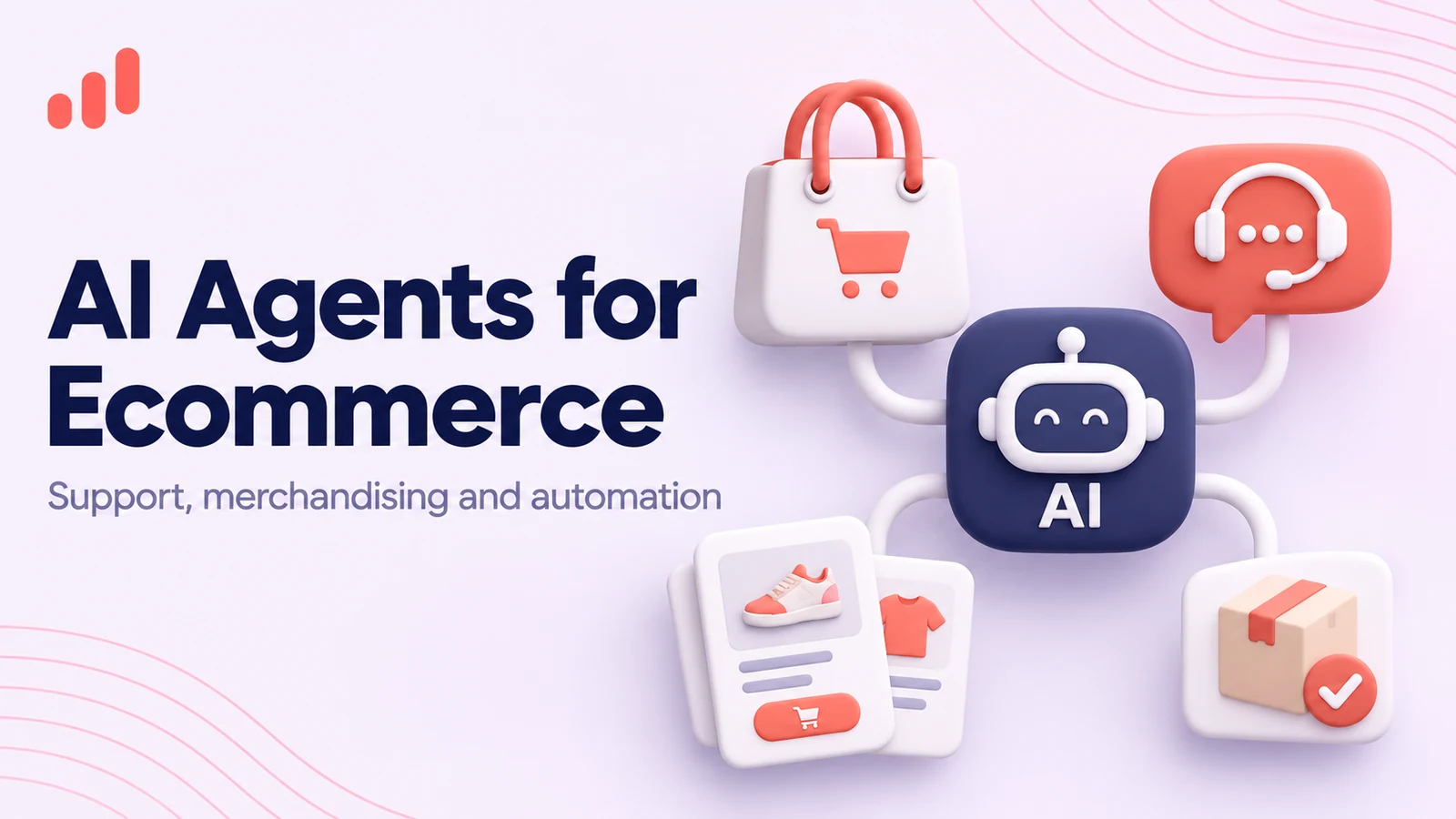
AI agents for ecommerce can answer product questions, check orders, manage routine returns, update subscriptions, and help merchandising teams maintain their catalogs. Unlike basic chatbots, agents can take action in connected store systems. The best place to start is a repetitive task with clear rules, reliable data, and an obvious benefit for customers or employees.
What are AI agents for ecommerce?
AI agents for ecommerce are software applications that can understand customer requests, retrieve information, and carry out approved tasks across online store systems.
A traditional chatbot might explain a return policy. An AI agent can check the order, confirm whether the item qualifies for a return, prepare the request, and update the customer.
The practical difference between an agent and a chatbot is what the system can do, not how naturally it talks: an agent can act, such as issuing a refund.
Imagine a customer who wants to exchange a pair of shoes.
A chatbot might explain the exchange policy and send a link to the returns portal.
An agent connected to the order management system (OMS) could find the purchase, check the return window, confirm whether the replacement size is available, and start the exchange if the request meets the store's rules.
The customer gets a faster resolution, and the support team has one less routine ticket to handle.
Of course, that only works if the agent has accurate order information, secure access to the relevant systems, and clear instructions about what it can and cannot do.
Where do ecommerce agents make the biggest difference?
Look at the questions customers ask most often and the tasks employees repeat throughout the day.
Shoppers want to know whether a product will fit, when their order will arrive, or how to exchange an item.
Support teams spend time checking information across several systems.
Merchandising teams update descriptions, organize catalogs, and review product recommendations.
Operations teams manage stock alerts, subscriptions, and routine reports.
These are all areas where an agent may be useful.
The point isn't to automate every customer interaction. It's to make common tasks easier to complete without sacrificing accuracy or customer trust.
Which ecommerce jobs can AI agents handle?
Ecommerce agents can help before a purchase, support merchandising work, manage routine post-purchase requests, and take care of certain back-office tasks.
How much independence an agent should have depends on the job.
Drafting a product description carries relatively little risk. Issuing a refund or changing a customer's subscription is a different matter.
| Ecommerce job | What the agent does | Systems it needs | Recommended autonomy | Buy or build? |
|---|---|---|---|---|
| Product Q&A | Answers questions about features, sizing, compatibility, and availability | Product catalog, inventory, knowledge base | Answer; escalate uncertainty | Usually buy |
| Shopping assistant | Helps customers compare products and find suitable options | Catalog, search, inventory, customer preferences | Recommend; customer approves purchase | Buy or customize |
| Product descriptions | Drafts product copy from approved attributes | PIM, CMS, product catalog | Draft; merchant approves | Usually buy |
| Catalog enrichment | Suggests categories, tags, and missing attributes | PIM, catalog, supplier data | Draft or approve | Buy or customize |
| Pricing suggestions | Identifies pricing opportunities using approved rules | ERP, pricing tools, inventory, sales data | Recommend; merchant approves | Often custom |
| Order status | Retrieves tracking details and answers delivery questions | OMS, carrier APIs, 3PL, helpdesk | Answer; escalate exceptions | Usually buy |
| Returns and exchanges | Checks eligibility and prepares or executes approved requests | OMS, returns platform, inventory, payment system | Approve or act within limits | Buy or customize |
| Subscription changes | Handles permitted skips, pauses, and plan updates | Subscription platform, OMS, billing | Act within policy | Buy or customize |
| Review requests and win-back | Prepares or triggers approved customer messages | CRM, marketing automation, order history | Draft or act within campaign rules | Usually buy |
| Reorders and fraud review | Identifies replenishment needs and flags suspicious transactions | ERP, inventory, payment and fraud systems | Recommend or flag; human approves high-risk actions | Often custom |
These are recommended levels of autonomy, not features guaranteed by every vendor.
Pre-purchase assistance
Customers often need help choosing between similar products.
Someone shopping for a replacement part may need to confirm compatibility. A clothing customer may be unsure about sizing. Another shopper may want to compare products without opening a dozen tabs.
A virtual shopping assistant can answer these questions using product information and guide customers toward suitable options.
But the assistant is only as useful as the information behind it.
If sizing details are missing or compatibility data is wrong, it may recommend the wrong product.
It also needs to know what's actually available. Recommending an out-of-stock item doesn't help the shopper or the store.
Merchandising and catalog management
Keeping an ecommerce catalog accurate takes time, particularly when products are added frequently or information comes from several suppliers.
Descriptions, attributes, categories, and search metadata all need attention.
AI can help prepare product copy, suggest missing attributes, and identify inconsistent or duplicate listings.
Merchandising teams should still review anything that affects product claims, technical specifications, pricing, or compliance.
Customer support
Order tracking, returns, exchanges, and delivery questions make up a large share of routine support work for many online stores.
An AI chatbot for ecommerce support can answer common questions and retrieve order information when connected to the right systems.
An agent can take the next step.
It might prepare a return label, start an exchange, or update delivery instructions when the store and carrier allow it.
The difference for the customer is simple: the problem gets resolved instead of being passed to another page or department.
Post-purchase workflows
Customer service doesn't stop when an order ships.
Brands still need to handle subscription changes, delivery problems, returns, exchanges, review requests, and repeat-purchase campaigns.
Agents can help coordinate this work across the OMS, helpdesk, CRM, and subscription platform.
The store needs to decide which actions can happen automatically and which require approval.
Operations
Some of the most useful automation happens behind the scenes.
An agent might monitor inventory, prepare reorder recommendations, or flag transactions for fraud review.
Reorders and fraud review are back-office jobs where AI automation services often start, because the data already moves between the store, ERP and payment systems.
That said, not every task needs an agent.
If the immediate problem is reporting, it may be more sensible to automate Shopify sales reports before building a system with permission to change store records.
How do agents handle support and post-purchase work?
Support agents combine customer requests with verified order information and store policies. They can complete permitted tasks, prepare actions for approval, or pass unusual cases to a person.
The agent needs to know what happened with the order, what the customer is entitled to request, and what the store allows.
Order tracking
Suppose a customer asks why an order hasn't arrived.
The agent checks the order, retrieves the latest carrier update, and compares it with the promised delivery window.
If the shipment is in transit, it can provide the current status.
If tracking hasn't updated, it should say that rather than inventing a delivery date.
When an order appears lost or seriously delayed, the agent can open a support case or prepare an approved resolution.
Customers get useful information sooner, and the support team spends less time answering straightforward tracking questions.
Returns and exchanges
Returns are well suited to automation because eligibility often follows established rules.
An agent may need to check:
- The customer's identity.
- The order and item involved.
- The applicable return window.
- Whether the product is eligible.
- The item's fulfillment or return status.
- Whether a replacement is available.
- Whether the request needs manual approval.
For straightforward cases, the agent can guide the customer through the process or initiate an approved return.
More complicated situations should go to the support team.
Damaged items, suspected abuse, unusual payment arrangements, or disputed eligibility may need a closer look.
Refunds need tighter controls
Refunds involve real money, so the rules need to be especially clear.
An agent shouldn't decide on its own to issue an arbitrary refund.
The system needs to verify the transaction, check eligibility, enforce refund limits, and prevent duplicate payments.
A store might allow automatic refunds for narrowly defined low-value cases while requiring approval for larger amounts.
Every refund should have a record showing the order, amount, reason, applicable policy, and approval.
Subscription changes
Subscription businesses deal with recurring requests to skip deliveries, pause plans, change addresses, or update product selections.
Agents can handle these changes through subscription and billing platforms.
But they need to respect cancellation terms, billing dates, and customer consent.
Before applying a change, the agent should confirm how it affects the next payment or shipment.
When is a chatbot enough?
If customers mainly need answers to FAQs, product questions, and store policies, a chatbot may be all the business needs.
An agent becomes more useful when it has to retrieve customer-specific information or make changes in connected systems.
That difference matters when budgeting.
AI chatbot development is often a more economical choice when the business doesn't need transactional capabilities.
How do AI agents help ecommerce merchandising?
AI agents can help merchandising teams prepare product content, organize catalogs, spot missing information, and recommend changes based on sales and customer behavior.
They can save time on repetitive work, but merchants still need control over product accuracy, pricing, and brand presentation.
Product descriptions and catalog enrichment
Supplier catalogs often arrive with incomplete or inconsistent information.
One product may have detailed specifications but no useful description. Another may be missing dimensions, materials, or relevant search attributes.
Generative AI can draft descriptions using verified product details and suggest missing categories or tags.
For stores with large catalogs or frequent launches, this can reduce the amount of manual editing required.
The system shouldn't invent features or make unsupported claims.
A clothing brand, for example, shouldn't publish an AI-generated statement about fabric composition unless that information appears in the approved product data.
Personalized recommendations
Recommendation systems use product information and customer behavior to suggest relevant items.
A store might recommend compatible accessories, complementary products, or alternatives based on browsing and purchase patterns.
AI product recommendations can help customers discover products and support cross-selling when the store has reliable catalog and transaction data.
Recommendations also need to account for stock availability, compatibility, and business rules.
Pushing the highest-margin product isn't helpful if it doesn't suit the customer's needs.
Pricing and promotion suggestions
AI can analyze sales patterns, inventory levels, and previous promotions to suggest pricing changes.
But pricing affects margins, customer trust, and sometimes legal or contractual obligations.
For most stores, it's safer to let AI recommend changes while merchandising teams make the final decision.
Discount rules should also prevent unauthorized stacking, repeated coupon abuse, and conflicts with existing offers.
Measuring merchandising results
Useful metrics include product content preparation time, catalog completeness, recommendation engagement, conversion rate, average order value, and return rate.
Look beyond the initial sale.
A recommendation system that increases purchases but also drives up returns may not improve profitability.
What is agentic commerce?
Agentic commerce is a form of online shopping in which AI agents help consumers discover products, compare options, and potentially complete purchases on their behalf.
This is different from a store using its own agent for customer support.
A merchant-operated agent helps run the business or serve its customers.
A consumer's shopping agent works on the buyer's behalf and interacts with merchants and payment systems.
Imagine someone asking an AI assistant to find a compatible replacement filter within a particular budget.
The assistant could compare products, check availability and shipping options, and prepare a purchase.
With the right authorization and supported integrations, it may also be able to complete checkout.
For merchants, that creates new requirements around product information, checkout access, and customer authorization.
What is the Agentic Commerce Protocol?
The Agentic Commerce Protocol (ACP) is an open, Apache 2.0 licensed standard that OpenAI and Stripe launched in September 2025 to connect AI shopping agents with merchant product feeds and checkout systems. The spec is still labeled beta.
It supports commerce workflows in which an AI agent can help a customer complete a purchase while the merchant remains responsible for its products, orders, and fulfillment.
ACP addresses how shopping agents interact with commerce systems.
It doesn't remove the need for accurate product information, customer authorization, payment security, or clear merchant policies.
The ecosystem has already shifted once: in March 2026 OpenAI scaled back Instant Checkout in ChatGPT and repositioned ACP around product discovery, with purchases moving to merchants' own checkout.
What is Google's Agent Payments Protocol?
Google introduced the Agent Payments Protocol (AP2) in September 2025 to address payments initiated through AI agents. In April 2026 Google contributed AP2 to the FIDO Alliance, which now develops it as an open industry standard.
According to Google Cloud's announcement of AP2, the framework focuses on authorization, authenticity, and accountability in agent-led payments.
Those questions matter when software acts on behalf of a customer.
A payment system needs to establish what the customer authorized, which agent initiated the transaction, and whether the purchase matches the agreed conditions.
ACP and AP2 address related but different parts of agentic commerce. Supporting one doesn't automatically mean a store supports the other.
Where does Model Context Protocol fit?
The Model Context Protocol provides a standardized way for AI applications to connect with external tools and information.
For ecommerce, those tools might include product catalogs, inventory systems, or order databases.
MCP isn't a checkout or payment protocol.
It helps agents access tools and information, while commerce-specific protocols and payment integrations handle purchasing and transactions.
How do you prepare your store for AI shopping agents?
Stores preparing for agentic commerce need accurate product information, clear purchasing policies, secure checkout integrations, and dependable inventory and fulfillment data.
Adding another chatbot won't solve those underlying requirements.
Clean up product data
Product feeds need consistent identifiers, descriptions, prices, variants, availability, and relevant attributes.
Compatibility information is especially important for technical products.
A shopping agent can't reliably determine whether a replacement part fits a customer's equipment if the catalog doesn't contain that information.
The same applies to sizing, materials, delivery restrictions, and other details that affect purchasing decisions.
Make store policies clear
Returns, exchanges, cancellations, shipping restrictions, and refund rules should be easy to understand and kept up to date.
Agents need to know what the store allows and when an exception requires approval.
Ambiguous policies can lead to incorrect promises and customer disputes.
Review checkout and payment capabilities
Agent-led purchasing requires secure ways to create orders, confirm totals, apply authorized discounts, and complete payments.
Stores also need appropriate controls over customer identity, authorization, and transaction records.
The Stripe documentation for the Agentic Commerce Protocol shows what an ACP integration involves on the merchant side: a structured product feed, checkout endpoints, and a way to accept a scoped payment token from the agent.
Before implementation, confirm what's supported by the store's commerce platform, payment provider, and intended AI shopping ecosystem.
Keep inventory and fulfillment information current
Shopping agents need accurate availability and delivery information.
If a product appears available but has already sold out, the agent may create a frustrating customer experience.
Inventory synchronization, fulfillment rules, and shipping estimates are therefore part of agentic commerce readiness.
Check current platform support
Agentic commerce standards and integrations are changing quickly.
Before investing in development, verify which ACP, AP2, and checkout capabilities are currently supported.
The existence of a protocol doesn't mean every ecommerce platform, payment provider, or AI assistant can use it.
Should you buy or build an ecommerce AI agent?
Most ecommerce brands should look at existing platform and helpdesk AI before investing in custom development.
Custom agents make more sense when workflows involve several systems or business rules that standard products can't handle.
| Approach | Best for | Typical time to launch | Control | Main risk |
|---|---|---|---|---|
| Platform-native AI | Catalog tasks, basic store assistance, standard ecommerce workflows | Days to weeks for supported features | Limited to platform capabilities | Feature limitations and platform dependency |
| Helpdesk AI | FAQs, order tracking, routine support, returns workflows | Days to several weeks, depending on integrations | Moderate; configurable policies and workflows | Incorrect responses or incomplete order context |
| Custom AI agent | Workflows spanning OMS, ERP, 3PL, subscriptions, payments, and helpdesk | Several weeks to months, depending on scope | High; tailored logic, permissions, and integrations | Greater development, maintenance, and governance responsibility |
Timelines are estimates. Data quality, access permissions, integrations, and testing can all affect the schedule.
When is platform-native AI enough?
Stores using Shopify or BigCommerce should start by reviewing the AI and automation features already available in their setup.
Those tools may cover product content, reporting, customer assistance, or standard workflows.
If they do the job, adding another agent may only increase costs and complexity.
When should you use helpdesk AI?
Helpdesk AI is a good option when customer support volume is the main problem.
These products can often connect to order information, help center content, and existing support workflows.
The important questions are whether the tool can access accurate information, handle exceptions, and follow store policies.
Test it with real customer requests rather than relying on polished demos.
When does custom development make sense?
Custom development becomes more useful when an agent needs to coordinate work across systems that don't communicate well.
A subscription brand, for example, might use one platform for ecommerce, another for recurring billing, a separate OMS, a third-party logistics provider (3PL), and a helpdesk.
A simple customer request could involve changes in several applications.
Custom AI agent development can bring those steps into one controlled workflow.
The business can define exactly what the agent is allowed to read, change, approve, or escalate.
The trade-off is more responsibility for development, testing, monitoring, and maintenance.
What does a custom ecommerce agent cost?
Costs depend on how many systems the agent needs to access, what actions it performs, and how much reliability and oversight the workflow requires.
A product information assistant is usually simpler than an agent handling refunds, subscription changes, and fulfillment exceptions across several applications.
A project budget may include:
- Data preparation and knowledge base setup.
- API and system integrations.
- Agent workflow development.
- Authentication and permissions.
- Testing and exception handling.
- Model usage and hosting.
- Monitoring, maintenance, and updates.
Integrations and testing usually drive what AI agents cost to build more than the model itself does, and model usage adds a monthly running cost after launch.
The business case should compare the total cost with measurable improvements, such as shorter support handling times, fewer manual updates, and faster customer resolutions.
What can go wrong with ecommerce AI agents?
Ecommerce agents can create problems when they rely on incorrect information, misinterpret store policies, expose customer data, or take financial actions without adequate controls.
The stakes are higher when an agent can change orders, issue refunds, or communicate directly with customers.
Incorrect refunds and returns
An agent may misunderstand eligibility rules or process the same request twice.
Refund workflows need transaction verification, duplicate-action prevention, clear limits, and audit records.
High-value or unusual cases should go to a person for review.
Invented store policies
Generative AI can produce answers that sound convincing but don't match the store's actual policies.
An agent might promise a longer return period, a shipping option that isn't available, or warranty coverage the product doesn't have.
Policy answers should come from approved, current information.
When the rules don't clearly cover a situation, the agent should ask for human review.
Discount abuse
Agents that can create or apply discounts need strict permissions.
Otherwise, customers may find ways to obtain unauthorized offers or combine promotions the store never intended to allow.
Discount amounts, eligibility, usage limits, and approval requirements should be enforced by the commerce system rather than left to the model.
Customer data exposure
Ecommerce systems hold names, addresses, purchase histories, payment-related information, and other sensitive data.
Agents should only access the information needed for the task.
Identity verification is especially important before revealing order details or changing an account.
A customer shouldn't be able to retrieve someone else's order information simply by providing an order number.
Incorrect product recommendations
An agent may recommend an incompatible product, miss a safety warning, or rely on outdated availability information.
For technical, regulated, or safety-sensitive products, recommendations should come from verified attributes and follow additional restrictions where necessary.
Unreliable integrations
An agent may understand a request perfectly but fail when updating the OMS or subscription platform.
The workflow needs to handle timeouts, duplicate requests, partial failures, and conflicting system responses.
Customers should never be told that an action is complete until the underlying system confirms it.
Poor escalation
Some requests are too unusual or sensitive for automation.
A customer may dispute a charge, report fraud, or describe a complicated delivery problem.
The agent needs a clear route to human support and should pass along the relevant context so the customer doesn't have to explain everything again.
How does RapidDev build ecommerce AI agents?
RapidDev, an AI development and integration company, builds AI-powered applications and automation workflows that connect ecommerce platforms, customer support tools, and business operations.
For ecommerce brands, the work starts with identifying where employees and customers are losing time.
A support team may spend hours checking order status. A subscription business may handle the same account changes repeatedly. A merchandising team may struggle to maintain a large catalog. An operations team may rely on manual updates between the store, OMS, and 3PL.
RapidDev can help assess those workflows and determine whether existing software, a simpler automation, or a custom agent is the better choice.
Depending on the project, the work may include:
Workflow assessment. Mapping customer and employee tasks, identifying repetitive steps, and defining measurable goals.
Store and system integrations. Connecting ecommerce platforms with OMS, ERP, helpdesk, subscription, payment, and fulfillment systems.
Customer support agents. Building assistants that retrieve verified order information, answer questions, and complete permitted actions.
Returns and post-purchase automation. Creating workflows for eligibility checks, return requests, exchanges, and subscription updates.
Merchandising tools. Supporting product content creation, catalog enrichment, search, and recommendations.
Operations agents. Coordinating inventory alerts, reporting, and other routine tasks across approved systems.
Permissions and governance. Defining approval limits, customer verification, audit records, and escalation rules.
Testing and monitoring. Evaluating accuracy, reliability, customer outcomes, and operating costs before and after launch.
Not every ecommerce business needs a fully autonomous agent.
A well-configured helpdesk tool may handle most routine support questions. A simple API integration may eliminate hours of manual reporting.
Custom development is worth considering when the business needs more control or coordination than existing tools can provide.
FAQs
Which AI agents are best for e-commerce?
The best choice depends on the job.
Platform-native AI, such as Shopify Sidekick, may be enough for product content and standard store workflows. Helpdesk AI, such as Gorgias AI Agent or Intercom Fin, is often well suited to FAQs, order tracking, and routine support.
Custom agents are more appropriate when tasks involve several systems, such as an OMS, ERP, 3PL, and subscription platform.
Compare options based on integration capabilities, accuracy, permissions, escalation handling, and total operating cost.
How can AI be used in e-commerce?
AI can help online stores answer product questions, recommend products, prepare descriptions, manage customer support, process routine returns, update subscriptions, and automate operational tasks.
It can also support inventory analysis, fraud review, and customer communication.
The most useful application depends on the store's systems, data, and day-to-day problems.
What is agentic commerce?
Agentic commerce refers to shopping workflows in which AI agents act on behalf of consumers to discover products, compare options, and potentially complete purchases.
It's different from a merchant using an AI agent for customer support or internal operations.
Agentic commerce requires reliable product information, customer authorization, secure checkout capabilities, and appropriate transaction controls.
Can AI agents process refunds on their own?
Yes, if the business has explicitly authorized that capability and the payment integrations support it.
Refund eligibility, transaction verification, financial limits, and duplicate-action prevention still need to be enforced.
Many stores should begin with agents that prepare refunds for approval or process only narrowly defined, low-risk cases.
Do I need a custom agent if I use Shopify?
Not necessarily.
Shopify merchants should first review the platform's available AI features, automation tools, and compatible support applications.
A custom agent may be worthwhile when the business has unusual workflows or needs to coordinate actions across Shopify, an external OMS, ERP, 3PL, subscription platform, or other systems.
The decision comes down to what existing tools can accomplish and whether custom development offers enough additional value.
When an agent needs your OMS, 3PL and helpdesk at once, custom AI agent development is usually a cleaner route than stacking separate tools.
To identify a practical first project, book a free AI strategy call and discuss your store's workflows, integrations, and priorities.