

September 14, 2026
•
12
min read

Lovable Pricing in 2026: Plans, Credits, and Running Costs
Lovable pricing for 2026, explained: compare the Free, Pro, and Business plans, learn how credits and running costs work, and choose the right plan.

Choosing a Lovable plan comes down to three separate questions: which features you actually need, how much credit capacity your building will use, and what your app will cost to operate once it is live. This guide keeps those three inputs distinct so you can budget with confidence. Prices here were checked on September 11, 2026; confirm current figures on Lovable's own pages before you pay.
How Much Does Lovable Cost?
Lovable has four tiers: Free, Pro, Business, and Enterprise. Here is the verified baseline.
The entry price is a starting point, not a flat unlimited plan. Both Pro and Business let you raise the credit allocation for a higher fee, so 100 credits is simply the smallest paid step. Business credits are priced roughly twice as high as Pro credits, which is why $50 buys 100 credits on Business but 200 on Pro. Higher allocations are available through the plan selector.
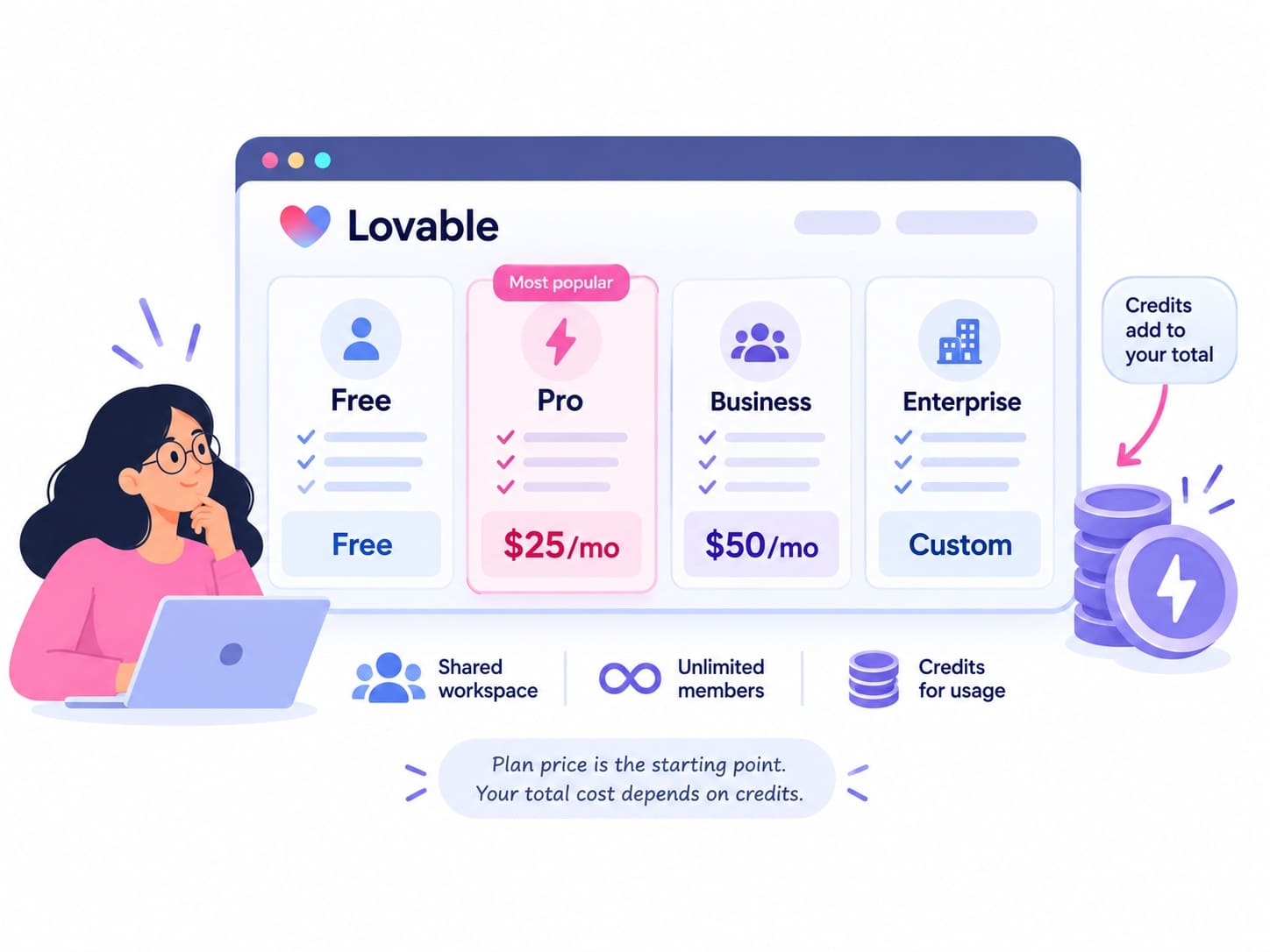
Lovable charges by workspace, not by seat. Every plan supports unlimited members who draw from one shared credit pool, so adding people does not raise the subscription price. It changes how quickly the pool drains.
Watch the difference between an annual commitment and its monthly equivalent. Annual Pro 100 is billed as $250 for the year, which works out to about $20.83 per month. Paying monthly for a year costs $300, so the annual plan saves about $50, or roughly 16.7%. Business 100 annual is $500 for the year, or about $41.67 a month. The annual amount is paid upfront; the monthly equivalent is a budgeting figure.
Is Lovable Free, and What Does the Free Plan Include?
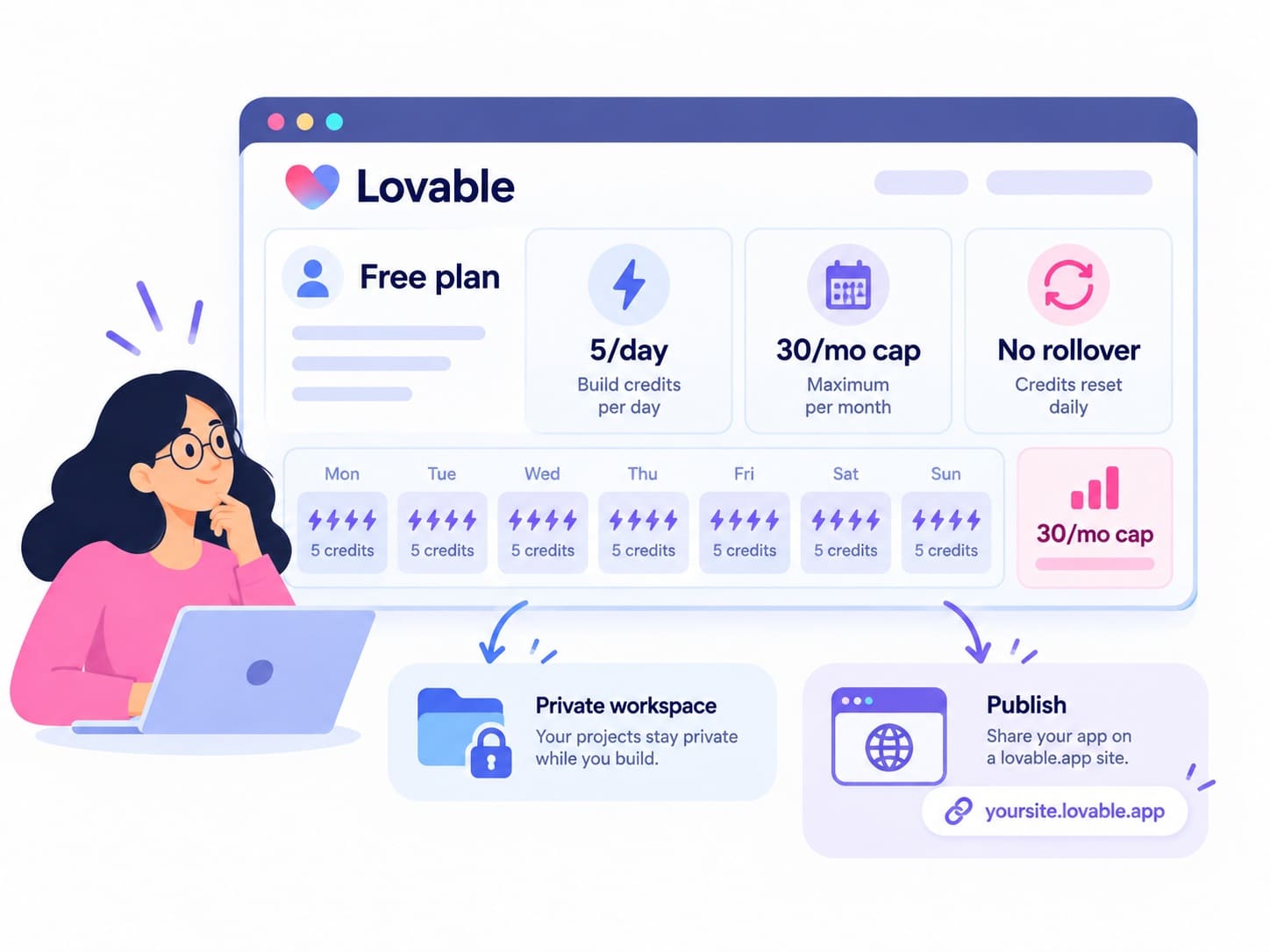
Yes, Lovable has a free plan. You get five build credits per day, and the daily grant is capped at 30 credits in a calendar month. Once you reach that monthly cap, the daily grant pauses until the first of the next month.
Daily credits reset at 00:00 UTC and do not roll over. Whatever you do not spend today is gone tomorrow. That matters for how you plan work: the free allowance is a daily trickle, not a monthly bundle you can save up and spend at once.
Free supports workspace-private projects in the editor. Publishing to a lovable.app address makes the site accessible to visitors, without exposing the project's source code or chat history. Project privacy and published-site access are separate settings.
Custom domains, code editing and download, badge removal, credit rollover, and top-ups are paid features, not free ones.
Whether Free covers your project depends on its scope and the changes you make. Use it to try a small workflow and observe credit consumption before committing to a larger build. No allowance guarantees a fixed number of completed apps.
How Do Lovable Credits Work?
A credit is a unit Lovable uses to charge for building an app and running its backend or AI features. Lovable draws from usage-specific grants first, then from your general credits, always spending the soonest-to-expire general credits first. General credits cover both building and runtime work.
Lovable is rolling out a unified credit balance that combines building, hosting, and in-app AI, so some workspaces still show an older, separate interface. Check what your own dashboard displays.
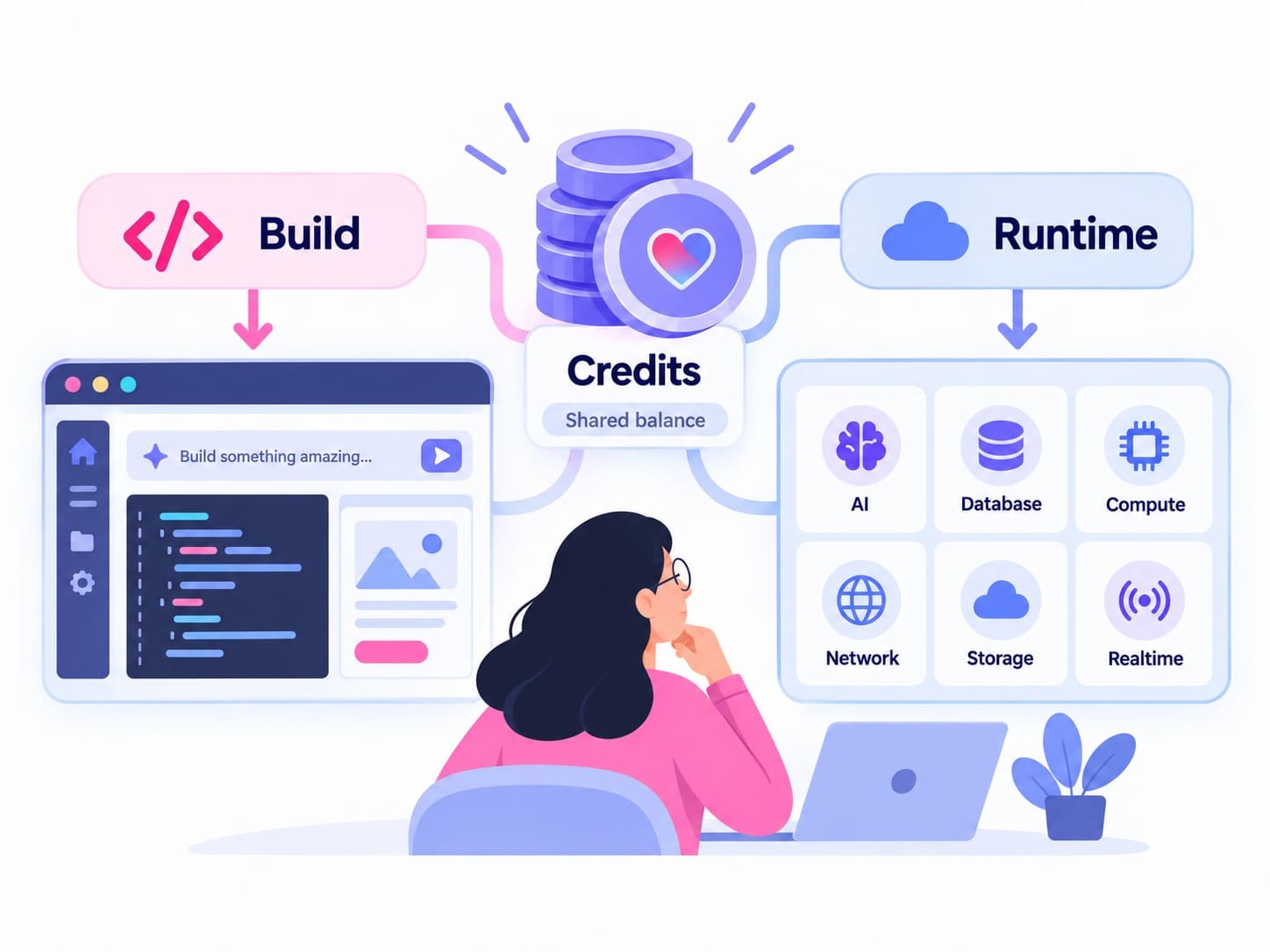
What uses credits when you build?
Build charges vary with the work you ask for. A minor style tweak may use less than a full-page generation, but there is no fixed price per feature. Lovable's documentation offers one illustrative figure, around two credits for a landing page with generated images, and labels it an example rather than a rule.
Plan mode is not a free workaround. Lovable's Plan mode documentation charges at least one credit for the planning message, plus any research its subagents run, and approving the plan then starts separately billed implementation. Even a request that comes back with a clarifying question can still incur the planning charge.
Keep two things separate. The agent that writes your app's code is one kind of usage. Any AI feature built into the published app, such as a chatbot, is a different kind that runs after development ends.
Because credit use tracks how you work, tighter prompts and scoping cost less than repeated retries. Our best practices for building with Lovable cover habits that reduce credit burn during a build.
When do credits reset or expire?
Different grants follow different clocks.
Unused monthly plan credits roll over while your subscription stays active, but rollover does not restart the expiry clock. Each credit still expires on its original date. Check the expiry date for each grant in your balance breakdown before buying more credits.
What does it cost to run a Lovable app after launch?
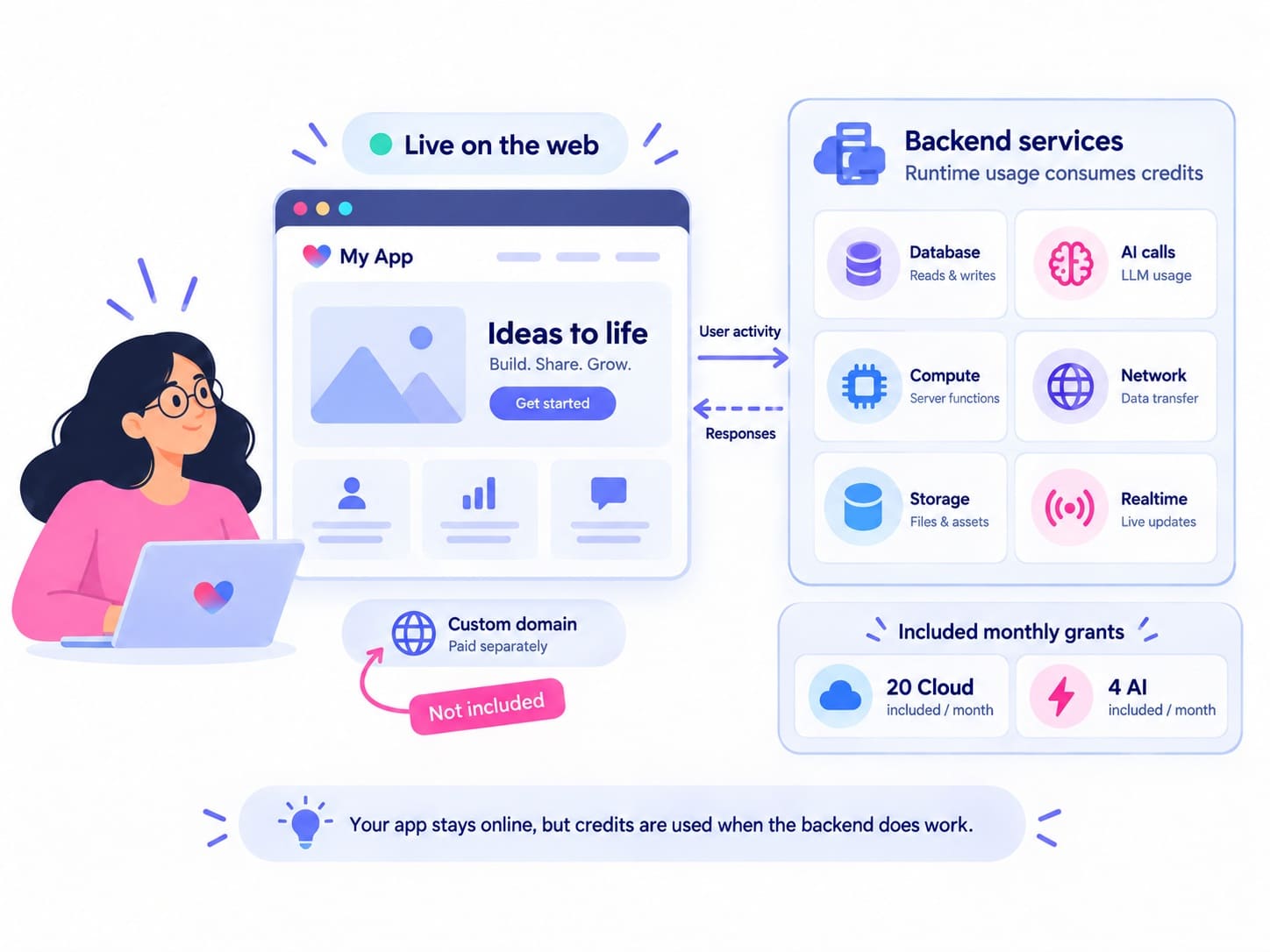
Running an app is separate from building it. Publishing your pages to a lovable.app address is free, and page delivery is distinct from backend activity. A live site does not consume credits simply by staying online. A custom domain does require a paid plan, and buying or renewing the domain is its own purchase, whether you register through Lovable or connect one from another provider.
Backend work is where runtime spending appears. As of September 11, 2026, Free, Pro, and Business include a monthly grant of 20 Cloud credits and 4 AI credits. Lovable labels these grants temporary and subject to change.
They refresh on the first of the calendar month on Free and with the subscription cycle on paid plans, without rollover. Once a relevant grant is exhausted, further usage draws from available general credits.
Your project usage report breaks runtime into database work, AI calls, compute, network, storage, and realtime activity. This is why visitor count alone cannot produce a dollar forecast. A simple text page, a file-sharing app, and a chatbot can serve the same number of visitors while doing very different amounts of work.
It also helps to know your backend option. A built-in Lovable Cloud backend and a separately connected Supabase project are two different choices. Existing Supabase integrations keep working, and new projects can use either route, so not every project needs a separate Supabase subscription.
If your usable credits run out, building stops and in-app AI features can fail, and some backend services can pause. Pages you have already published keep serving. The practical lesson is that keeping enough credit availability matters more than simply having a live URL.
How Can You Estimate Your Total Monthly Lovable Bill?
Use one plain budget model:
Monthly cost = subscription payment due + additional credit purchases + external service charges.
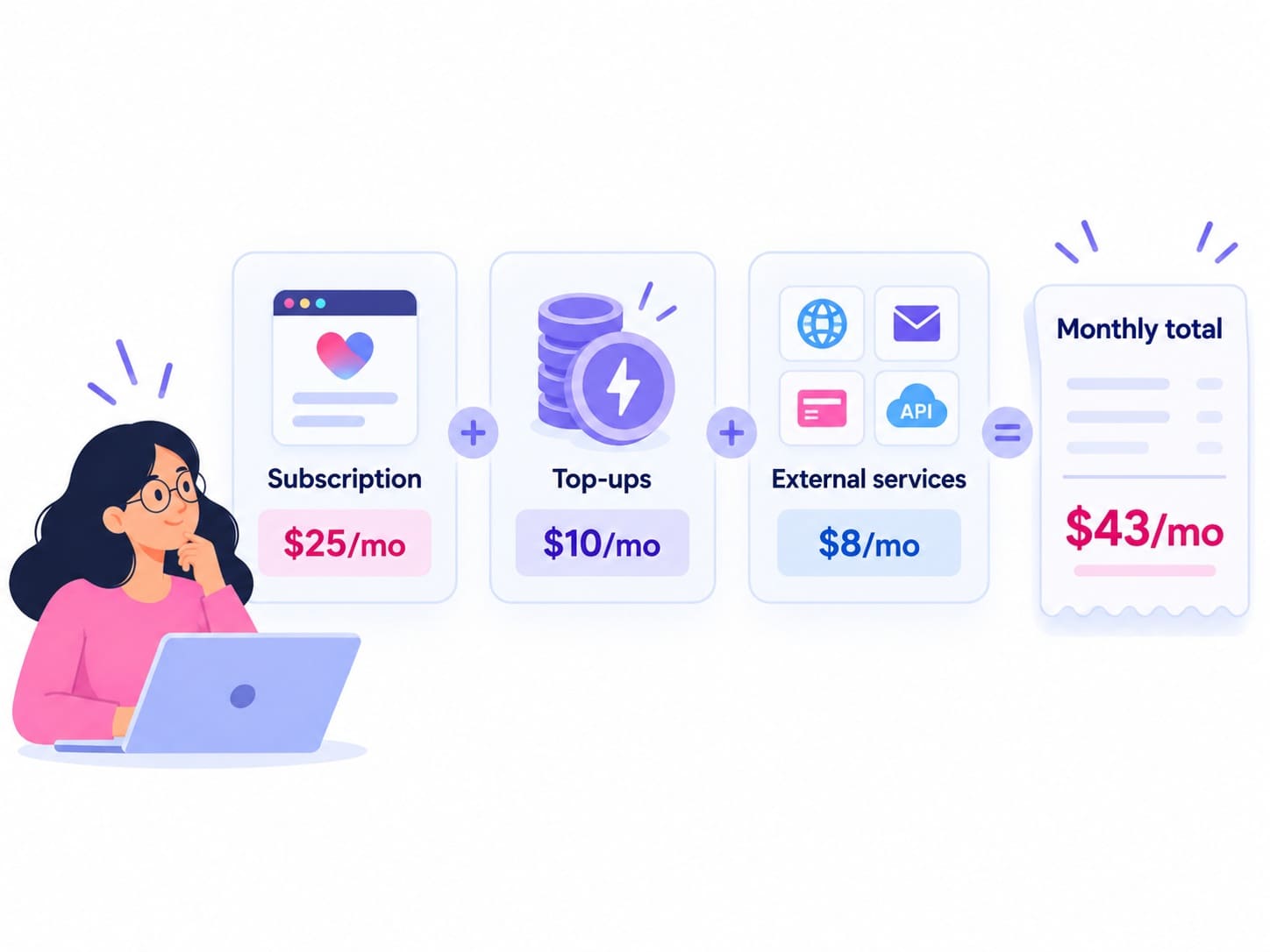
Do not double-count. Runtime work that your credits already paid for should not be added again as a separate line. If you pay annually, show two views: the cash actually due in a given month and an amortized monthly budget, so a month with no payment does not look misleadingly cheap.
The table below is hypothetical arithmetic using the published prices above. These are examples of buying credits, not quotes for building an app. They ignore taxes and external services.
Top-ups and tier changes are different tools. Top-ups are one-time purchases available in several quantities, priced at $15 per 50 credits on Pro and $30 per 50 on Business. They do not change the recurring subscription price. Raising your tier supplies the difference up to the new allocation rather than adding a second full pool on top. Auto top-up has a monthly purchase limit, which only caps automatic purchases, not your total spending.
List external costs separately, and only if you actually choose them: domain registration, payment processing, email, outside APIs, and any implementation help. None of these is automatically required. If you plan to fund the app from revenue, our guide on making money with Lovable covers whether income can cover ongoing costs.
Before forecasting growth, measure a representative period of real usage and find your largest cost category. That gives a better estimate than any fixed cost per thousand visitors.
Which Lovable Plan Should You Choose?
Match the plan to your needs in a fixed order: pick features first, then capacity.
Free fits learning the tool and projects whose requirements fit its allowances. Projects can remain private within the workspace even when their published pages are public.
Pro suits builders and teams that need custom domains, code editing, and monthly plan credits. It also includes per-member credit limits. If capacity is the issue, compare a larger Pro allocation with repeated top-ups before changing plans.
Business adds features such as SSO, internal publishing, and workspace data exclusion from AI training by default. Free and Pro support account-level training opt-out, so opt-out itself is not exclusive to Business. Choose Business for the controls you need, not simply because more collaborators are joining.
Enterprise serves organizations that need features such as SCIM provisioning, audit logs, and publishing controls, with volume-based pricing. Confirm contract terms for the intended rollout.
These controls support governance, but application security still depends on configuration, permissions, and ongoing operation.
A short decision sequence: identify the features you must have, measure your usage, choose the credit allocation that fits, then decide between monthly and annual billing.
How Do You Cancel or Change a Lovable Subscription?
These steps apply to a standard web-billed subscription. In Lovable, go to Settings, then Plans and credit usage, then Manage, then Downgrade to free. The change takes effect at the end of your current billing period, so you keep paid access until then. Moving to a smaller paid tier is different from moving all the way to Free; a lower credit tier within the same plan preserves that plan's features with a smaller allocation.
Credit handling on cancellation deserves care. Lovable's public FAQ says you keep your remaining credits until the end of the billing period, after which the workspace switches to Free with only free-plan grants. The more detailed documentation distinguishes frozen subscription and rollover credits from purchased top-ups and bonuses, which remain usable until their own expiry. Frozen subscription credits become usable again if you re-subscribe before they expire. Check the credit type and displayed expiry in your balance; contact support if access differs from the documented rule.
Do not count on a refund, and do not expect paid features to continue after a downgrade takes effect. For app-store purchases, check the billing terms shown in your account.
Frequently asked questions
Does Lovable offer a student discount?
Lovable's subscription documentation specifies 50% off the Pro plan with 100 monthly credits, billed monthly, for eligible verified students and teachers. The discount lasts up to twelve months and ends on cancellation. It does not cover annual billing or higher credit tiers under those documented terms. Verify eligibility through Lovable's student page and confirm the offer at checkout, since its promotional page describes a broader discount.
Does every Lovable project need a separate paid subscription?
No. A plan applies to a workspace, not to a single project, and a workspace can hold many projects. Everyone you invite shares the same credit pool on one subscription and one invoice. So one paid workspace can support several projects at once. What changes as you add projects or people is how quickly the shared credits are used, not the subscription price.
Does a custom domain come with a Lovable subscription?
A paid plan lets you connect a custom domain, but connecting a domain and owning one are different things. You still register the domain and pay to renew it, either through Lovable or another registrar, and renewal pricing can differ from the first purchase. Budget registration and renewal separately from your Lovable plan; the amount depends on the domain.
Does Lovable Business make hosting and AI usage more expensive?
No. Business credits are priced higher than Pro credits, but the underlying cost of running your app and its in-app AI is the same on both plans. Business subscribers simply see fewer credits consumed for equivalent work, because each Business credit is worth more. A higher credit count on one plan does not mean the same task does more work or costs more to run.
Does exporting Lovable code remove all ongoing costs?
No. You already own your code; exporting gives you a copy to work with outside Lovable. Hosting elsewhere may involve infrastructure, backend services, and maintenance costs, depending on the app. Moving off the platform is a migration, not a switch that zeroes your bill. For the mechanics of getting your code out, see our guide on exporting Lovable code.
What Should You Check Before Paying For Lovable?
Before you commit, confirm three things: the features you truly need, the credit allocation that matches your building workload, and a rough operating budget for after launch. Recheck current prices and allowances on Lovable's own pages, since the credit model is still changing.
If you want a second opinion on scope before you commit to an approach, talk with the team at RapidDev about your app's requirements, integrations, and launch plan.