

September 2, 2026
•
17
min read

How to Use Lovable to Make Money?
Lovable isn’t just an AI toy. It’s helping regular people turn ideas into income. This guide breaks down nine realistic ways to make money building with Lovable.

Quick Answer: Can You Actually Make Money With Lovable?
Yes, people do. The honest framing is narrower than most guides admit: Lovable reduces the cost and time of producing software. It does not create customers, demand, distribution, or a profitable business on its own.
That distinction matters because building an app is only the production step. Whether it earns money depends on demand in your niche, how you reach buyers, how you price, how many trials convert, how many customers stay, and how much support and infrastructure cost you along the way.
Lovable's own June 2026 "Build Economy" report gives a sense of intent versus outcome. Drawing on platform data from January 2025 to May 2026 and a survey of more than 14,300 users, Lovable reported that roughly 8 in 10 respondents intend to monetize what they build, over half said they are building a business, and about a quarter have side projects they want to earn from. In the same data, a majority said they were not yet making money from their projects. These are Lovable's own self-reported, unaudited platform and survey numbers, and survey respondents skew toward active enthusiasts. Treat them as signals of intent, not as income benchmarks.
So the useful question is not "will Lovable make me money" but "which business model am I actually running, and can I make that model work." The rest of this guide answers that.
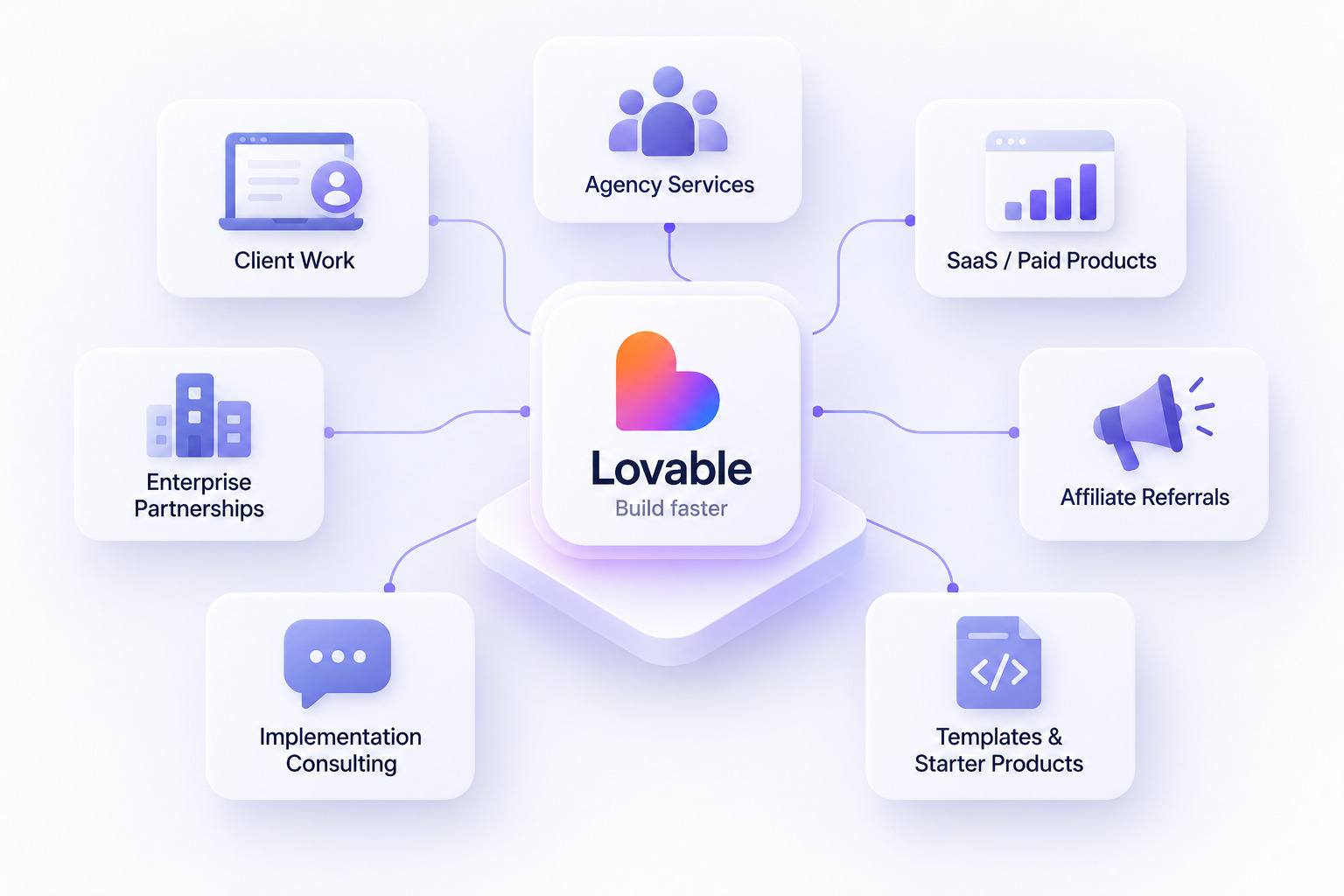
How to Make Money With Lovable: The Main Business Models
There is no single best path. Each model has a different customer, a different revenue shape, and a different amount of work outside the build. Pick based on what you can realistically distribute and support.
Build Websites and Apps for Clients
Client services are often the lowest-risk place to start, and the reasons are structural rather than motivational. The customer already has a problem they want solved. The client funds the build, so you are not spending months hunting for broad product-market fit. And every project adds to a portfolio and to operational experience you can reuse.
A workable flow looks like this: problem discovery, a small prototype to confirm you understand the need, a defined scope, a fixed project fee or retainer, testing, then handoff and support. Lovable's speed helps most in the prototype step, because showing working software early tends to shorten sales cycles.
What it does not remove: finding clients, scoping accurately, and supporting what you ship. Income depends on your pipeline and your pricing, not on how fast the code appears.
Start a Lovable-Focused Agency
An agency is the client-services model turned into a repeatable operation, usually with a niche, a team, and defined service packages. The economic argument is the same one that helps solo freelancers: rapid prototypes can compress both the sales cycle and the delivery cycle, which lets a small team take on more defined work.
The trade-off is that an agency adds real operating overhead, including sales, staffing, quality review, and account management. Revenue scales with your ability to sell and deliver consistently, not with the tool.
Build a SaaS or Paid Digital Product
A SaaS or paid product is the model with the highest recurring potential and the highest distribution burden. Here you are the one who has to find and keep users, which is a different and harder job than delivering to a client who already asked for the work.
Lovable is well suited to shipping a first version quickly, which lets you test an idea cheaply and pivot if it does not land. That speed is an advantage in validation. It does nothing for acquisition, retention, or support, which is where most products stall. Build to test demand, then put most of your effort into distribution.

Join the Lovable Affiliate Program
If you already publish content or have an audience, Lovable's affiliate program is a way to earn from referrals without building anything.
Per Lovable's current affiliate page, approved partners can earn up to $100 for each first-time subscriber they refer, with performance bonuses at milestones, a real-time dashboard for clicks and conversions, and monthly payouts. Applications are handled through Lovable's affiliate platform.
Two caveats. "Up to $100" is a ceiling, not a typical payout, and it depends on the plan the referred user buys. And affiliate income is neither passive nor guaranteed: it tracks the size and trust of your audience and the quality of your content, and it takes ongoing work to sustain.
Sell Templates or Starter Products
Templates turn work you have already done into something you can reuse or resell. There are three realistic ways they make money: selling starter kits to other builders through your own channels, using a free or cheap template as lead generation for higher-value services, and reusing internal starter systems to improve your margins on client work.
Be skeptical of "build once, earn forever" framing. Templates need documentation, updates, and support to keep selling, and there is no first-party evidence that Lovable itself pays template authors, so do not plan around that.
Offer Internal-Tool and Implementation Consulting
Many businesses need internal tools such as dashboards, trackers, and workflow apps, and they do not want to hire a full engineering team for a one-off. That is a consulting opportunity: you scope, build, integrate, and often maintain the tool.
This model resembles client services but skews toward operations teams and existing business relationships rather than cold marketplaces. Deals are usually larger and slower, and the technical responsibility, including data access and security, sits with you.
Join the Lovable Solution Partner Program
The Solution Partner Program is a separate, enterprise-oriented track, not the consumer affiliate program. It is built for service businesses, typically agencies, consultancies, and system integrators, that deliver production software to clients and can bring qualifying enterprise deals to Lovable.
Per Lovable's current program reference, it has four tiers with revenue share on the first-year subscription revenue of qualifying enterprise referrals: Registered at 0%, Select at 10%, Premier at 15%, and Elite at 20%. Progression is based on certification, sold annual recurring revenue, and the ARR a partner manages, and higher tiers carry real qualification requirements. Baseline eligibility includes an active Business plan or higher and a registered business, and there is a minimum payout threshold. This path makes sense mainly for firms already selling to business and enterprise clients, not for individuals. (Lovable also runs a separate individual and small-agency track for smaller client deals; check the current partner pages for which fits you.)
Which Lovable Business Model Should You Choose?
The right model depends on who your customer is, how much you have to distribute yourself, and how much technical and support responsibility you want to carry. This table compares structure, not earnings, because earnings depend on your specific niche, pricing, and execution.
A reasonable pattern: use services or consulting to generate cash and learn the market, then fund a product or template effort with that income rather than betting everything on a product before you have distribution.
How Do You Monetize a Lovable App?
As of 2026, Lovable has built-in payments, so charging money no longer requires wiring up a payment backend by hand. This is a meaningful change from the older approach of manually configuring Stripe through a database backend.
Native Lovable Payments lets you add subscriptions, one-time purchases, memberships, digital products, and SaaS billing by describing what you want in chat. Lovable handles much of the infrastructure: creating the provider account, setting up products and prices, building the checkout, keeping subscription data current, registering webhooks, and managing separate test and live environments.
The project also gets a Payments tab that shows transactions, subscriptions, revenue analytics, and adjustments such as refunds and chargebacks, plus a go-live checklist that tracks the steps required before you can accept real money.
A few current constraints are worth knowing before you rely on it. Built-in payments require a paid Lovable plan (on the Free plan you can connect your own Stripe account instead). Only one provider can be active per project. And once payments are enabled, the project can no longer be remixed. Test mode uses provider test cards and charges no real money; live mode only works after you complete verification and the go-live checklist.
Should You Use Paddle or Stripe?
Lovable's built-in payments are powered by two providers, Paddle and Stripe, and Lovable will often recommend one based on what you are selling. The core difference is who acts as merchant of record.
Paddle operates as a dedicated merchant of record. That means Paddle is legally the seller and takes on tax calculation, compliance, billing, and invoicing across many countries. Per Lovable's documentation, Paddle's pricing through Lovable is 5.0% plus 50¢ per transaction with no monthly fee (with reduced flat pricing on small microtransactions). It is generally the better fit for digital products and SaaS sold to a global audience, where handling international sales tax yourself would be a burden.
Stripe is primarily a payment processor with an optional merchant-of-record capability (Managed Payments) that can be enabled per transaction for digital products. It uses standard pay-as-you-go Stripe rates and supports services in addition to digital products, so it is often the better fit when you sell services, target mostly domestic customers, or want per-transaction control over whether MoR applies. Stripe's managed-payment option is available in fewer countries than its standard processing.
Do not oversimplify the tax and legal side. A merchant of record shifts sales-tax and compliance responsibility to the provider; standard processing does not, which can leave those obligations with you. Lovable adds no extra fee on top of either provider, so using them through Lovable costs the same as setting them up directly. Verify current provider pricing and country support before you commit, since both change.
Do You Need Lovable Cloud or Supabase?
Architecture now depends on the project, and this is another area where older guidance is out of date.
Lovable Cloud is the built-in backend, enabled by default, and it covers a database, authentication and user management, file storage, server functions, and secrets and integrations. Under the hood it runs on Supabase's open-source stack, but Lovable provisions and manages the instance, so you do not sign up for or see a separate Supabase account.

Supabase remains a fully supported alternative on all plans. You would connect your own Supabase project when you want direct ownership of the backend: your own account and billing, full dashboard access, or an existing project you already use. Many agencies prefer this for client work so the database stays with the client.
Two practical points. First, there is no one-click migration between the built-in backend and your own Supabase project in either direction, so decide early which backend a project should use. Second, and importantly for monetization: for most existing projects — those on the older React and Vite setup — built-in Lovable Payments requires Lovable Cloud and is not available for projects connected to an external Supabase backend. There is one current exception: newer apps on Lovable's TanStack Start setup (created from May 13, 2026, or June 22, 2026 on Enterprise plans) can use built-in payments alongside your own Supabase project. If your project uses an external Supabase connection and is not on TanStack Start, you can still integrate Stripe separately, but that is a different setup from Lovable's built-in Payments flow. Confirm the current requirements before you architect around payments.
How Much Does Lovable Cost When You Build for Profit?
Re-check Lovable's pricing page directly, because plans and credit details change. As of 2026, Lovable offers a Free plan, Pro at $25/month, Business at $50/month, and custom Enterprise pricing, with paid plans starting at 100 monthly credits and scaling up a credit ladder. Annual billing lowers the effective monthly price.
The change that matters most for a business is the move to a unified credit balance. Building your app, running it on Lovable Cloud, and any AI features your live app uses now draw from the same credit pool rather than separate bills. Lovable has been rolling this out gradually, so some workspaces may still show the older separate balances.
Here is why that changes the math: revenue is not profit. A monetized Lovable app can incur several costs at once. Building and editing consumes build credits. A live app consumes credits for hosting and backend usage, and again for any in-app AI. On top of that sit payment-processing fees from Paddle or Stripe, plus the real cost of support and maintenance. Most small or new apps stay within the included monthly grants, but costs rise with traffic, data, and AI usage.
Do not assume a subscription price replaces all engineering cost, and do not plan around a fixed margin. Price the whole operation, including your time, and watch how your running costs scale with usage before you treat any of it as profit.
Can You Sell an App Built With Lovable?
Sometimes, but be precise about what "selling" means, because two very different things get lumped together.
Selling access to your app, subscriptions and one-time purchases, is straightforward once payments are live. Selling or transferring the software or business itself to another owner is a bigger undertaking.
On ownership, Lovable's terms (effective August 15, 2026) state that, as between you and Lovable, you own the applications, websites, and projects you build with the service, and you also own the AI output generated for you, subject to any third-party rights in the underlying models, training data, or outputs. Practically, paid plans let you sync or export your code to GitHub and host it elsewhere, which is what makes a transfer possible.
Two cautions. First, copyright protection for purely AI-generated code is legally unsettled in several jurisdictions because it can require meaningful human authorship; this is a live area, so keep records of your own contributions and consider a license scan before a sale. Second, a clean code export is not the same as a clean business handoff. Because there is no one-click migration of the backend between Lovable Cloud and Supabase, transferring backend data, authentication, and secrets to a new owner takes real planning. Do not assume a seamless migration.
What Should You Check Before Charging Customers?
Lovable built it" is not the same as "production-ready and safe to sell." AI-generated code still needs human review, and it helps to understand how secure Lovable-built apps really are before you ship. The gap between a working prototype and a chargeable product is usually where problems hide.
Before you take money, confirm the following:
- Authentication and authorization: users can only sign in as themselves and only see what they are allowed to see.
- Secrets and API keys: no keys or credentials are exposed in client code or logs.
- Database permissions: row-level access is enforced so one customer cannot read another's data.
- Payment test mode: the full flow works end to end in test mode before you go live.
- Subscription lifecycle: upgrades, downgrades, cancellations, renewals, failed payments, and trials all behave correctly.
- Legal pages: a real privacy policy, terms of service, and refund policy are published (providers check for these during go-live).
- Backups and monitoring: you can recover data and you will notice when something breaks.
- Customer support: there is a way for customers to reach you and get help.
- Security testing: someone has actively tried to break access controls, not just confirmed the happy path.
If you cannot check these off, you are not ready to charge, regardless of how finished the app looks.
Real Examples of People Making Money With Lovable
Two sourceable examples are worth citing, with clear labels on what they are.
Harry Roper / Imaginary Space. Roper runs Imaginary Space, an agency that Lovable has featured as an official partner and that builds custom software for enterprise operations teams, with named clients including Dude Wipes and the UK Military. In interviews and Lovable-published material, Roper has self-reported roughly $100,000 per month in revenue, on track toward about $1.2 million in annual revenue. These figures are self-reported and company-published, and they reflect an established agency with a team; they are not a typical or expected result. The transferable lesson is the operating one: rapid prototypes can shorten sales and delivery cycles, which helps an agency win and ship work faster.
Lovable's Build Economy report. As platform-level evidence, Lovable's June 2026 report found that most surveyed users intend to monetize and that some builders have reached five- and six-figure revenue since payments launched in February 2026. Lovable did not disclose how many users reached those milestones or the distribution of outcomes, and the data is self-reported and unaudited. It shows intent and a few high points, not the average.
You will also find individual income stories on Reddit, Medium, and YouTube. Treat those as self-reported anecdotes, not benchmarks; they are useful for understanding what people build and where they struggle, not for forecasting your own income.
Common Mistakes When Trying to Make Money With Lovable
- Confusing building with a business. Shipping fast solves production. It does not solve demand, distribution, or retention, which is where revenue actually comes from.
- Skipping validation. Building before confirming anyone will pay is the most common and expensive mistake. Find the buyer first.
- Underestimating running costs. With a unified credit balance, a live app keeps consuming credits, and payment fees and support cost real money. Track this before you assume profit.
- Treating any income as passive. Affiliate payouts, templates, and products all need ongoing work to keep earning.
- Shipping AI code without review. Access-control and secrets issues do not show up in the happy path. Review and test before charging.
- Choosing a backend or payment provider carelessly. Because migrations are not one-click, a rushed early choice about Cloud versus Supabase, or Paddle versus Stripe, can be costly to unwind later.
- Anchoring on someone else's headline number. A featured agency's revenue is not your baseline.
Frequently Asked Questions
Can you really make money with Lovable?
Yes, but through a business model, not the tool itself. Lovable lowers the cost and time of building software; income still depends on demand, distribution, pricing, and support.
Can you sell apps made with Lovable?
You can sell access (subscriptions or one-time purchases) easily once payments are live. Selling or transferring the whole software or business is possible via code export to GitHub, but backend data, auth, and secrets take planning to move, and copyright over purely AI-generated code is legally unsettled.
Can you accept payments in a Lovable app?
Yes. Native Lovable Payments supports subscriptions and one-time purchases through Paddle or Stripe on paid plans, with checkout, webhooks, and a Payments tab handled for you. On the Free plan you can connect your own Stripe account.
Does Lovable have an affiliate program?
Yes. Its current affiliate program advertises up to $100 for each first-time subscriber referred, performance bonuses, a real-time dashboard, and monthly payouts. It is not passive or guaranteed income.
Do you own the code generated by Lovable?
Per Lovable's 2026 terms, you own the projects you build and the AI output generated for you, subject to third-party rights in the models and training data. Note that legal copyright protection for purely AI-generated code is still uncertain in several jurisdictions.
Can you use Lovable for client work?
Yes, and client services are often the lowest-risk starting model because the client funds the build and already has a problem to solve. For client work, many builders connect their own Supabase project so the backend stays with the client.
Can you build a SaaS with Lovable?
Yes. Lovable is well suited to shipping a first version and testing demand. The hard part is acquiring and retaining users and supporting a production app, which the tool does not do for you.
If You Get Stuck Turning a Build Into a Product
Lovable makes the build fast, but turning it into something you can safely charge for — production hardening, access controls, payment and subscription logic, integrations, scaling — is a different kind of work, and it's completely normal if that part isn't your strength.
That stage happens to be what RapidDev works on, building on the same React stack Lovable exports to. If it's ever useful, you're welcome to share what you're working on and we're glad to talk through what it would take — no pressure either way.