

November 13, 2026
•
18
min read

AI SDRs and AI Sales Agents: What They Automate, What They Cost, and Build vs. Buy
What AI SDRs and sales agents automate, how they are priced, where they fail and when to build your own. Book a free AI strategy call to scope yours.
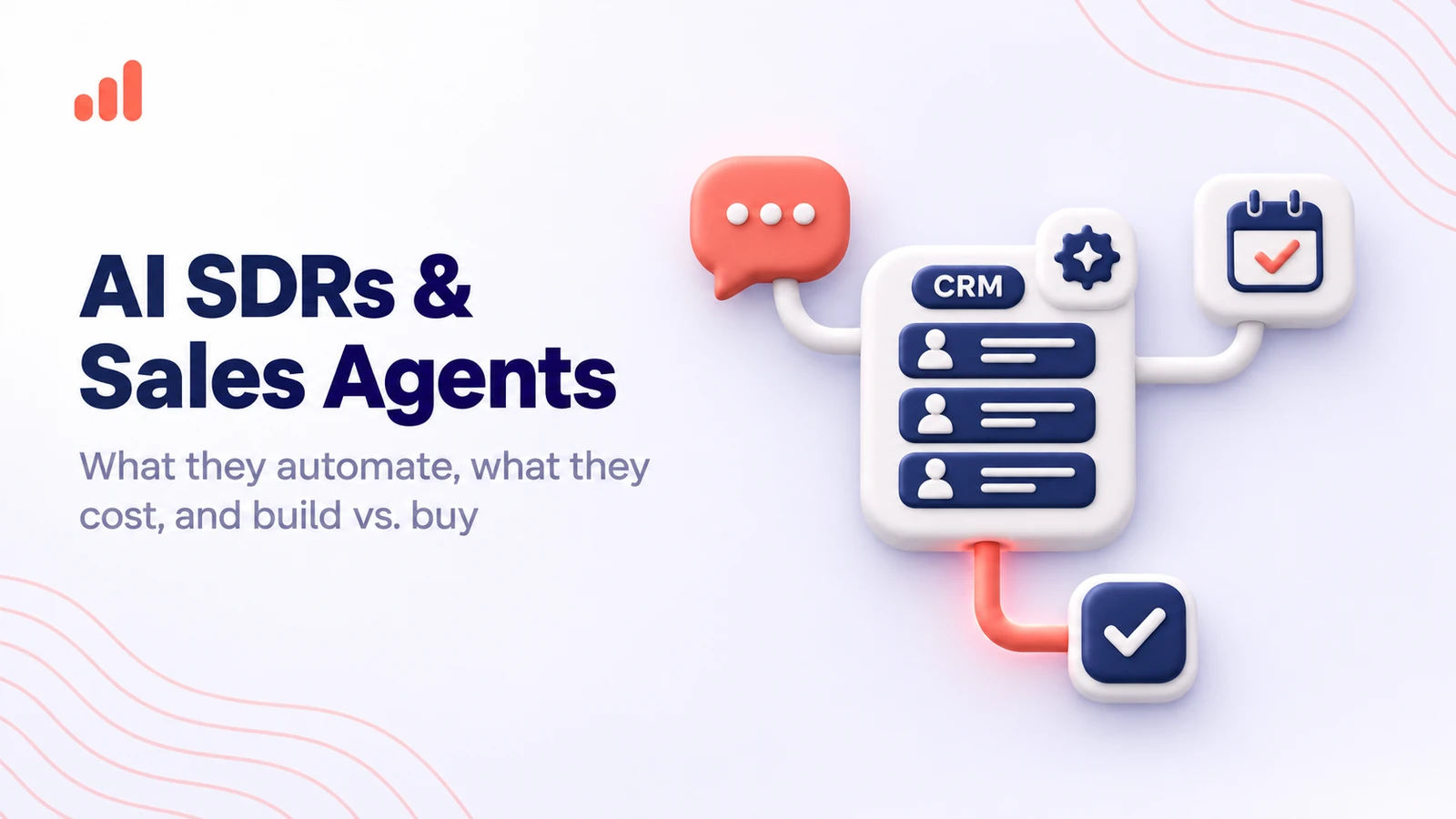
An AI SDR is software that handles parts of a sales development representative's job, including prospect research, outreach, follow-ups, lead qualification, and meeting scheduling. More advanced AI sales agents can also work inside your CRM and other business systems. They're most useful for repeatable tasks, but messaging, compliance, and important sales decisions still need human oversight.
Sales teams spend a lot of time doing things that aren't really selling.
Researching accounts. Updating CRM records. Chasing unanswered emails. Scheduling meetings. Making sure the right person follows up with the right lead.
AI SDR tools promise to handle much of that work. Some do it well. Others just make it easier to send more emails, whether those emails are worth sending or not.
At RapidDev, an AI development and integration company, we build AI agents and connect them to existing business systems. We don't sell a standalone AI SDR platform, so we're less interested in how many messages a tool can send than whether it improves the way your team works.
Prospecting is only one slice of AI automation across sales and CRM. This guide sticks to AI sales agents: what they can handle, where they tend to fail, what they cost and when building your own makes sense.
What is an AI SDR?
An AI SDR is a software tool that automates selected sales development tasks, from researching prospects to qualifying leads and booking meetings.
SDR stands for sales development representative. In a traditional sales team, SDRs identify potential customers, start conversations, qualify interest, and arrange meetings for account executives.
AI SDR software takes on some of that work.
Depending on the platform, it might research companies, draft personalized emails, follow up with prospects, answer inbound questions, or update CRM records.
You'll also see the term AI sales agent. It's broader and usually refers to a system that can take actions through connected tools, such as retrieving customer information, creating CRM tasks, or triggering a follow-up workflow.
Not every product marketed as an AI agent has those capabilities.
Some mainly generate messages. Others run predefined sequences. More advanced agents can use information from connected systems to decide which permitted action to take next.
That's the practical difference between an AI agent and a chatbot: a chatbot primarily responds to questions, while an agent can also carry out tasks.
For most sales teams, the most valuable features aren't necessarily the most impressive demos. They're the ones that keep the CRM accurate, prevent leads from getting lost, and help qualified prospects reach the right salesperson faster.
What can AI SDRs and sales agents automate?
AI SDRs can handle account research, outreach drafts, follow-ups, inbound qualification, scheduling, and CRM updates. How much of that work you should automate depends on the risk involved.
Researching a prospect is one thing. Sending them an inaccurate claim about your product is another.
Here's where AI can help and where your team should stay involved.
| Sales task | What AI can handle | What people still need to do | Risk |
|---|---|---|---|
| Account research and enrichment | Gather company information, summarize buying signals, and enrich lead records | Verify important details and choose target accounts | Low–medium |
| Personalized first touch | Draft emails using prospect information and approved messaging | Approve targeting, claims, tone, and sending rules | High |
| Follow-ups | Prepare messages, schedule reminders, and run approved sequences | Set frequency limits and review unusual responses | Medium–high |
| Inbound qualification | Answer common questions, collect requirements, and apply AI lead scoring | Define qualification criteria and handle complex opportunities | Medium |
| Meeting booking | Check availability, suggest times, and create calendar events | Handle exceptions and high-priority meetings | Low–medium |
| CRM updates | Summarize conversations, update fields, and create tasks | Review important changes and correct errors | Low–medium |
Risk levels are general assessments. Actual risk depends on the data, permissions, audience, and actions involved.
Start with research and CRM work
An AI sales agent doesn't have to send emails to be useful.
It can prepare account briefs, summarize conversations, fill in missing CRM fields and flag leads that need attention, the back-office work where AI automation services usually pay off long before outbound campaigns do.
They're also easier to evaluate. You can check whether the information is accurate, whether the CRM was updated correctly, and how much time your team saved.
Be careful with automated outreach
AI can write a convincing email in seconds. That doesn't mean the email is ready to send.
Prospect information may be outdated. The model may misunderstand what a company does or invent a reason the recipient should be interested.
Even factually correct messages can feel awkward when they try too hard to sound personalized.
Start with drafts that a salesperson reviews. Expand automation only after you've established clear rules for targeting, product claims, sending frequency, and exception handling.
Inbound qualification is a better fit
When someone fills out a demo form or contacts your company, you already know they're interested in something you offer.
An AI agent can respond, collect missing details, answer approved questions, and route the lead to the right salesperson.
There's a clear reason for the conversation, and the agent has a defined job.
That's a much more manageable use case than sending unsolicited messages to hundreds or thousands of people.
Do AI SDRs actually work?
AI SDRs can work well for structured, repeatable tasks. They're much less predictable when asked to create demand, build relationships, or run outbound sales without supervision.
It depends on what you're trying to achieve.
If you want faster inbound responses, cleaner CRM records, and fewer missed follow-ups, AI can help.
If you expect software to find ideal customers, understand their priorities, start meaningful conversations, and consistently generate qualified opportunities on its own, that's a much harder problem.
Inbound and outbound need different approaches
Inbound AI SDRs work with people who have already contacted your business.
They can answer common questions, ask for missing information, and move qualified leads toward a meeting or human handoff.
Outbound AI SDRs face more uncertainty.
They need accurate contact information, a clear understanding of your ideal customer, relevant messaging, and a sending process that doesn't damage your reputation.
More automation won't fix poor targeting.
If your outreach isn't working because the audience is wrong or the offer isn't compelling, an AI SDR may simply help you make the same mistake faster.
Don't judge performance by meetings booked alone
Meeting volume is easy to measure. Meeting quality matters more.
An agent that books ten meetings with people who aren't a good fit may create more work than it saves.
Track metrics that tell you whether the process is improving:
- Qualified meetings that actually happen
- Meeting-to-opportunity conversion
- Lead qualification accuracy
- Positive and negative reply rates
- CRM data quality
- Time spent reviewing or correcting AI output
- Email deliverability and sending costs
Compare those results with your existing sales process.
An agent that saves your team several hours a week on research and administration may be worth keeping even if it doesn't improve outbound conversion.
You don't have to automate the entire SDR role to see a return.
How much does an AI SDR cost?
AI SDR pricing depends on the vendor, the number of users or contacts, outreach volume, included features, and the integrations your team needs.
There isn't a standard pricing model across the market.
Some platforms charge per user. Others bill for contacts, credits, or booked meetings. Custom AI agents have a different cost structure altogether.
Common AI SDR pricing models
| Pricing model | How it works | What to check |
|---|---|---|
| Per seat | Monthly or annual subscription for each user | Whether AI features, integrations, and sending accounts cost extra |
| Per contact or lead | Charges based on records researched, enriched, or processed | Credit limits, duplicate records, and overage charges |
| Per meeting | Fees tied to booked or qualified meetings | Qualification rules, cancellations, and no-shows |
| Platform plus usage | Base subscription with additional usage charges | Message limits, credits, and costs as volume increases |
| Custom development | Development fee plus infrastructure and maintenance | Integration complexity, model usage, hosting, and ongoing support |
The subscription isn't always the full cost
An entry-level plan may look affordable until you add everything your team needs.
Depending on the platform, additional costs may include:
- Email accounts and sending infrastructure
- Contact data and enrichment credits
- CRM integrations or higher subscription tiers
- AI usage credits
- Setup and onboarding
- Monitoring and support
Ask vendors to calculate the cost for your actual monthly lead volume and workflow.
A custom build swaps the subscription for a development fee plus hosting, model usage and maintenance, and what a custom AI agent costs comes down to scope and how many systems it has to connect to.
Is an AI SDR cheaper than hiring a salesperson?
It may be cheaper for specific tasks, but comparing a software subscription with an SDR's salary doesn't tell you much.
A human SDR can adapt during a conversation, recognize buying signals, handle objections, and build relationships.
An AI SDR is better evaluated against the work it automates.
If it saves hours of administration and speeds up inbound qualification, you can measure that value.
If it books more meetings but produces few real opportunities, the apparent savings may not amount to much.
What are the risks of using AI SDRs?
The biggest risks are email deliverability, legal compliance, inaccurate messaging, poor CRM data, and damage to your company's reputation.
Sales outreach is particularly sensitive because the agent communicates directly with potential customers.
A mistake doesn't stay inside your software. It reaches someone outside your company.
Damaging your email reputation
Sending more emails isn't necessarily better.
High spam complaint rates, invalid addresses, weak targeting, and sudden increases in volume can hurt your sender reputation.
That can affect legitimate business email, too.
Gmail is strict about this: Google's Email sender guidelines FAQ requires anyone sending close to 5,000 messages a day to Gmail accounts to authenticate with SPF, DKIM and DMARC, offer one-click unsubscribe and keep reported spam below 0.3%.
Getting compliance wrong
AI-written cold email is still commercial outreach.
In the United States, the FTC's CAN-SPAM Act compliance guide sets the baseline: accurate sender information, no deceptive subject lines, a valid postal address and an opt-out you honor within 10 business days.
If you're contacting people in the European Union, GDPR and applicable electronic marketing laws also matter.
Publicly available contact information doesn't automatically mean you can use it for unrestricted automated outreach.
Your compliance approach needs to account for where recipients are located, how their information was obtained, and what type of communication you're sending.
Making claims your company can't support
AI can write a confident statement that's completely wrong.
It might promise a feature your product doesn't have, offer an unauthorized discount, or refer to a prospect's business inaccurately.
Those mistakes can be embarrassing and may create commercial or legal problems.
Use approved product information and clear boundaries around pricing, commitments, and claims. Anything uncertain should go to a salesperson.
Working with unreliable CRM data
If your CRM contains duplicate contacts, outdated records, or inconsistent account ownership, an AI agent may contact the wrong person or update the wrong record.
Before giving it write access, decide exactly which fields it can change and which actions require approval.
Automated calling
AI-generated calls bring additional legal and reputational risks.
In the United States, the FCC declaratory ruling on AI-generated voices in robocalls (2024) confirmed that AI-generated voices count as artificial voices under the TCPA, so the consent rules for prerecorded calls apply.
Consent and other requirements depend on the circumstances. Don't assume a call is permitted simply because software can place it.
Live calls also fail in ways email doesn't: voice AI agents struggle with latency, interruptions and misheard names or numbers, so for standard calling a proven platform is usually the safer buy.
Should you buy, configure, or build an AI SDR?
Buy an existing platform for standard outreach, configure AI inside your CRM when most of the work happens there, and consider a custom agent when your sales process needs deeper integrations or more control.
There's no reason to build software from scratch if an existing product already does what you need.
Here's how the three options compare.
| Approach | Best for | Time to launch | Control | Cost profile | Main risk |
|---|---|---|---|---|---|
| Buy a standalone AI SDR | Standard prospecting and outreach workflows | Days to weeks | Limited to vendor features | Subscription and usage fees | Deliverability, platform limitations, and vendor dependence |
| Configure AI inside your CRM | Qualification, routing, and follow-ups managed in one CRM | Days to several weeks | Moderate | CRM subscription, AI features, and setup | Workflow restrictions and limited customization |
| Build a custom AI sales agent | Complex qualification, proprietary data, or multiple connected systems | Weeks to months | High | Development, infrastructure, model usage, and maintenance | Greater implementation responsibility |
Timelines are general estimates and depend on the scope and existing systems.
Buy when your process is fairly standard
If your team needs lead enrichment, email sequencing, and meeting scheduling, start by evaluating existing products.
Test them with a small group of representative prospects before committing to a larger rollout.
Pay attention to message quality, CRM synchronization, permissions, and deliverability rather than relying only on meeting-booking claims.
Configure what you already have
If your team works primarily in HubSpot, Salesforce, or another CRM, check which AI and automation features are already available.
You may be able to automate inbound qualification, lead routing, and routine follow-ups without adding another platform.
That keeps your reporting and customer data in fewer places.
Build when the workflow is unique
Custom development makes sense when off-the-shelf products can't support the way your company sells.
Maybe qualification depends on proprietary data. Maybe your agent needs to check several internal systems. Or perhaps every outbound action must go through an approval process.
In those situations, AI agent development gives you more control over how the system accesses information and takes action.
You may not need a full custom platform, either.
A team with engineering resources could automate Gmail sales outreach for a narrow, approved workflow before investing in something larger.
Start with the simplest approach that meets your requirements.
What does a custom AI sales agent look like?
A custom AI sales agent connects your CRM, approved data sources, communication tools, and business rules so it can complete defined tasks without operating outside your control.
Think of it as a workflow that can interpret information and take permitted actions, not just a chatbot that writes emails.
Most custom agents need five components.
CRM integration
The agent reads account information, contact history, lead status, and other approved fields.
It might connect to HubSpot, Salesforce, or a custom CRM.
Your CRM should remain the system of record. The agent shouldn't create a separate, disconnected version of your pipeline.
Research and enrichment
The agent gathers relevant information from permitted sources and prepares account summaries.
That might include company size, industry, recent activity, or previous interactions.
Important details should be verified before they're used in external communication.
Qualification rules
Your sales team defines what makes a lead worth pursuing.
Criteria might include company size, location, industry, budget, product requirements, or existing account status.
The agent applies those rules and records why a lead was qualified, rejected, or sent for review.
Actions and approvals
The agent can create tasks, update CRM fields, prepare messages, or schedule meetings.
Some actions can run automatically. Others should require approval.
For example, you might allow the agent to update a research summary but require a salesperson to approve first-touch outreach or changes to an opportunity stage.
Monitoring
The system records what it did, whether each action succeeded, and where human intervention was needed.
That gives your team a way to review qualification accuracy, message quality, errors, and business results.
Without monitoring, it's hard to tell whether the agent is helping or just creating more activity.
Will AI replace SDRs?
AI will take over more of the repetitive work SDRs do, but it won't eliminate the need for sales judgment, relationship-building, and complex conversations.
The role is changing.
Research, meeting preparation, CRM updates, and routine follow-ups are becoming easier to automate.
But good sales development involves more than moving information between systems.
An experienced SDR can recognize when a prospect's stated problem isn't the real issue, adjust during a conversation, pick up on hesitation, and know when to stop pushing.
Those skills are harder to automate reliably.
For most teams, the better question isn't whether AI can replace an SDR.
It's how much administrative work AI can remove so SDRs spend more time talking to qualified prospects.
An agent that keeps your CRM accurate, prepares useful account briefs, and handles straightforward inbound inquiries may deliver more value than one that sends hundreds of generic emails.
How does RapidDev build AI sales agents?
We build AI sales agents around the way your team already sells, with CRM integrations, clear permissions, approval rules, and measurable results.
At RapidDev, we start with the workflow, not the model.
Understand the sales process
We look at where leads come from, how they're qualified, which tools your team uses, and where work gets delayed.
We also identify the decisions that should stay with a person.
Define what the agent should handle
Next, we agree on the specific tasks worth automating.
That might include account research, inbound qualification, CRM updates, follow-up drafts, or scheduling.
We define which information the agent can access, what it can change, and when it needs approval.
Build and connect the agent
We integrate the agent with your CRM, data sources, and communication tools.
We also put validation, logging, error handling, and safeguards around sensitive actions.
The goal is to make the agent part of your existing process, not another tool your sales team has to manage.
Test it with real sales scenarios
Before launch, we test the agent with representative leads, incomplete records, unusual requests, and situations where it should hand off to a salesperson.
We look at whether it makes the right decisions, handles errors properly, and produces useful results.
Start small and expand
We recommend launching with a limited set of responsibilities.
Once the agent is working reliably, you can add more tasks based on actual results.
That could mean expanding qualification rules, connecting another data source, or automating a workflow that previously required manual review.
The goal isn't to automate everything. It's to make your sales process work better.
FAQs
What is an AI SDR?
An AI SDR is software that automates parts of sales development, including prospect research, outreach drafts, follow-ups, lead qualification, and meeting scheduling.
Some tools focus on email campaigns. Others connect to CRMs and additional systems to handle more complex tasks.
How much does an AI SDR cost?
AI SDR pricing depends on the vendor and how the product is billed.
Common models include per-seat subscriptions, per-contact charges, per-meeting fees, and platform subscriptions with usage-based costs.
Custom AI sales agents are priced based on development scope, integrations, infrastructure, and ongoing support.
When comparing options, account for contact data, sending infrastructure, CRM features, and maintenance, not just the advertised subscription.
Will SDRs be replaced by AI?
AI will automate more research, administration, and routine communication, but human SDRs will remain important for complex qualification, relationship-building, and conversations that require judgment.
For many teams, AI will change how SDRs spend their time rather than replace the role entirely.
Do AI SDRs actually work?
They can work well for structured tasks such as inbound qualification, meeting scheduling, account research, and CRM updates.
Fully automated outbound outreach is less predictable.
The best way to evaluate a tool is to test it against your current process and measure qualified opportunities, meeting quality, data accuracy, deliverability, and the time your team spends reviewing its work.
Is it legal to send AI-written cold email?
AI-written cold email isn't automatically illegal, but it must comply with the laws that apply to the sender, recipient, and type of outreach.
In the United States, commercial email is subject to CAN-SPAM requirements. Outreach involving people in the European Union may also be subject to GDPR and applicable electronic marketing rules.
Using AI to write a message doesn't remove those obligations.
Before automating outreach, review how contact data was collected, the applicable consent or other legal requirements, your opt-out process, and your sending practices.
At RapidDev, we help businesses identify where AI can improve their sales workflows and build agents that work with their existing systems.
If you're weighing an off-the-shelf AI SDR against a custom build, our AI agent development team can show you which parts of your sales process are worth building and which are better bought. To scope a sales agent on your own pipeline, book a free AI strategy call.