

November 18, 2026
•
25
min read

AI in Procurement: Use Cases, ROI Drivers, and a First-Project Checklist
Practical AI use cases in procurement, what really drives ROI, and a first-project checklist. Book a free AI strategy call to scope your pilot.
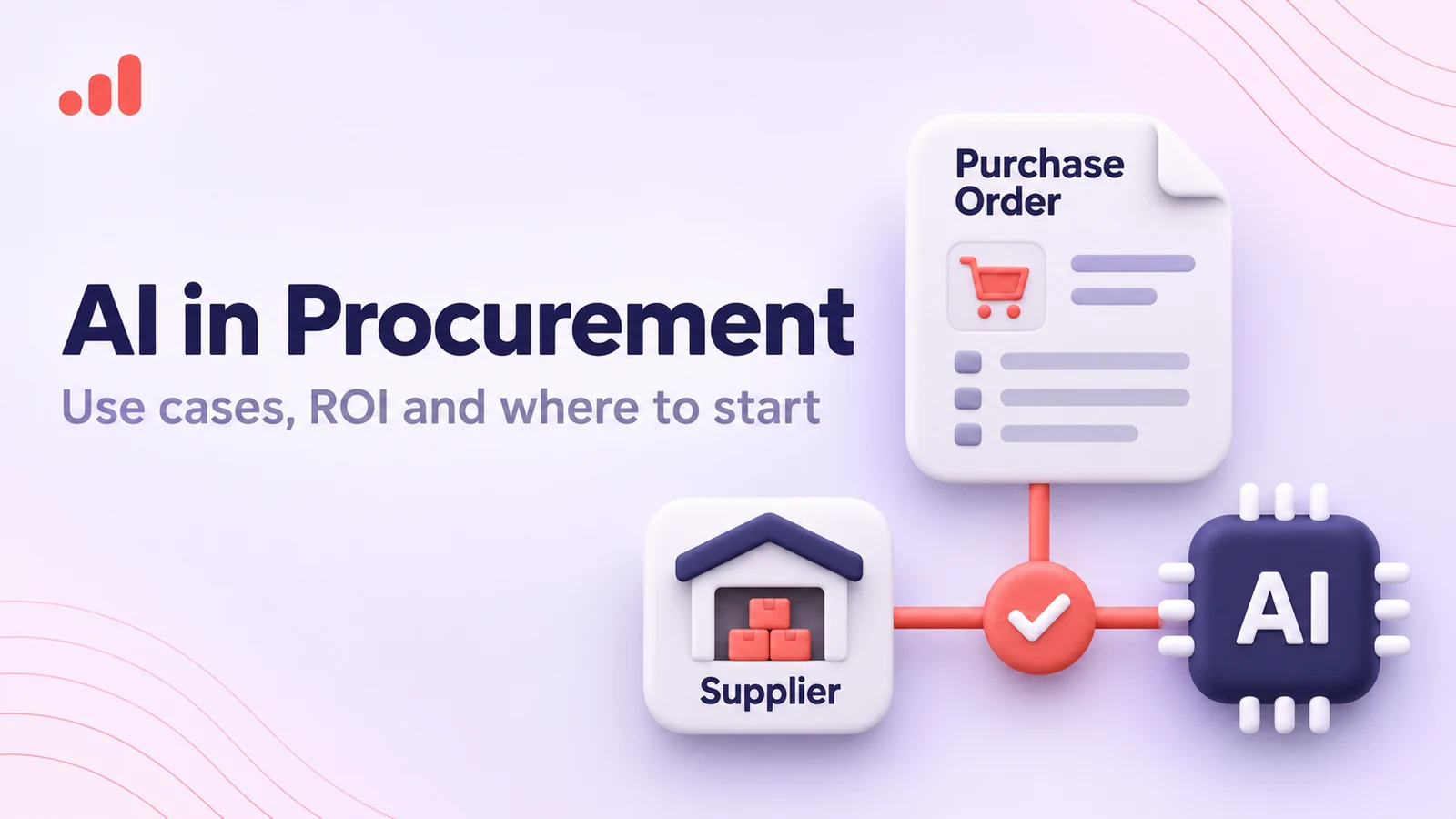
AI in procurement helps businesses analyze spending, compare supplier bids, review contracts, process invoices, and spot purchasing risks. The best place to start is usually a repetitive task with reliable data and a clear way to measure results. AI automation services can connect these workflows to existing systems without handing purchasing decisions over to software.
How is AI used in procurement?
AI helps procurement teams manage information and repetitive tasks throughout the source-to-pay process, from identifying suppliers and analyzing spending to reviewing contracts and processing invoices. Adoption is still early: in the Art of Procurement and HFS Research: State of AI in Procurement 2026, 15% of the 73 executives surveyed, mostly at large enterprises, said they had rebuilt procurement around AI, and 38% were still running pilots.
Traditional automation is good at following fixed rules. AI becomes useful when the work involves inconsistent documents, unstructured information, or exceptions that would otherwise need manual review.
Take invoice matching.
A conventional system can compare an invoice with a purchase order when the supplier names, reference numbers, and line items match exactly. But suppliers don't always use the same descriptions, formats, or terminology. An invoice might arrive as a scanned PDF, contain abbreviated product names, or reference several deliveries.
Those differences often send the document to an employee for review.
AI can extract the information, suggest likely matches, and flag discrepancies. Instead of checking every invoice manually, the team can concentrate on the transactions that need attention.
The same approach works in other parts of procurement.
Sourcing managers can organize supplier proposals without copying information into spreadsheets. Contract managers can locate renewal dates across hundreds of agreements. Procurement analysts can classify spending that would otherwise take days to sort through.
The technology is most useful when it removes work from an existing process rather than creating another system employees have to manage.
Which procurement tasks can AI automate?
The most practical applications tend to involve repetitive, document-heavy work. Procurement teams spend a surprising amount of time extracting information, comparing records, and following up on missing details. Much of that work can be streamlined.
Here are seven AI in procurement examples, from spend classification to supplier emails.
| Procurement task | What AI does | Data needed | Maturity | Human role |
|---|---|---|---|---|
| Spend classification | Categorizes transactions, standardizes supplier names, and identifies spending patterns | ERP transactions, supplier records, category taxonomy | Established | Validate categories and investigate exceptions |
| Supplier discovery and risk monitoring | Organizes supplier information and flags potential risk indicators | Supplier records, performance history, approved external data | Mixed: monitoring is established; autonomous discovery is emerging | Verify information and approve suppliers |
| RFP/RFQ drafting and bid comparison | Drafts requests, extracts proposal details, and organizes bids for comparison | Requirements, previous RFPs, supplier proposals, scoring criteria | Established for drafting and extraction; emerging for automated evaluation | Set criteria, review comparisons, and select suppliers |
| Contract clause extraction | Identifies payment terms, obligations, renewal dates, and unusual clauses | Contracts, approved templates, clause libraries | Established for extraction | Interpret terms and approve changes |
| Purchase order and invoice matching | Extracts invoice data, compares records, and flags discrepancies | Invoices, purchase orders, goods receipts, ERP/P2P records | Established | Resolve exceptions and authorize payments |
| Off-contract spend detection | Identifies purchases outside approved agreements or supplier lists | Transaction data, contracts, purchasing policies | Established with reliable data | Confirm exceptions and decide what action to take |
| Supplier emails | Drafts inquiries, reminders, and routine follow-ups | Supplier contacts, order status, approved templates | Established for drafting; autonomous follow-up is emerging | Review sensitive messages and manage relationships |
Maturity refers to the underlying technology, not the readiness of every product on the market.
Spend classification
Ask a procurement manager how much the company spends on a particular category, and the answer may be harder to find than expected.
The transaction data usually exists. The problem is that supplier names, product descriptions, and spending categories aren't consistent.
One department might record a purchase under office equipment, while another uses IT supplies. The same supplier may appear under several names.
AI can group similar transactions, suggest categories, and identify records that don't fit.
With cleaner spending data, procurement teams can see where purchases are fragmented, which suppliers account for the largest share of spending, and where consolidation might make sense.
For a mid-sized business, better visibility can be valuable even before more advanced automation is introduced.
Supplier discovery and risk monitoring
Finding and evaluating suppliers involves collecting information from different sources, checking its reliability, and comparing vendors against business requirements.
AI can organize supplier profiles, compare capabilities, and flag changes in delivery performance or other risk indicators.
But an automated alert isn't proof that a supplier is in trouble.
Outdated information, incorrect company matches, and unreliable external sources can produce misleading results. Procurement professionals still need to verify the findings and understand their commercial significance.
The same applies to broader supply chain risks. A supplier's financial position matters, but so do transportation constraints, production capacity, and the availability of alternative sources.
RFP and RFQ preparation
Preparing an RFP or RFQ often means gathering requirements from several departments, reviewing previous documents, and coordinating feedback.
Generative AI can help prepare a first draft from approved requirements, suggest relevant questions, and organize responses once suppliers submit their proposals.
It can also extract pricing, delivery terms, service commitments, and other details into a comparison table.
That saves buyers from manually transferring information between documents.
The final evaluation still belongs to the procurement team. AI shouldn't fill gaps with invented information, change scoring criteria without approval, or make supplier selection decisions on its own.
Contract review and management
Contract repositories often contain information procurement teams need but can't easily retrieve.
Payment terms, notice periods, renewal dates, and service commitments may be buried in lengthy agreements. Finding them manually becomes increasingly difficult as the contract portfolio grows.
AI can extract these details and organize them into searchable records.
Lenders already use the same AI document processing pattern in underwriting: extract the key terms, compare them against requirements and flag what needs a closer look.
An AI contract analysis tool can sit on top of the contract repository, pull notice periods and auto-renewal dates into one list, and alert the contract owner before each deadline.
Interpretation is where human expertise remains essential.
A clause may look unusual without being problematic. A standard-looking provision may carry significant commercial or legal consequences. AI can help locate the language, but procurement and legal teams should decide what it means.
Purchase order and invoice matching
Invoice matching is one of the clearest opportunities for procurement automation because the process has defined inputs and a measurable outcome.
Three-way matching compares three records:
- The purchase order, showing what the company ordered.
- The goods receipt or service confirmation, showing what was delivered.
- The invoice, showing what the supplier wants to be paid.
When the records agree, the invoice can move through the approved payment process. When they don't, someone needs to investigate.
AI invoice processing helps with the difficult part: extracting information from inconsistent documents, identifying likely matches, and highlighting exceptions.
The benefit isn't simply faster data entry. It's reducing the number of invoices employees need to examine manually while maintaining controls over duplicate invoices, pricing discrepancies, and payment approvals.
Off-contract spending
Negotiating favorable supplier terms is only useful if employees actually purchase under those agreements.
Off-contract spending happens when purchases are made outside approved contracts or preferred supplier arrangements.
AI can compare transaction data with supplier lists and contract information to identify possible exceptions.
Not every exception represents a problem. Emergency purchases, regional availability, and legitimate operational needs may explain why an employee used another supplier.
The system should help procurement investigate those purchases, not automatically label them as policy violations.
Supplier communication
Supplier follow-ups take more time than most teams realize.
Buyers regularly request delivery updates, missing documents, revised quotations, and order confirmations. Many of these messages follow a predictable format.
Generative AI can prepare emails using information from purchasing records. More advanced workflows can monitor outstanding requests and suggest follow-ups when a supplier hasn't responded.
Routine reminders are a reasonable candidate for automation. Price negotiations, contract disputes, and sensitive supplier relationships are better handled directly by procurement professionals.
What about generative and agentic AI in procurement?
Generative AI helps procurement teams create and analyze information. Agentic AI goes further by carrying out tasks across connected systems. The difference matters most when an AI system moves from preparing work to taking actions that affect suppliers, contracts, or company spending.
Where generative AI fits
Generative AI is useful for work that involves writing, summarizing, and comparing information.
Procurement teams can use it to:
- Draft RFPs and supplier correspondence.
- Summarize contracts.
- Compare bids against approved requirements.
- Prepare negotiation briefs.
- Explain internal purchasing policies.
- Summarize supplier performance reports.
The output still needs to be checked.
A tool might summarize five supplier proposals in seconds, but it could overlook an unusual payment condition or misunderstand an ambiguous pricing clause. Buyers need access to the original documents and a way to verify important details.
What can a procurement AI agent do?
An AI agent can handle a sequence of connected tasks instead of waiting for a separate instruction at every step.
Suppose a supplier hasn't confirmed a purchase order.
An agent could check the order status, review recent correspondence, draft a reminder, and update an internal task record.
With the right permissions, it might send a routine follow-up automatically.
Other possible applications include collecting quotations, tracking contract renewals, monitoring delivery updates, and preparing purchase requisitions.
These workflows are useful because they remove repetitive coordination work without necessarily giving the system authority over commercial decisions.
How much authority should an AI agent have?
There's a significant difference between an agent preparing a purchase requisition and approving an order.
Before allowing an agent to act independently, procurement leaders need to define:
- Which systems the agent can access.
- What information it can read or modify.
- Whether it can communicate directly with suppliers.
- Which spending categories and financial limits apply.
- Which actions require human approval.
- How activities are recorded and audited.
- How incorrect actions can be stopped or reversed.
For an initial project, keeping spending commitments subject to human approval is usually the safer option.
Cost matters too: what an AI agent costs to build depends mostly on integrations, testing and monitoring, and model usage and support add a running cost every month after launch.
What drives ROI from AI in procurement?
Procurement AI creates financial value when it reduces manual effort, shortens purchasing cycles, prevents errors, or helps recover savings that would otherwise be missed.
The strongest business cases start with the company's own numbers.
What does industry research tell us?
In its 2026 research on AI-first procurement, BCG discusses cost savings of 8% to 15% from AI-agent applications and models the potential to free up 60% of buyer capacity through broader workflow redesign.
These are BCG's reported figures and modeled opportunities, not results that every procurement team should expect. The research also points to the gap between AI's potential and what current implementations are actually delivering.
For a mid-sized company, a more useful forecast starts with its invoice volume, processing time, labor costs, error rates, and technology expenses.
Applying an industry percentage to the entire procurement budget may produce an impressive number, but it won't tell management whether a particular project is worth funding.
Time spent processing documents
Document handling is often the easiest place to measure potential savings.
Start by recording how long employees spend processing invoices, reviewing contracts, or comparing supplier proposals.
Suppose a procurement team handles 1,000 invoices per month and spends an average of eight minutes on each one.
That's roughly 133 hours of processing time.
If automation brings the average down to three minutes, the team could save approximately 83 hours per month.
But saved hours aren't automatically cash savings.
The financial benefit depends on whether the company reduces overtime or external processing costs, avoids additional hiring, or uses the capacity for other valuable work.
The calculation also needs to account for time spent reviewing AI outputs and handling exceptions.
Procurement cycle time
Cycle time measures how long a process takes from beginning to end.
For invoice processing, that might be the period between receiving an invoice and approving it for payment. For sourcing, it could be the time between an approved purchasing request and supplier selection.
Measure the current average or median cycle time, then compare it with the new process.
Look closely at where delays occur.
If AI cuts document preparation from two hours to ten minutes but the request still waits three days for approval, the overall improvement may be limited.
Savings leakage
Savings leakage happens when a company doesn't receive the full benefit of its negotiated purchasing arrangements.
Common examples include:
- Buying outside preferred supplier agreements.
- Missing contracted discounts.
- Paying incorrect invoice prices.
- Overlooking opportunities to consolidate purchases.
AI can help identify these discrepancies, but the financial benefit should only be counted when the company actually recovers or avoids the cost.
A potential saving isn't the same as a realized one.
Fewer processing errors
Manual procurement work creates opportunities for duplicate entries, mismatched records, incorrect classifications, and missed contract details.
Measure the current error rate and compare it with the automated process.
Include both the errors AI catches and any new mistakes it introduces.
An invoice system that works faster but incorrectly approves discrepancies may create more financial risk than operational value.
Early-payment discounts
Some suppliers offer discounts when invoices are paid within an agreed period.
If invoice processing is slow, the company may miss the deadline even when it has sufficient cash available.
Automation can help shorten the approval process and make more discounts accessible.
Measure the value of eligible invoices, the discounts available, and how much the company actually captures before and after implementation.
Finance should also confirm whether early payment makes sense given the organization's cash flow and working capital priorities.
How do you calculate procurement AI ROI?
A basic ROI calculation is:
ROI (%) = (Annual benefit − Annual project cost) ÷ Annual project cost × 100
Annual benefit should include verified labor or processing savings, recovered discounts, and avoided costs.
Project cost should include implementation, integration, licensing, training, monitoring, and maintenance. Each cost should be counted once.
| ROI driver | Baseline to collect | What to measure after launch |
|---|---|---|
| Document processing | Average minutes per document and monthly volume | Time saved after review and corrections |
| Cycle time | Time from request or receipt to completion | Change in average or median cycle time |
| Savings leakage | Verified pricing or contract discrepancies | Savings actually recovered or avoided |
| Error rate | Percentage of transactions requiring correction | Error rate after automation |
| Early-payment discounts | Available discounts versus discounts captured | Additional discounts captured |
| Operating cost | Labor, licenses, integrations, support, and maintenance | Total cost per successfully completed transaction |
A credible business case should include a conservative scenario. Assume adoption takes longer than expected and that some manual review will still be necessary.
If the project makes financial sense under those conditions, it's a stronger candidate for investment.
Will AI replace procurement teams?
AI is more likely to change procurement jobs than eliminate the need for procurement professionals.
Document extraction, spend classification, routine supplier communication, and other repetitive tasks are becoming easier to automate.
That leaves buyers with more time for work that requires experience and commercial judgment.
Instead of comparing hundreds of line items manually, they can investigate exceptions, manage supplier performance, negotiate better terms, and work more closely with the business.
Procurement involves more than finding the lowest price.
A supplier may offer attractive pricing but lack the production capacity, reliability, or service quality the company needs. Those trade-offs require context that an automated recommendation may not fully capture.
Should you use your procurement suite's AI or build your own?
Before investing in a new tool, look at what your existing ERP, purchasing, or procure-to-pay platform already offers.
Many procurement systems now include features for document extraction, spend classification, and workflow automation. If those capabilities meet your requirements, they may be the fastest and least complicated option.
Custom development becomes more attractive when the process involves several systems, unusual requirements, or business rules that standard software can't accommodate.
| Approach | Best for | Main advantage | Main limitation |
|---|---|---|---|
| Built-in procurement AI | Standard workflows within an existing platform | Faster implementation and fewer integrations | Limited customization |
| Specialist AI tool | Specific processes such as contract analysis or invoice processing | Focused functionality | Another vendor and integration to manage |
| Custom AI solution | Cross-system workflows and company-specific requirements | More control over data, logic, and approvals | Greater development and maintenance responsibility |
When is built-in AI enough?
If your procurement platform already handles invoice extraction, spend classification, or contract search reliably, start there.
Review the available features, data access, security controls, and licensing costs.
There may be no reason to introduce another application if the current system can already solve the problem.
When should you consider a specialist tool?
A specialist product may be appropriate when one procurement process is particularly demanding.
A company processing thousands of invoices, for example, might benefit from dedicated document processing software that integrates with its ERP.
Before buying, test how the tool handles exceptions and whether it supports your existing approval requirements.
A polished demonstration doesn't necessarily mean the product will work well with your actual data and processes.
When does custom development make sense?
Custom AI is worth considering when procurement work spans several disconnected systems or depends on company-specific rules.
Imagine a distributor that manages purchasing in one ERP, stores contracts in a separate repository, and handles supplier confirmations by email.
A custom workflow could retrieve the relevant information, identify missing confirmations, prepare follow-ups, and update internal records.
The value comes from connecting the process, not from building another standalone chatbot.
Custom development should be justified by the expected benefits, transaction volume, integration requirements, and long-term operating costs.
What is the checklist for a first AI procurement project?
A good first project has one clearly defined process, enough transaction volume to make automation worthwhile, accessible data, and a measurable outcome.
The rules for how to choose your first process to automate hold in procurement too: frequent work, stable rules and a result you can check. Procurement adds three questions of its own: system access, exception handling and financial controls.
Use this checklist before committing to a pilot.
| Checklist item | Question to answer | What to document |
|---|---|---|
| Process | Which workflow are we improving? | One defined process and its boundaries |
| Monthly volume | How often does the task occur? | Documents, transactions, or requests per month |
| Data access | Can the system retrieve reliable information? | ERP/P2P sources, permissions, formats, and data gaps |
| Owner | Who is accountable for the results? | Named procurement owner and technical support |
| Baseline | How does the process perform today? | Time, cycle length, error rate, or cost |
| Risk | What happens if the system makes a mistake? | Financial, contractual, privacy, and operational risks |
| Success metric | What would justify further investment? | Target improvement and acceptable error threshold |
| Timeframe | How long will testing take? | Start date, pilot period, review, and decision point |
Pick one process
"Automate procurement" is too broad for a first project.
Choose a specific task, such as:
- Extracting invoice information and flagging mismatches.
- Classifying uncategorized spending.
- Identifying renewal dates in supplier contracts.
- Preparing routine supplier follow-ups.
Look for work that happens frequently enough to produce useful test results but is narrow enough to manage safely.
Measure the current workload
Record how many transactions the team handles and how much time each one takes.
Include exceptions, corrections, and follow-ups.
If processing a document takes ten minutes but resolving issues adds another fifteen, both belong in the baseline.
Without that information, you won't know whether automation has actually improved the process.
Check the data
Identify where the information lives and whether the system can access it securely.
Invoice matching may require invoices, purchase orders, receiving records, and supplier data.
Contract analysis may require scanned agreements, document repositories, and approved clause libraries.
Look for missing fields, duplicate records, inconsistent formats, and access restrictions.
You don't need perfect data to begin, but you do need data that is reliable enough to test the workflow.
Assign responsibility
The procurement process owner should define what the system needs to do and how success will be measured.
IT or an implementation partner can manage integrations, technical testing, and security.
Finance, legal, or compliance may also need to participate when payments, contracts, or sensitive supplier information are involved.
A technically successful pilot can still fail if nobody owns the process after launch.
Define what success looks like
Choose one primary metric and a few supporting measures.
For invoice processing, the main metric might be average handling time per invoice.
Supporting measures could include extraction accuracy, exception rate, and cost per completed transaction.
Set an acceptable error threshold and identify the mistakes that would make the system unsuitable, even if it saves time.
Test the difficult cases
A six-to-eight-week pilot is a reasonable starting point for a contained workflow, assuming the necessary data and integrations are available.
Don't test only clean, straightforward transactions.
For invoice matching, include missing purchase orders, inconsistent supplier names, partial deliveries, duplicate invoices, and pricing discrepancies.
Keep human approval in place for payments and contractual commitments.
The system needs to work with the documents and exceptions your team actually encounters.
Review the results
At the end of the pilot, compare performance with the original baseline.
Did processing time decrease? Are there fewer errors? How much manual review remains? What does each completed transaction cost?
If the results support expansion, identify what needs to change before a wider rollout.
If they don't, find out whether the problem lies in the data, workflow, integrations, or technology.
A pilot that exposes a poor fit can still save the company money by preventing a larger investment in the wrong solution.
What goes wrong with AI in procurement?
Most procurement AI problems come down to poor data, disconnected systems, unclear processes, or giving automation more authority than it should have.
Inconsistent supplier and transaction data
Supplier records often contain duplicate companies, outdated contact details, inconsistent identifiers, and incomplete classifications.
AI can help identify some of these problems, but it can't reliably make up for missing or contradictory information.
Focus first on improving the data required for your chosen workflow. Trying to clean the entire procurement database before a small pilot may be unnecessary.
Systems that don't communicate
Procurement information is frequently scattered across ERP platforms, P2P tools, contract repositories, spreadsheets, and email.
A tool that can read an invoice but can't access the corresponding purchase order won't deliver the full benefit of matching automation.
Map the required integrations before selecting the technology.
Inaccurate or unsupported outputs
Generative AI can misread documents, invent missing details, or produce comparisons that look convincing but aren't supported by the original records.
In procurement, those mistakes can affect prices, contractual obligations, and supplier decisions.
Important outputs should be traceable to their source documents. High-impact decisions need appropriate human review.
Weak approval controls
Technical access shouldn't give an AI system authority to bypass purchasing rules.
Supplier onboarding, purchase approvals, payment instructions, and contractual commitments must follow established authorization procedures.
These controls should form part of the company's AI governance framework, alongside data permissions, monitoring, and accountability.
Supplier confidentiality and data security
Procurement systems hold commercially sensitive information, including negotiated prices, supplier agreements, financial details, and purchasing forecasts.
Before connecting an AI tool, establish what information it can access, where the data is processed, how long it's retained, and whether the provider uses it for model training.
Access permissions should reflect the rules already applied to the underlying procurement systems.
Automating a process that needs fixing
If a purchasing workflow has unnecessary approvals, unclear responsibilities, or inconsistent rules, AI may simply make those problems happen faster.
Fix obvious process issues before automating them.
The best first project isn't necessarily the one with the most manual steps. It's the one where the team understands how the work should happen and can measure whether the new approach is better.
No plan for production
A prototype may work well with a small sample of documents and struggle once it encounters real transaction volumes and exceptions.
Before moving into production, decide who will monitor accuracy, maintain integrations, update rules, handle failures, and support users.
A successful pilot is only the beginning. The system needs to remain reliable after the project team moves on.
How does RapidDev build procurement automation?
RapidDev, an AI development and integration company, helps businesses improve procurement workflows by connecting AI to the systems, data, and approval processes they already use.
The work starts with understanding where time is being lost or where information is difficult to manage.
For one company, the problem may be manual invoice handling. For another, it could be poor contract visibility, inconsistent spending categories, or supplier follow-ups that consume hours every week.
Each requires a different technical approach.
Depending on the project, RapidDev can help with:
Workflow assessment. Mapping the current process, identifying repetitive work, and establishing a baseline.
Document processing. Extracting information from invoices, contracts, quotations, and other procurement documents.
ERP and P2P integrations. Connecting AI workflows to purchase orders, supplier records, transaction data, and existing approval systems.
Supplier communication. Automating routine inquiries, reminders, and status updates within defined limits.
Exception handling. Routing mismatches, incomplete records, and sensitive decisions to the right people.
Custom AI agents. Building agents that carry out specific tasks across approved systems, with clear permissions and approval controls.
Testing and monitoring. Measuring accuracy, processing time, exception rates, and operating costs before and after deployment.
Not every project needs a custom AI agent. Sometimes configuring existing software or connecting tools the business already uses is enough.
For a mid-sized procurement team, the first worthwhile result may be relatively simple: fewer hours spent processing documents, faster resolution of exceptions, or a clearer view of company spending.
Once that improvement is measurable, there's a stronger case for expanding automation into other parts of procurement.
FAQs
Is procurement going to be replaced by AI?
AI is unlikely to replace procurement as a business function, but it will change how procurement teams spend their time.
Document extraction, spend classification, and routine supplier communication are increasingly suitable for automation.
Negotiation, supplier relationship management, commercial judgment, and complex risk decisions still require experienced professionals.
The bigger shift is away from manual processing and toward managing exceptions, supplier performance, and strategic purchasing decisions.
Which AI is best for procurement?
The right technology depends on the task.
Machine learning works well for spend classification and anomaly detection. Document AI can extract information from invoices and contracts. Generative AI is useful for drafting sourcing documents and summarizing supplier information.
Agentic AI may be appropriate when a workflow involves several connected actions across different systems.
Most source-to-pay suites now ship their own AI procurement tools, such as SAP's Joule agents in SAP Ariba and Coupa's Navi agents, so check what your current platform already does before buying or building anything new.
Can I use AI to handle procurement services?
Yes. AI can support sourcing preparation, supplier communication, contract review, spend analysis, and invoice processing.
The level of automation should depend on the risks involved.
Routine document handling and follow-ups can often be automated extensively. Supplier selection, purchase approvals, contractual commitments, and payment decisions require stronger controls and appropriate human authorization.
What is the 80/20 rule in procurement?
The 80/20 rule suggests that roughly 80% of purchasing spend may be concentrated among 20% of suppliers or categories.
It's a common rule of thumb, not a fixed formula.
The remaining long tail of smaller suppliers and purchases can create a substantial administrative burden. AI can help classify those transactions, identify repeated buying patterns, and reveal opportunities for consolidation.
What data do you need to start using AI in procurement?
It depends on the process.
Invoice matching typically requires invoices, purchase orders, receiving records, and supplier information.
Spend classification needs transaction history, supplier records, and an agreed category structure.
Contract analysis requires accessible agreements and clear rules for the information being extracted.
The data doesn't have to be perfect, but it must be accurate, accessible, and representative enough to support reliable testing.
Invoice matching and contract review are where our AI automation services usually start in procurement, because both have a clear baseline and a result finance can check.
If you're considering a project using your own procurement data, book a free AI strategy call to discuss your requirements and find a practical place to start.