


June 24, 2026
•
8
min read

Product, Process, or Coordination? How to Diagnose What's Slowing Growth
Growth slowdowns are usually misdiagnosed. Learn whether product, process, or coordination is your real bottleneck, plus a quick self-assessment to find it.
Something changes once a company finds traction, and most founders feel it before they can name it. The scrappy speed that got you here starts to thin out. A feature that used to ship in two weeks now takes six, and nobody can say why. Work that used to flow now waits on three other things first. You've added people, which should have helped. Yet output somehow feels slower than it did at half the size.
The instinct is to reach for the obvious lever. More features. More headcount. Push harder. But the thing actually slowing you down usually hides somewhere less visible. It lives in how work moves, not in the work itself. Operational bottlenecks don't send up a flare. They sit quietly in the gaps between systems and teams, draining a little velocity at a time. Then one quarter the growth chart flattens, and everyone starts asking what happened.
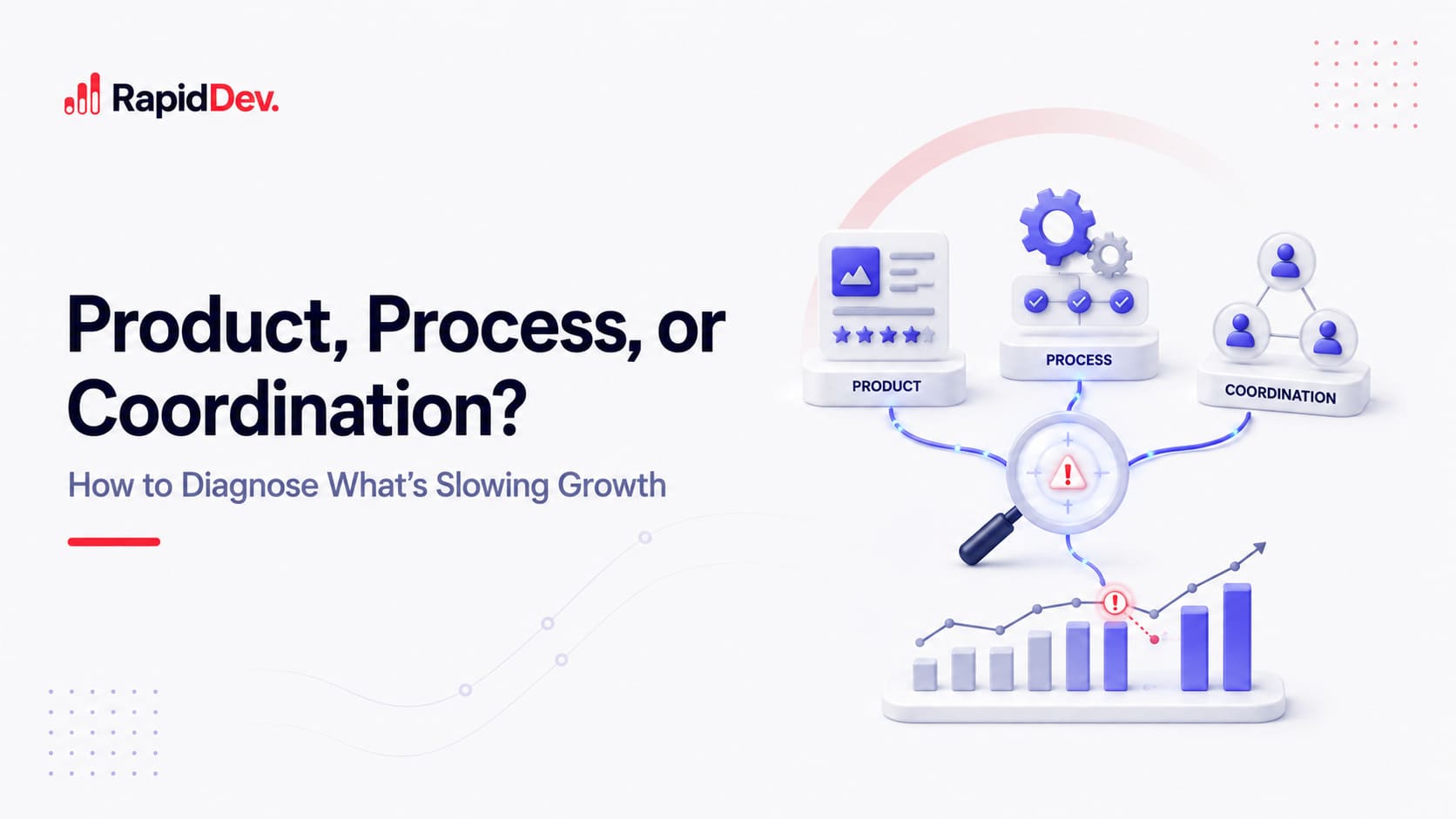
The fix starts with diagnosis. You can't unblock a slowdown until you know what kind it is. In practice, operational bottlenecks tend to land in one of three buckets: product, process, or coordination. They look different on a Tuesday afternoon, and they call for completely different responses. Get the diagnosis wrong and you'll spend real money making the problem worse. Most teams skip this step entirely, which is why so many operational bottlenecks go unsolved for quarters.
So here's what each one looks like on the ground. We'll cover why smart teams misread them so often, and a quick way to figure out which is biting you hardest right now.
Why operational bottlenecks only show up after traction
In the early days, a small team can brute-force almost anything. Five people in one room don't need process. Everybody knows what everybody else is doing. The hard calls get made over lunch, and most of the company's context lives in two or three people's heads.
Then you grow. The team doubles, and doubles again. The informal habits that felt effortless at ten people start to groan at forty. That's when operational bottlenecks surface. Not because anyone got worse at their job. The old way of running things simply can't stretch any further. What looked like natural speed was really the absence of friction. Scale adds friction in every direction at once: more handoffs, more dependencies, more people to loop in before anything moves.
None of that means you're failing. It means you've outgrown the operating model that got you here, which is a good problem wearing a frustrating disguise. The real question is which part of the model buckled first.
Signs of a product bottleneck
Product-related operational bottlenecks mean the product itself has become the slow step. Building it, shipping it, and improving it is where the time goes, and no amount of process tidying changes that.
On the ground it tends to look like this:
- Engineering slows to a crawl because the codebase is tangled, and every change carries a real risk of breaking something three modules away.
- The roadmap keeps slipping, and not because of politics. The technical work just genuinely takes longer than anyone planned.
- Bugs come in faster than the team clears them, so a chunk of every sprint disappears into firefighting instead of building.
- Customers keep asking for things the current architecture can't support without a serious rebuild.
- A new engineer takes three or four months to ship anything meaningful, because the system takes that long to understand.
When the product is the constraint, the pain clusters right at the build. The team usually knows what to do and who owns it. The doing is just slow. Of the three operational bottlenecks, this is often the easiest to spot. The symptoms point straight at the usual suspects: technical debt, an architecture that was right two years ago, or tooling that never kept pace with the product's complexity.
Signs of a process or systems bottleneck
Process-related operational bottlenecks are sneakier, and they fool a lot of capable teams. The product works. The people are good at their jobs. Yet everything still moves at half speed. The systems connecting the work are either broken or were never built in the first place.
The patterns usually show up like this:
- A routine task passes through four sets of hands before it's done, and each handoff adds a day of waiting.
- Reporting is scattered across a dozen spreadsheets and three dashboards that disagree with each other, so nobody trusts any single number.
- Smart, expensive people spend their afternoons copy-pasting between tools that software should have connected months ago.
- A basic question like "how many deals closed last week" takes two days and four Slack threads to answer.
- The same status meeting repeats every Monday, mostly to reconstruct where things even stand.
These operational bottlenecks come from execution systems that never scaled alongside the company. A workflow one person ran in their head falls apart the moment it has to cross four departments. Manual workarounds pile up, each one reasonable on its own. Eventually the team spends more energy managing the process than doing the work the process was meant to enable. This is usually the point where teams bring in workflow automation to replace the manual stopgaps that quietly multiplied.
The giveaway is the gap between effort and output. Everyone's busy, some people are fried, and the results still don't match the hours going in. Of all the operational bottlenecks, this one hides the longest, because everybody looks productive while it's happening. That mismatch almost always points at process and tooling, not talent. We saw a clear version of this with WorldVia, a host agency whose business had the momentum to scale but whose infrastructure couldn't keep up, until the underlying systems were rebuilt to carry the growth.
Signs of a coordination bottleneck
Coordination-driven operational bottlenecks live in the space between teams instead of inside any one of them. Each function can be firing on all cylinders, and the work still falls apart in the handoffs between them.
You'll know it by symptoms like these:
- Ownership is fuzzy, so a critical piece of work sits untouched for a week while three teams each assume another one has it.
- Product ships a genuinely strong feature, but nobody else was ready. Sales didn't know it was coming, support wasn't trained, and marketing had nothing prepared, so the launch lands with a thud.
- A cross-functional project crawls for a month because no single person has the authority to push it across the line alone.
- Two teams want opposite things, and the only way to settle it is to drag a founder into the room. Again.
- A decision gets made on Thursday and quietly comes undone by the following Wednesday, because the people who needed to agree never actually did.
This is the hardest of the three to diagnose, because every part looks healthy on its own. Engineering ships. Marketing runs campaigns. Sales closes. And growth still stalls, because the connective tissue between functions is thin. Coordination operational bottlenecks are tricky precisely because no single dashboard shows them. Strong work inside each team adds up to very little without strong follow-through across them.
Coordination problems also compound the fastest as you grow. More teams means more dependencies, and more dependencies means more places for good work to sit waiting on someone else. Anyone working out how to scale a SaaS company past its first real growth phase tends to hit this wall. It usually shows up right after a hiring spree that was supposed to fix everything. Fixing it is less about more software and more about adoption and operational alignment across the teams involved.
What happens when teams misdiagnose operational bottlenecks
This is where it gets costly. A misread bottleneck doesn't just stay unfixed. It quietly punishes every resource you throw at it, which is what makes misdiagnosed operational bottlenecks so dangerous.
Take a team stuck on coordination. Launches keep landing flat because the functions aren't aligned before release. Leadership looks at the flat launches, decides the product isn't compelling enough, and leans on engineering to ship more. So engineering ships more. The pile of poorly coordinated launches grows taller, and the real problem deepens while everyone works longer hours convinced they're fixing it. Of all the operational bottlenecks, this misread is the most common one we see.
Or picture a process bottleneck read as a staffing shortage. Output feels thin, so the company hires hard for two quarters. But dropping new people into a broken workflow just manufactures more handoffs and more overhead. Now payroll is up, output per person is down, and you've hit the oldest trap in scaling: more people, slower execution. I've watched companies do this twice in a row before anyone questioned the premise.
That's the whole case for diagnosing before acting. Effort pointed at the wrong constraint doesn't stall out neutrally, it backfires. You burn budget and wear out the team. You chip away at everyone's faith in leadership's read on the business, all while the real bottleneck sits exactly where it was. Naming your operational bottlenecks correctly is the line between progress and very expensive motion.
A quick self-assessment: find your primary operational bottleneck
Run down these three lists and check anything that sounds like your company this quarter. Whichever group collects the most checks is probably your primary bottleneck. Be honest rather than generous.
Product signals
- Shipping anything new takes noticeably longer than it did a year ago.
- People route around certain parts of the codebase because they're too fragile to touch.
- Customer requests die on technical limits, not on prioritization calls.
- New hires take months, not weeks, to contribute real work.
Process and systems signals
- Work changes hands too many times before it's finished.
- Reporting is scattered, and there's no single source anyone trusts.
- Capable people do manual work that obviously should be automated.
- Everyone's slammed, but the output doesn't reflect the effort.
Coordination signals
- Ownership of important work is unclear or actively contested.
- Launches fall flat because teams weren't aligned beforehand.
- Cross-team projects stall without a founder pushing them along.
- Strong individual work isn't adding up to strong company results.
If your checks pile up in one column, that's your starting point. If they're spread evenly across all three, begin with whichever is costing you the most growth right now. Work down from there. You can't fix everything at once, and the teams that try usually fix nothing.
Start with the right diagnosis
Slowdowns feel urgent, and urgency pushes you toward the fix you can see. Build more. Hire more. Grind harder. But the constraint doing the real damage is often the quiet one, sitting in how work moves through the company rather than in the work itself.
Getting the name right is most of the job. Once you know whether product, process, or coordination is the actual ceiling, the path clears. You can point your time and money at the thing that will genuinely get growth moving again, instead of the thing that merely feels productive. That single diagnostic step saves more operational bottlenecks than any amount of raw effort.
If it would help, we can map where your operational bottlenecks are showing up first and what to tackle next. At RapidDev, we help scaling teams untangle this exact knot, building the systems, internal tools, and automations that turn slow, dependency-heavy execution back into momentum. In our experience, most of what looks like a product problem turns out to be process or coordination underneath. Book a call and we'll help you find the constraint worth fixing first.