

November 18, 2026
•
22
min read

Private LLMs: When to Run AI on Your Own Infrastructure, and What It Costs
When a private LLM makes sense, how VPC, on-premise and local setups compare, and what drives cost. Book a free AI strategy call to scope your setup.
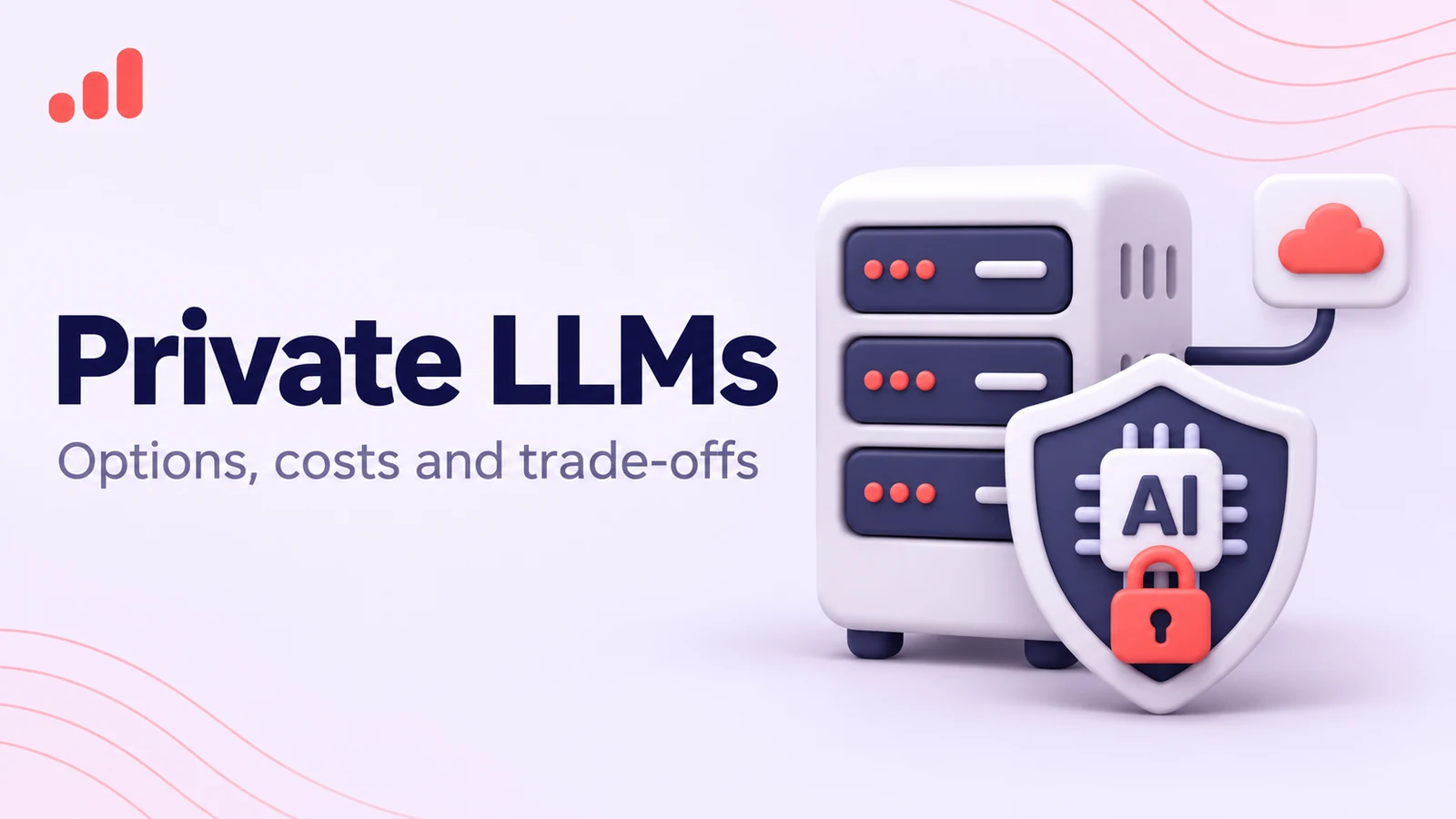
A private LLM runs in an environment your business controls, whether that's a private cloud, an on-premises server, or a local device. It gives you more say over where data goes and how the model operates, but it also brings infrastructure costs and maintenance responsibilities. RapidDev's AI app development team helps businesses determine when private deployment is worth it.
What is a private LLM?
A private LLM is a large language model deployed in an environment where a business controls access, infrastructure, and data-handling policies. This guide covers business deployments, not the consumer app called Private LLM.
It might run on servers in your office, inside your company's cloud account, or directly on an employee's device.
What matters is how much control your organization has over the model and the information it processes.
With a typical hosted AI service, your application sends a request to the provider's servers. The provider runs the model and sends back a response.
With a self-hosted LLM, your company operates the model-serving environment.
That gives you more control over network access, logging, data retention, and integrations. It also means your team is responsible for keeping the infrastructure running.
Does a private LLM have to run on your own servers?
No. A private LLM doesn't have to sit in your office or data center.
Many businesses run models on cloud GPUs inside an environment they manage. Others use dedicated on-premises hardware. Smaller models can run on individual workstations or supported devices.
Each option comes with trade-offs.
Cloud infrastructure is easier to expand when demand grows. On-premises hardware gives you more direct control over the equipment. Local models can work without sending every request to a remote service.
The right choice depends on your security requirements, expected usage, and budget.
Private LLM vs. self-hosted LLM: what's the difference?
The terms overlap, but they aren't quite interchangeable.
A self-hosted LLM is a model your organization operates on infrastructure it controls.
A private LLM is a broader term that can also describe managed deployments with strict access and data-handling controls.
For example, a model running on GPUs inside your cloud account is self-hosted.
A managed model accessed through an approved private cloud connection might satisfy your company's privacy requirements without requiring your team to operate the model itself.
That distinction becomes important when you compare costs.
Why do companies want a private LLM?
Businesses consider private LLMs when they need tighter control over sensitive data, infrastructure, access permissions, or how their AI applications work.
Privacy is usually the reason the conversation starts, but it isn't the only consideration.
Keeping sensitive information under company control
Some AI applications need to process information that a business doesn't want to send to an outside provider.
That could include customer records, financial reports, confidential contracts, product designs, or internal research.
A private deployment can keep model inference inside an approved environment.
But the model is only part of the picture.
If your application sends documents to an external processing service or forwards logs to a third-party platform, information may still leave your network.
You need to look at the entire system, not just where the model runs.
Meeting data residency requirements
Companies operating across different countries may have rules about where certain information can be stored or processed.
Running a model in a specific cloud region or on-premises environment can give the business more control over data location.
That doesn't automatically resolve every legal or regulatory question.
Backups, support access, subprocessors, and cross-border transfers still need attention.
Operating in restricted networks
Some organizations need AI systems that work without access to the public internet.
That might be necessary for sensitive research, industrial environments, or systems subject to strict internal security policies.
An on-premises deployment can support that requirement.
The downside is that software updates, security patches, and model upgrades become more complicated when the environment is isolated.
Customizing the model and infrastructure
Self-hosting gives engineering teams more flexibility.
They can choose a suitable open-weight model, configure how it runs, control the serving infrastructure, and integrate it with internal systems.
Depending on the model and license, they may also be able to fine-tune it for a specific task.
That level of control is valuable when the application has requirements that a managed service can't accommodate.
Managing high-volume workloads
Some companies prefer dedicated infrastructure because they expect a steady volume of AI requests.
If a model is busy throughout the day, running it on reserved compute capacity may eventually cost less than paying per API request.
But that isn't guaranteed.
Dedicated hardware costs money even when nobody is using it, and someone has to maintain it.
Do you actually need a private LLM?
Not necessarily. Many businesses can meet their security and privacy requirements without running a model themselves.
Before buying hardware, find out exactly what your organization needs to protect against.
Will an enterprise AI provider train on your data?
This is one of the first questions companies ask.
They don't want confidential documents, customer information, or internal conversations used to train models for other customers.
Enterprise AI services often have different data-use terms from consumer products.
For example, OpenAI's enterprise privacy page states that data from covered business offerings isn't used to train models by default.
That doesn't mean all providers follow the same rules, or that no information is ever retained for operational purposes.
You still need to review the agreement, retention settings, and controls for the specific service you plan to use.
What does zero data retention mean?
Some enterprise API arrangements offer zero data retention for eligible services and use cases.
This can reduce the amount of customer content stored by the provider.
But zero retention doesn't mean zero external processing.
The provider still needs to process the request to generate an answer.
If your policy prohibits sending the information outside your environment at all, a hosted API may not be an option.
Can a contract solve the privacy problem?
Sometimes.
A data processing agreement (DPA) can establish how a provider handles personal data and what responsibilities it accepts.
In healthcare, a business associate agreement (BAA) may be necessary when a vendor processes protected health information on behalf of a covered entity or business associate.
The details depend on the service and the data involved.
A contract also needs to match the technical setup. A signed agreement won't help if employees are using an unapproved service or sending data through an insecure integration.
When is self-hosting the right choice?
Self-hosting deserves serious consideration when your company:
- Cannot allow certain data to leave its approved infrastructure.
- Needs an AI system that works in an isolated network.
- Has strict data residency or processing requirements.
- Needs model configurations unavailable through approved managed services.
- Wants direct control over inference infrastructure.
- Has enough predictable usage to justify dedicated compute capacity.
If none of these apply, a managed enterprise service may be easier and less expensive.
If you're unsure, book a free AI strategy call before committing to hardware. It's worth confirming whether self-hosting is actually required.
What are your private LLM deployment options?
Businesses can choose between enterprise APIs, managed cloud models, self-hosted cloud GPUs, on-premises servers, and local devices.
The main differences are where data is processed, who maintains the infrastructure, and how costs are charged.
| Deployment option | Does data leave your network? | Setup effort | Cost profile | Model quality | Best for |
|---|---|---|---|---|---|
| Enterprise API with eligible zero-data-retention terms | Yes, the provider processes requests | Low to moderate | Usage-based API pricing | Access to capable commercial models | Businesses that can allow external processing under approved terms |
| Managed cloud model through AWS Bedrock, Azure, or Vertex AI | Depends on the service and configuration | Moderate | Managed inference and cloud service charges | Depends on the available models | Teams wanting enterprise cloud controls without managing model servers |
| Open-weight model on cloud GPUs | Can stay within your configured cloud environment | High | GPU usage, storage, networking, and maintenance | Depends on the model and configuration | Businesses needing more control over model serving |
| On-premises GPU servers | Can remain on your internal network | Very high | Hardware, power, cooling, maintenance, and staff | Depends on hardware and model selection | Restricted environments and strict infrastructure requirements |
| Local or on-device model | Can operate entirely on the device | Low for individual use; higher across an organization | Device hardware and management | Limited by available device resources | Offline tools and smaller workloads |
Enterprise APIs
Enterprise APIs are often the quickest way to launch an AI application.
The provider handles model infrastructure and scaling. Your team builds the application, manages access, and connects it to the systems employees already use.
The trade-off is that requests still go to an outside provider.
Managed models in your cloud environment
Services such as AWS Bedrock, Azure AI, and Google Vertex AI provide managed access to models with enterprise cloud controls.
They can reduce the work involved in operating your own inference servers.
However, processing locations, retention terms, and network isolation features vary.
A private endpoint doesn't necessarily mean the model runs inside your VPC. Your security team should review the service architecture before approving it.
Self-hosted models on cloud GPUs
This option gives your team direct control over model serving.
You choose an open-weight model, provision GPUs, configure the inference software, and manage deployment.
Cloud infrastructure is more flexible than buying hardware, but GPU availability and ongoing costs still matter.
On-premises LLMs
An on-premises LLM runs on servers your organization owns or controls.
This can be a good fit when external processing is prohibited or the company already has suitable data center infrastructure.
But you're also responsible for capacity, maintenance, backups, monitoring, and hardware failures.
For many businesses, operating the system is harder than getting the model running in the first place.
Local and on-device models
Smaller models can run on laptops, workstations, and other supported devices.
They're useful for offline tools or focused tasks that don't require a large model.
The limitations are usually memory, processing power, and performance.
Running a model on one employee's laptop is relatively straightforward. Managing the same setup across hundreds of devices is another matter.
Which models can you run privately?
Private LLM deployments generally use open-weight models that permit local inference under their licenses.
Common options include Llama, Qwen, Mistral, Gemma, and Phi.
| Model family | Available sizes | License considerations | Good for |
|---|---|---|---|
| Llama, including Llama 4 Scout | Multiple sizes and architectures | Llama 4 Community License; companies above 700 million monthly active users need a separate license from Meta | General-purpose assistants and larger deployments |
| Qwen | Small through large models, including specialized versions | Apache 2.0 for current open releases (Qwen3, Qwen3.5); the Max and Plus tiers are API-only | Multilingual tasks, coding, and business assistants |
| Mistral | Compact and larger models | Apache 2.0 for current releases such as Mistral Small 4 and Mistral Large 3; some older models use other terms | Enterprise applications and specialized workflows |
| Gemma, including Gemma 3 | Smaller and larger variants | Apache 2.0 from Gemma 4 (April 2026); Gemma 3 and earlier use Google's Gemma terms | Local inference and resource-conscious deployments |
| Phi | Primarily compact models | MIT license for Phi-4 and its variants | Focused tasks and environments with limited resources |
Licenses checked in November 2026. Confirm the terms for the exact checkpoint you deploy, since they can differ between versions of the same family.
Open-weight doesn't always mean open source
An open-weight model makes its trained weights available under certain conditions.
That doesn't necessarily mean its training data, source code, or license meets every definition of open source.
Some models restrict redistribution or particular types of use.
Review the license before building a commercial product around a model.
How should you choose a model?
Start with what the application needs to do.
A model that's strong at general conversation may not be the best choice for document extraction, classification, coding, or multilingual support.
Test candidates against your actual tasks.
Look at accuracy, latency, context requirements, supported languages, hardware needs, licensing, and maintenance.
You can compare model limits and pricing to narrow the options before investing in a deployment.
Don't assume the largest model is the best investment.
For a narrowly defined business task, a smaller model that performs reliably may be all you need.
What hardware does a private LLM need?
Hardware requirements depend on the model's size, memory needs, context length, and how many requests it must handle simultaneously.
A model used occasionally by a small internal team needs a very different setup from one serving hundreds of employees all day.
Start with GPU memory
Most production LLM deployments use GPUs because they're well suited to the calculations involved in inference.
GPU memory, or VRAM, is one of the first constraints.
The model's weights need to fit in available memory, along with the additional memory required during inference.
Larger models generally need more memory.
Longer prompts and more simultaneous requests can increase requirements further.
That's why it's better to size the hardware around the workload rather than choose a GPU first and hope it's enough.
Can quantization reduce hardware costs?
Yes. Quantization reduces the precision used to represent model weights and, in some cases, other values.
That can lower memory requirements and make a model practical on less expensive hardware.
The trade-off is that reduced precision may affect performance or output quality.
For many applications, it's worth testing a quantized model before investing in additional GPUs.
How many people will use the system?
Concurrency matters more than many teams expect.
A model might respond quickly when one person uses it, then slow down considerably when dozens of requests arrive together.
Capacity planning should account for:
- Average and peak request volume.
- Input and output lengths.
- Expected response times.
- Concurrent users.
- Memory requirements.
- Availability and redundancy.
- Future growth.
The right configuration depends on actual usage patterns, not just the total number of employees.
What software runs the model?
You also need an inference server to load the model, manage requests, and make it available to your application.
One option is vLLM, an open-source engine for serving language models.
The vLLM documentation shows it can expose an OpenAI-compatible API, so an application built against a hosted API can often switch to a self-hosted model with few code changes.
Production systems may also need authentication, load balancing, monitoring, logging, and automated deployment.
Getting a model to answer a prompt is a useful first step. Keeping it available and responsive in production takes more work.
How much does a private LLM cost?
Private LLM costs depend on compute capacity, model size, user demand, security requirements, and the people needed to maintain the system.
There's no useful one-size-fits-all price.
A small internal assistant and a business-critical application serving thousands of requests have very different budgets.
Cloud GPU costs
If you self-host in the cloud, GPU usage is likely to be one of your largest expenses.
Costs depend on the GPU type, number of instances, uptime, and workload.
A model that needs to remain available around the clock may generate infrastructure charges even when usage is low.
Storage, networking, backups, and other cloud services add to the bill.
Autoscaling can help in some cases, but it doesn't eliminate the cost of running the system.
On-premises hardware
An on-premises deployment involves purchasing or leasing servers with suitable GPUs, memory, storage, and networking equipment.
Then you need to pay for electricity, cooling, maintenance, and eventual hardware replacement.
This can make sense if your company already operates a data center or has strict infrastructure requirements.
For a business starting from scratch, the upfront investment may be difficult to justify.
Engineering and maintenance
Someone needs to keep the system running.
That means installing models, configuring inference servers, managing access, monitoring performance, applying updates, and troubleshooting failures.
If employees depend on the application for daily work, you'll also need a plan for outages and recovery.
These costs are easy to overlook when the initial conversation focuses on GPU prices.
Security and compliance
Private deployments may need encryption, identity management, audit logging, network segmentation, vulnerability management, and formal security testing.
The exact requirements depend on the company and the information being processed.
Healthcare and financial services often have additional considerations.
In custom healthcare software development, for example, teams need to consider how applications handle protected health information.
Similar questions about access, data residency, and oversight come up in custom fintech software development.
If you plan to use a hosted tool instead, start with our HIPAA compliance checks for AI tools before any patient data goes into it.
When does self-hosting become cheaper than an API?
Self-hosting can become attractive when usage is high and predictable.
Commercial APIs generally charge based on the tokens processed.
Self-hosting is different. You pay for compute capacity and operations, even when the model isn't busy.
For an application with occasional requests, an API may be considerably cheaper.
For one handling a steady stream of requests throughout the day, dedicated infrastructure may become competitive.
But compare the complete costs.
If a self-hosted model makes more mistakes, requires extra retries, or needs frequent human correction, the savings may disappear.
And if you're building agents around the model, hardware is only part of the budget. Monitoring, evaluation and integration upkeep are the running costs most teams leave out when they budget an agent.
How should you estimate your budget?
Start with expected usage.
Estimate daily requests, average input and output lengths, peak concurrency, and response-time requirements.
Then test candidate models against representative tasks.
Use those results to estimate infrastructure needs and compare them with a managed API alternative.
Include development, security, monitoring, maintenance, and future capacity.
Don't buy hardware based on a model's parameter count alone.
Private LLM vs. ChatGPT Enterprise: what's the difference?
The biggest difference is who operates the model.
ChatGPT Enterprise is a managed business AI service. A self-hosted private LLM runs on infrastructure your organization manages.
Both can be appropriate for business use, depending on the information involved and the company's requirements.
Data privacy
ChatGPT Enterprise provides business-oriented privacy and security controls, but information is still processed through OpenAI's infrastructure.
A self-hosted model can keep inference inside an environment your organization controls.
That matters if your policies prohibit external processing.
It doesn't automatically make self-hosting safer.
Model capabilities
Managed enterprise services provide access to capable models without requiring you to operate the underlying infrastructure.
Self-hosting lets you choose from supported open-weight models and configure how they run.
The trade-off is that models differ in reasoning, coding, language support, and other capabilities.
You need to test the models against your own workload.
Maintenance
With ChatGPT Enterprise, the provider handles the model infrastructure.
Your company still manages users, permissions, policies, and connected business information.
With a self-hosted LLM, your team also manages serving, capacity, updates, availability, and troubleshooting.
That can be a significant commitment.
Customization
Self-hosting may provide more flexibility over model selection, inference settings, and fine-tuning.
Managed enterprise services offer their own configuration and integration features, subject to the provider's capabilities and terms.
If your application needs specialized knowledge or behavior, you may also need retrieval or model adaptation.
Where the model runs is only one part of that decision.
Which option makes more sense?
A managed enterprise service is often the better starting point for companies that want AI capabilities without operating their own infrastructure.
Self-hosting becomes more compelling when external processing isn't allowed, specialized controls are required, or the workload justifies dedicated compute.
Neither option is universally better.
Can AI agents run on a private LLM?
Yes. Private AI agents can use self-hosted models to understand requests, retrieve internal information, and work with approved business systems.
For example, an internal support agent could search company documentation, retrieve account details, and prepare service requests.
The model could run on company-controlled infrastructure while the application connects to internal tools.
But keeping the model private doesn't necessarily keep the entire workflow private.
External APIs, monitoring services, document processors, and connected applications may still transmit information outside the approved environment.
Agents also need strict permissions.
An agent that reads a document is very different from one that changes financial records or approves transactions.
Private deployment doesn't replace authentication, approval rules, or audit logs.
How does RapidDev build private AI systems?
RapidDev, an AI development and integration company, helps businesses evaluate private AI requirements, select suitable models, and build applications around their existing infrastructure.
The first question is whether the company actually needs to run its own model.
Some organizations do. Their data can't leave an approved environment, their systems must work offline, or their applications need controls that managed services don't offer.
Others can meet their requirements with a secure enterprise API or managed cloud model.
That decision should come before buying hardware.
Reviewing security and data requirements
The team starts by understanding what information the application will process.
That includes data sensitivity, access permissions, retention rules, approved processing locations, and relevant policies.
It also means looking at how information moves between the model, application, databases, and connected services.
This helps determine which deployment options are acceptable.
Choosing the model
Once the requirements are clear, candidate models can be tested against the actual work.
That might include document analysis, classification, summarization, internal knowledge questions, or other specialized tasks.
The comparison should cover accuracy, latency, throughput, licensing, hardware requirements, and cost.
The goal isn't to choose the biggest model. It's to find one that performs the job reliably.
Designing the infrastructure
Depending on the requirements, RapidDev can help plan a private cloud deployment, an on-premises setup, or an application using approved managed model services.
The architecture may include model-serving infrastructure, secure APIs, authentication, monitoring, and integrations with existing business systems.
Applications that work with internal documents may also need retrieval.
The design should fit the company's security policies and technical resources.
Building the application
A language model alone isn't a complete business tool.
Employees need an interface they can use, access to the right information, and workflows connected to their existing systems.
Development may involve frontend and backend services, document processing, retrieval, and software integrations.
The model is one part of the application, not the entire product.
Testing before launch
Before production, the system needs to be tested with realistic inputs and workloads.
That includes output quality, response times, concurrency, permissions, and failure handling.
Security controls and monitoring should be in place before employees start processing sensitive information.
The company also needs a plan for maintenance after launch.
Setting up governance
Self-hosting puts more responsibility on your organization.
You'll need policies for model access, data handling, approved uses, monitoring, and incident response.
The NIST AI Risk Management Framework organizes that work into four functions (Govern, Map, Measure, Manage), which a self-hosting team can use as its checklist.
Self-hosting doesn't remove the need for AI governance best practices; it moves the work in-house, from access reviews to incident response.
FAQs
What is a private LLM?
A private LLM is a language model deployed in an environment where an organization controls infrastructure, access, and data-handling policies.
It may run in a private cloud, on company-owned servers, or on local devices.
Businesses use private deployments when they need greater control over sensitive information, network access, or model configuration.
What is the best private LLM?
There isn't one model that's best for every business.
The right choice depends on the task, required accuracy, languages, hardware, licensing, and cost.
Llama, Qwen, Mistral, Gemma, and Phi are among the model families worth evaluating.
Test suitable models against representative tasks before choosing one.
Is there any AI that is private?
Yes. AI applications can run on company-controlled infrastructure, including private cloud environments, on-premises servers, and local devices.
However, privacy depends on the entire application.
External APIs, logs, analytics tools, and connected services may still process information outside your approved environment.
Review the full data flow before treating a system as private.
Is a private LLM more secure than ChatGPT Enterprise?
Not automatically.
Self-hosting provides more control over infrastructure and data location, but your organization must manage security, patching, monitoring, and access controls.
ChatGPT Enterprise offers managed privacy and security features, although requests are processed through OpenAI's infrastructure.
The safer option depends on your requirements and how well the system is configured and maintained.
Can a private LLM be HIPAA compliant?
Yes. A private LLM can be part of a HIPAA-compliant application, but private deployment alone doesn't establish compliance.
Healthcare organizations need appropriate administrative, technical, and physical safeguards for protected health information.
The HHS guidance on HIPAA and cloud computing says a cloud provider that stores protected health information is a business associate and needs a BAA, even if it only holds encrypted data and has no decryption key.
The complete application, its integrations, and the organization's procedures need to be reviewed against applicable requirements.
When client data cannot leave the network, our AI app development team builds the private deployment, from model selection to the application employees actually use.
If you're considering self-hosting, book a free AI strategy call before investing in hardware. We'll help you determine whether a private deployment is necessary and what it would take to build one.