

September 4, 2026
•
12
min read

Best Free Lovable Alternatives in 2026: Open-Source and Self-Hosted Options
Compare the best free Lovable alternatives in 2026, including open-source and self-hosted options. See what's actually free, what you own, and which to choose.
What Is the Best Free Alternative to Lovable?
It depends on why you're leaving. The best Lovable free alternative for someone who wants to own their code and run everything locally without a subscription is Dyad. If you'd rather stay in the browser and just need free monthly usage, Bolt.new or v0 fit better.
The rest is about stack and skill. React-and-Vercel builders lean toward v0. People who want an editor and manual code alongside AI pick Replit. Non-technical builders trying an all-in-one hosted tool start with Base44, while Bubble and Softr solve different problems entirely.
bolt.diy is MIT-licensed, but it relies on the WebContainer API. Commercial, for-profit production use of that API requires a separate license; prototypes and POCs do not.
What Does "Free" Actually Mean for a Lovable Alternative?
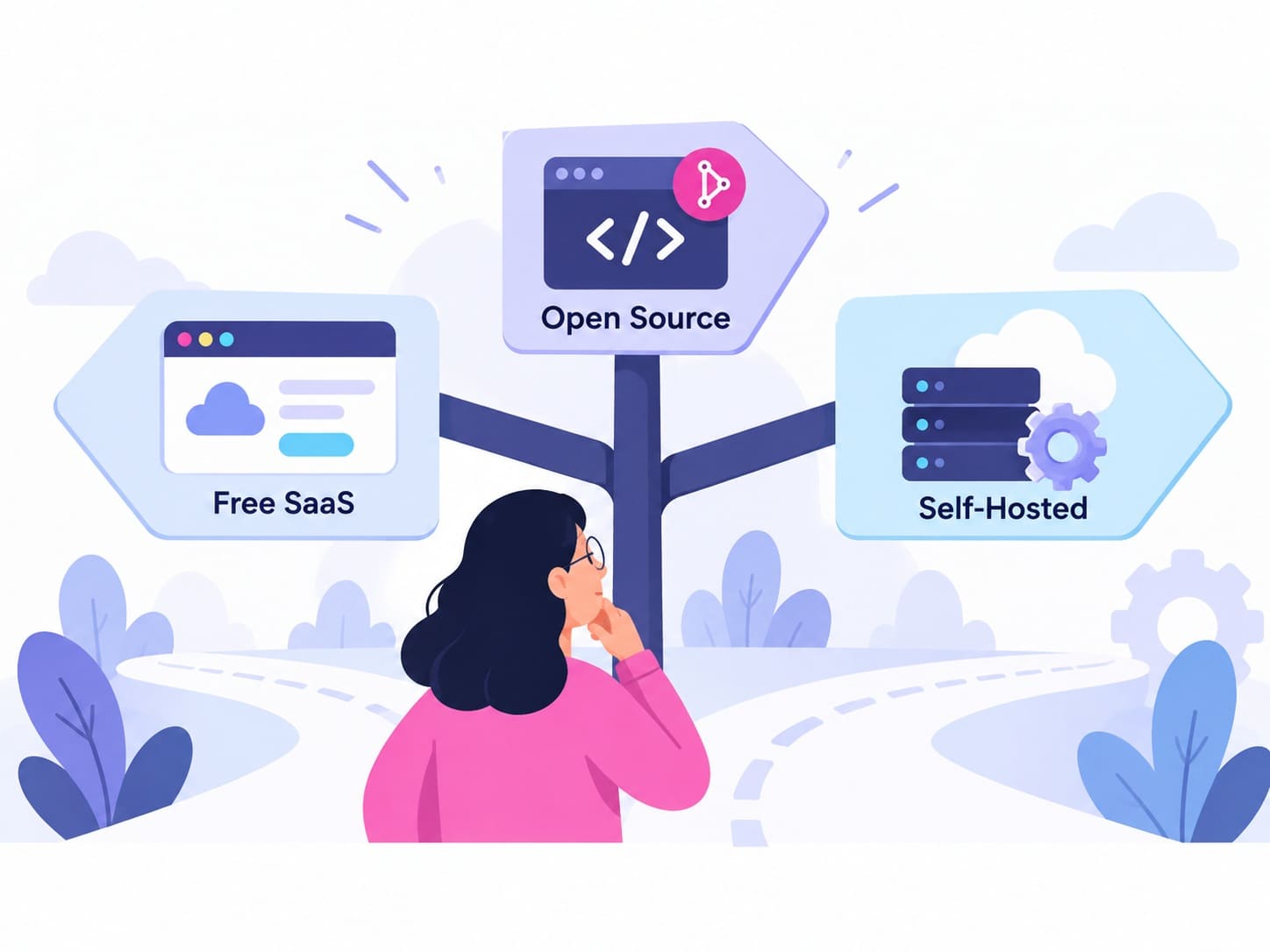
"Free" hides at least three different deals, and knowing which one you're signing up for saves you a surprise mid-build.
Free SaaS tiers
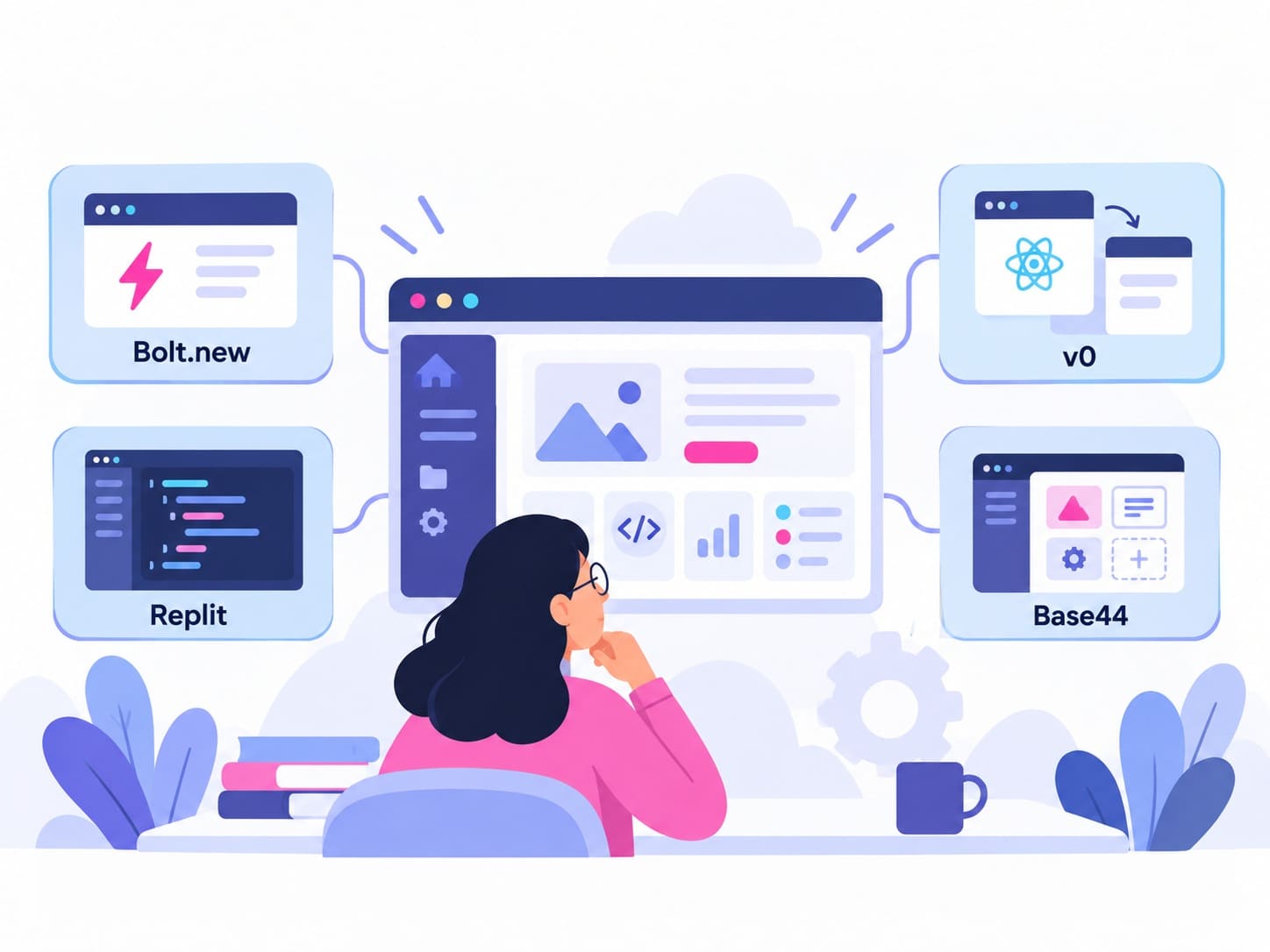
A hosted free tier gives you a monthly or daily allowance and nothing to install. You'll hit one of a few walls: build credits or tokens, message caps, project limits, or restrictions on deployment and custom domains. Bolt.new, v0, Replit, Base44, Bubble, and Softr all work this way — free until your usage crosses a line, then you wait for a reset or upgrade.
Open-source tools
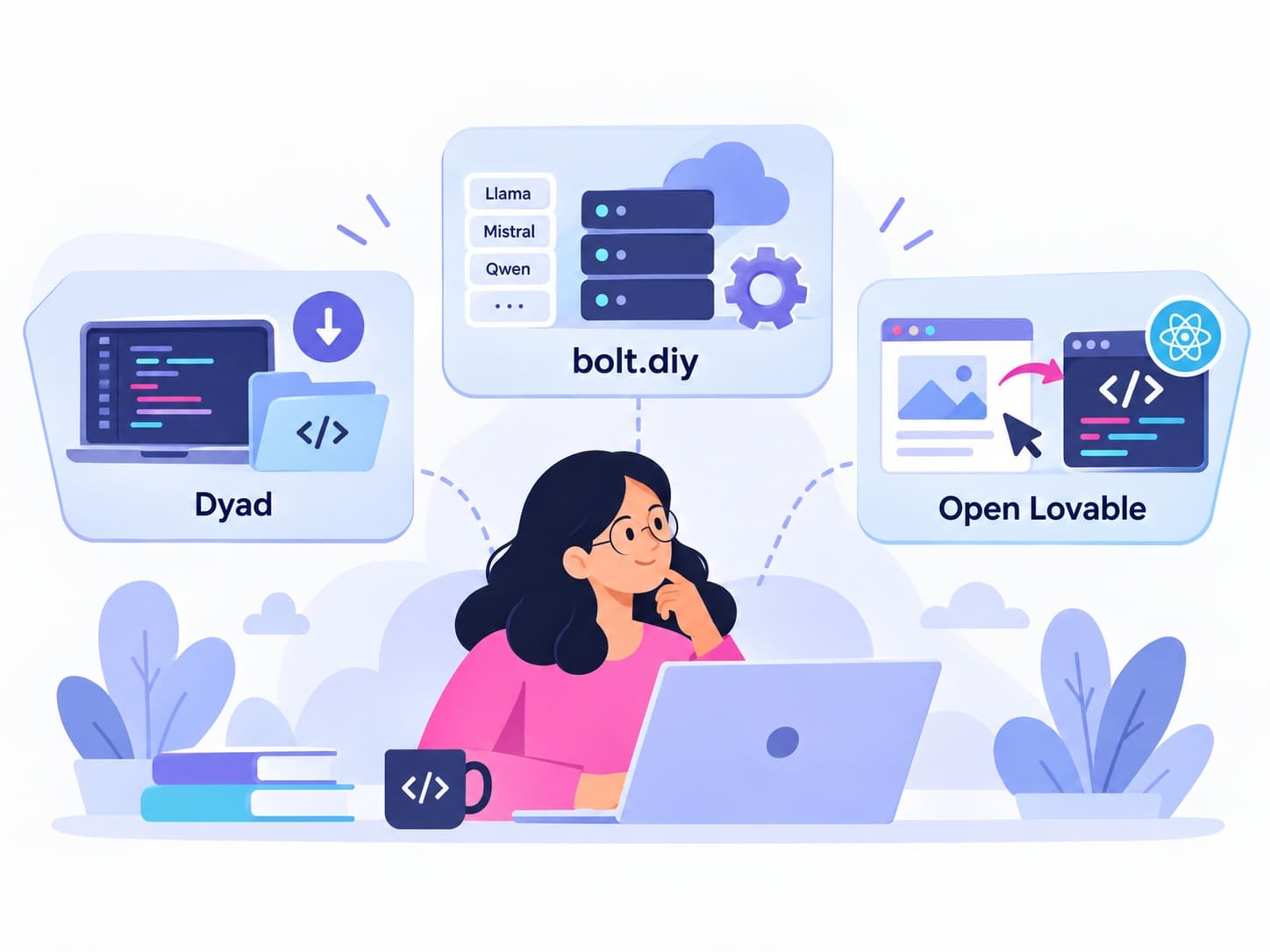
Open source means the code is public: you can read it, change it, and usually run it yourself. Dyad, bolt.diy, and Open Lovable qualify. The part people miss is that open source doesn't mean zero cost. These tools ask you to bring your own model API key, so every generation still bills against your OpenAI, Anthropic, or Google account unless you run a free local model through something like Ollama. The software is free; the AI usage and hosting usually aren't.
Self-hosted tools
Self-hosting means running the software on your own machine or server. It removes platform dependence but hands you the operational work: the environment, deployment, secrets and environment variables, updates, debugging, and whatever infrastructure it runs on. That trade is the point — control and privacy in exchange for maintenance. It's a great deal for a technical user and heavy overhead for someone who just wants an app to exist.
Which Free Lovable Alternatives Are Worth Using in 2026?
Nine tools are worth a look, and they don't all solve the same problem. For each: why pick it over Lovable, what's actually free, the trade-off, and who it suits.
1. Dyad — Best for a Free, Local, Open-Source Lovable Alternative
Dyad is a free, open-source AI app builder that runs as a desktop app on macOS and Windows. Pick it over Lovable when you want to own your code outright and skip a subscription and credit meter.
The app is free with no sign-up. You connect your own model provider — OpenAI, Anthropic, Google, or a local model via Ollama or LM Studio. It exports standard Next.js code, connects to Supabase or Neon for database and auth, and deploys to GitHub and Vercel or your own cloud.
The trade-off is convenience: bringing your own key means the software is free, but your model calls aren't. Skip it if you want a zero-config hosted experience.
2. bolt.diy — Best for Developers Who Want Self-Hosting and Model Choice
bolt.diy is the official open-source version of Bolt.new, and its edge is provider freedom: pick the LLM per prompt from 19-plus options, including OpenAI, Anthropic, Google, and local models through Ollama or LM Studio. You run it yourself — locally, in Docker, or as an Electron desktop app — with Supabase integration, Git support, and deployment to Netlify, Vercel, or GitHub Pages.
More control means more setup and upkeep. One licensing note: bolt.diy is MIT-licensed, but commercial production use of the WebContainers API it relies on may require a separate license. Don't confuse it with Bolt.new, the hosted product below.
3. Open Lovable — Best for Recreating Existing Websites and React Apps
Open Lovable is an open-source (MIT) example app from the Firecrawl team with a deliberately narrow scope: clone and recreate a website as a modern React app. Point it at a URL and it rebuilds that site as React you can edit.
It runs locally and needs a Firecrawl API key plus a model key and a sandbox configuration. Since it's your repository, code access is complete. Be clear about what it isn't: a focused site-recreation tool, not a full Lovable-style build-to-deploy platform — Firecrawl's own maintainers point people to Lovable.dev for a complete cloud solution. It's not the tool for end-to-end app building.
4. Bolt.new — Best Hosted Free Alternative for Fast Prototyping
Bolt.new lives in the browser and turns a prompt into a working full-stack app with almost no setup — the closest hosted feel to Lovable here. Its free plan is permanent, not a trial: $0, 1M tokens per month with a 300K-per-day cap, public and private projects, website hosting, unlimited databases, and Bolt branding on published sites. It runs on a token model, and most tokens go to syncing your project's files and context to the AI on each message, so cost climbs with project size rather than prompt length.
The main limit is that daily cap, which is easy to hit mid-session on anything past a simple page.
5. v0 — Best for React and Vercel Projects
v0, from Vercel, generates React and Tailwind interfaces from prompts and deploys straight to Vercel. Over 2026 it grew from a component generator toward a fuller builder with a code editor and database connectivity.
The free plan includes $5 in monthly credits and 7 messages per day, with Vercel deployment, Design Mode, and GitHub sync. It's frontend-first, so backends, auth, and integrations often lean on external services, and Vercel hosting is billed separately. It's at its best when your stack is already React and Vercel; outside that ecosystem the integration matters less.
6. Replit — Best If You Want AI Building Plus a Full Development Environment
Replit is broader than Lovable by design. Alongside its AI Agent, you get a real code editor, the ability to write and edit code by hand, databases, and deployment — a full development environment rather than a prompt-only builder.
Replit still offers a free way to start, and its current model centers on Free Mode: everyday Agent tasks — chatting, ideating, running routine work — don't consume credits, within usage limits that reset on a rolling basis. Heavier or more complex work shifts to its paid Power and Max modes, with Core starting at $20/month. Check replit.com/pricing for current allowances before you commit.
The trade-off is surface area: that flexibility can feel less simple than a pure prompt-to-app tool. If you're weighing several builders, our broader Lovable alternatives comparison lines them up across paid and free options.
7. Base44 — Best for Non-Technical Users Who Want an All-in-One Builder
Base44 (now part of Wix) generates full apps — frontend, database, and auth — from plain-language prompts, aimed at non-technical builders who want everything in one hosted place.
The free plan is $0 with 25 message credits and 100 integration credits per month, up to five apps, plus authentication, a database, and analytics. Message credits burn on iteration, so the 25-message monthly allowance makes the free tier better suited to testing an idea than sustained iteration. On code ownership, Base44 says users own their code and supports GitHub-based source export; verify the exact plan-level availability before relying on it for a free-plan workflow.
Skip it if you expect to build continuously for free.
8. Bubble — Best for Visual No-Code Apps Rather Than Vibe Coding
Bubble isn't the same kind of tool as Lovable, and treating it like one leads to disappointment. It's a mature visual no-code platform — a drag-and-drop editor, a workflow engine, a built-in database, and a deep ecosystem for genuinely complex web apps. You can develop for free on its free tier, which is limited by workload units and can't host a live app on a custom domain.
The portability model is the real difference. Bubble doesn't generate source code you can export and host elsewhere. You can export data as CSV, but there's no code or SQL dump, so leaving later means rebuilding — a real form of lock-in, which we dig into in our full Bubble review.
9. Softr — Best for Internal Tools and Portals
Softr builds client portals, internal tools, dashboards, and simple business apps on top of data in Airtable, Google Sheets, or its own database. Its free-forever plan is usable for small projects, with limits on records and app users and one custom domain; paid plans mostly meter the number of people who log in.
It shines when you're presenting structured data to a controlled group. It's less suitable for arbitrary full-stack development — you're assembling blocks on a data source, not generating an application — and, like Bubble, it doesn't hand you exportable source code.
How Do Free Lovable Alternatives Compare?
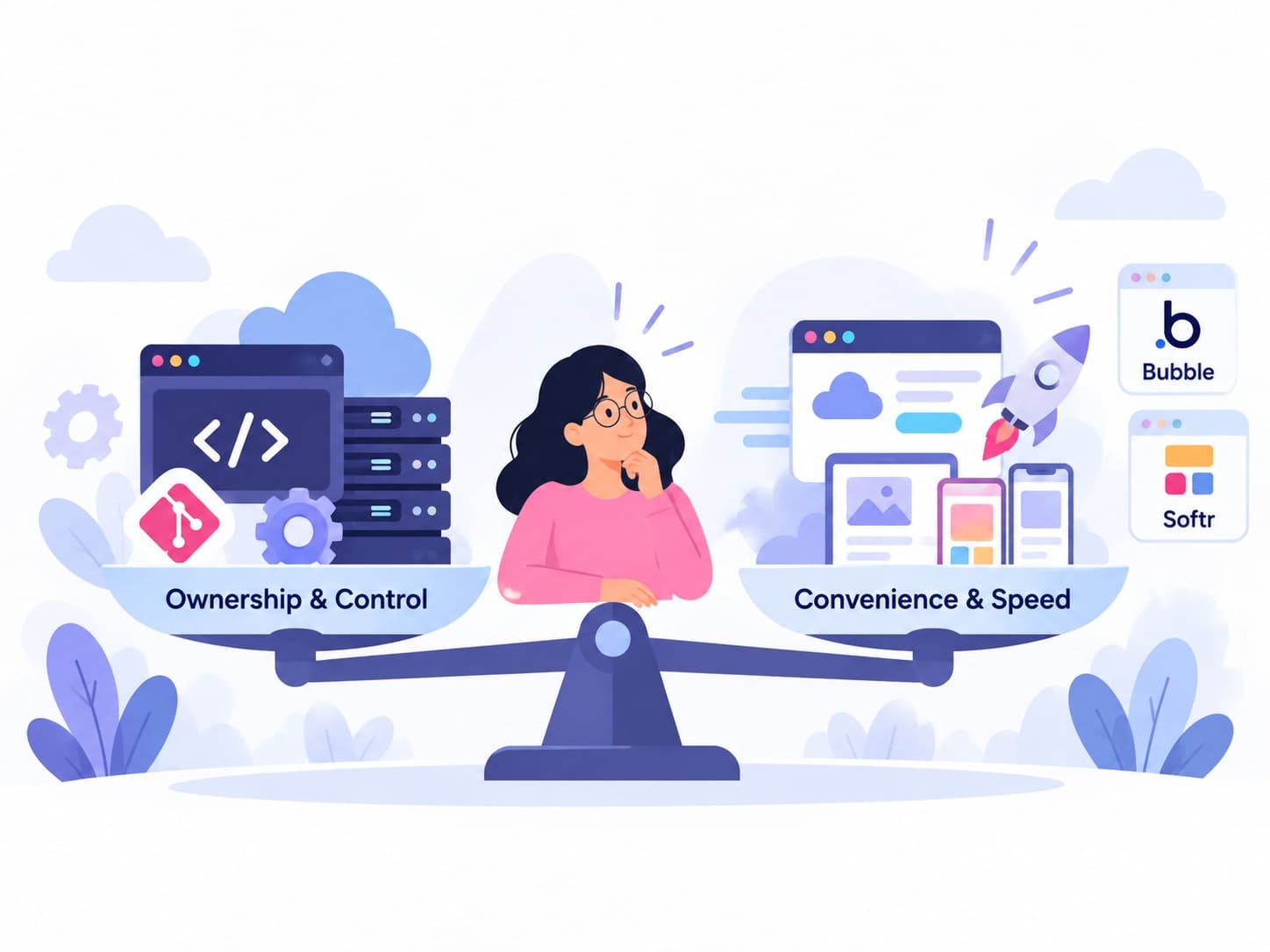
The honest summary: open-source tools give you ownership and control at the cost of setup and API spend, while hosted tools give you speed at the cost of usage caps and lock-in. Bubble and Softr sit apart as no-code platforms for specific app types.
Which Free Lovable Alternative Should You Choose?
Pick by what you're optimizing for. The right Lovable free alternative is the one that removes your specific blocker.
- Dyad — you want to own your code, work locally, and skip subscriptions, and you'll bring your own API key.
- bolt.diy — you want to self-host and switch models freely, and you don't mind running your own stack.
- Open Lovable — your job is turning an existing website into editable React, not building a full app.
- Bolt.new — you want the fastest hosted prototyping with real free monthly usage and no setup.
- v0 — you're building in React and deploying to Vercel.
- Replit — you want AI generation plus an editor, manual coding, and a database, and you'll watch usage on paid modes.
- Base44 — you're non-technical and want an all-in-one hosted builder to validate an idea.
- Bubble — you're building a complex, multi-role web app and value visual depth over owning source code.
- Softr — you're shipping a portal or internal tool on Airtable, Sheets, or its own database.
Are Open-Source Lovable Alternatives Actually Cheaper?
Sometimes, but not automatically. "Free to install" and "free to operate" are different things. An open-source tool like Dyad or bolt.diy costs nothing to download, but running a real app still involves model API spend, hosting, a database, storage, a domain, and deployment — those bills just move onto your accounts.
Time counts too. Days spent configuring, deploying, and debugging a self-hosted tool are a real cost that can outweigh a hosted subscription for a small project on a deadline. For a technical user the math often flips, because setup is quick and they skip per-seat pricing and usage meters entirely. The right answer depends on who's running it and whether they're optimizing for money, control, or time.
When Is a Free Lovable Alternative Not Enough?
A free plan stops being enough the moment a project turns from an experiment into something people depend on. A prototype working in a demo isn't the same as a production-ready system.
Watch for the signals: going live for real users, handling sensitive data, needing complex permissions and roles, usage climbing past the free ceiling, custom backend logic, several integrations, observability, billing, or specific security controls — plus anything touching long-term maintenance or a future migration.
That's the implementation gap: the distance between "it generated something" and "it runs reliably." Real systems need error handling, monitoring, permission models, deployed integrations, clear code ownership, and someone accountable for upkeep. It's worth reading up on Lovable security before putting user data behind any AI-generated app. At that point the question changes from "which free builder?" to "what does this app actually need to be dependable?"
Can You Move From Lovable to Another Builder Without Starting Over?
Sometimes, and it depends far more on your backend than your frontend. If your Lovable project exports clean code and syncs to GitHub, the interface layer usually travels well.
The friction lives underneath. Your database (often Supabase), environment variables, authentication, integrations, and deployment configuration don't move with a copy-paste, and anything wired tightly to one vendor's runtime is hardest to carry across. That's why tools that generate standard, exportable code — Dyad, bolt.diy, and the hosted builders that sync to GitHub — are easier to leave than Bubble or Softr, which don't hand you source code at all. If migration is on your mind, start by exporting your Lovable code into GitHub, then rebuild the backend connections on the new platform. The frontend is rarely the blocker; the data and platform wiring are.
What Should You Check Before Choosing a Free Lovable Alternative?
Run any candidate through this checklist before committing. It's short so you can answer each from the tool's own pricing and docs.
- Is the free plan permanent, or a time-limited trial?
- What exactly consumes credits or tokens?
- Can you export your source code?
- Can you sync with GitHub?
- Can you bring your own model or API key?
- Is self-hosting supported?
- What backend and database are included?
- Can you deploy outside the platform?
- What happens when you exceed the free allowance — a pause, a wall, or a charge?
- Who owns the generated code?
- How hard would migrating away be later?
- Are the security controls enough for what you're building?
If a tool can't cleanly answer the code-export, credit-consumption, and "what happens at the limit" questions, treat that as a warning sign.
Frequently Asked Questions
Is there a completely free alternative to Lovable?
Not in the sense of zero total cost. Dyad, bolt.diy, and Open Lovable are free and open source, so the software costs nothing — but you still pay for AI model calls (via your own API key), plus hosting, a database, and a domain once the app is live. The builder is free; operating the app usually isn't.
What is the best open-source Lovable alternative?
For most people it's Dyad or bolt.diy. Dyad is the friendlier local desktop option with clean code export; bolt.diy gives more provider flexibility and self-hosting through Docker at the cost of more setup. Open Lovable is open source too, but it's built for recreating websites as React apps rather than full app development.
Is there a self-hosted alternative to Lovable?
Yes. bolt.diy is the clearest self-hosted option — run it locally with Node.js or in Docker, even with local models via Ollama. Dyad also runs on your own machine as a desktop app. Both remove platform dependence, but you take on setup, updates, secrets, and infrastructure.
Is Lovable itself free?
Lovable has a free plan, but it's built for trying the tool rather than continuous building. It includes 5 daily build credits capped at 30 per month, plus 20 Cloud credits a month and 4 credits for AI features inside your apps. Building pauses once you're out until the allowance refreshes. Those ceilings are a big reason people start looking for alternatives. Check lovable.dev/pricing for the latest.
Can I build an app for free without Lovable?
Yes, for many prototypes and smaller apps. Hosted free tiers from Bolt.new, v0, and Replit, or open-source tools like Dyad, can get a working app off the ground at no subscription cost. Just budget for the infrastructure and API costs that appear once real users show up.
Which free Lovable alternative is best for beginners?
If you want the least setup, a hosted builder is easiest — Bolt.new for fast full-stack prototyping, v0 if you're leaning React, or Base44 for an all-in-one no-code feel. Open-source and self-hosted tools give more control but ask for more technical comfort, so they're a better second step than a first one.
Conclusion
The right free Lovable alternative comes down to the one thing you're trying to escape. Subscription cost or usage credits? A generous hosted free tier like Bolt.new or v0. Platform lock-in or limited code access? An open-source tool like Dyad or bolt.diy. Technical complexity itself? A visual no-code platform like Bubble or Softr.
Roughly: a free hosted platform buys convenience, open source buys ownership and control, self-hosting buys maximum control in exchange for maintenance, and no-code buys a lower technical barrier for specific app types.
One thing holds across all of them. Once a prototype grows into a product with real users, custom workflows, integrations, and permissions, the question quietly shifts from "which builder should I use?" to "what architecture do we actually want to own?" That's where it's worth thinking past the free tier and deciding what your app needs to be dependable.