

November 13, 2026
•
19
min read

How to Set Up an AI Center of Excellence in a Mid-Size Company
How to set up a lean AI Center of Excellence: who you need, which model fits and your first 90 days. Book a free AI strategy call to plan yours.

An AI Center of Excellence (AI CoE) is a small, cross-functional team that helps a company manage AI adoption. It sets priorities, establishes rules, supports employees, and tracks results. For a mid-size business, it doesn't need to be a separate department. You can start with part-time roles and a 90-day plan.
AI adoption rarely follows a company-wide plan.
Marketing starts using generative AI to draft content. Finance experiments with document processing. Customer support tests a chatbot. Someone in operations signs up for an automation platform.
Before long, several departments are using AI, but nobody has a complete picture of what's happening.
Which tools are approved? What company information is being shared? Are teams paying for different products that do the same thing? And who's responsible when something goes wrong?
An AI Center of Excellence exists to answer those questions.
At RapidDev, an AI development and integration company, we help businesses turn scattered AI experiments into coordinated, practical adoption.
For a mid-size company, that doesn't mean hiring a team of data scientists or creating another management layer. In many cases, you can get started with the people you already have.
What is an AI Center of Excellence?
An AI Center of Excellence is a group that coordinates how a company chooses, implements, manages, and uses AI.
You may also see it called an AI CoE or AI Centre of Excellence. Some companies call it a generative AI Center of Excellence when its main focus is tools such as ChatGPT, Copilot, or AI agents. The job is the same.
Its purpose is to make sure AI projects support business priorities, follow consistent standards, and don't introduce unnecessary risks.
The CoE doesn't need to build every solution itself.
Instead, it helps departments identify worthwhile opportunities, choose appropriate tools, manage risks, and share what works.
Imagine your sales and customer support teams both want AI assistants connected to customer records.
Without coordination, they might buy different platforms, build overlapping integrations, and create separate rules for handling customer data.
An AI CoE can help them agree on shared technical standards, security requirements, and ownership while leaving each team free to develop the solution it needs.
Think of it as a way to keep AI efforts aligned, not another approval committee.
Does a mid-size company need an AI Center of Excellence?
A mid-size company should consider an AI CoE when several departments are using AI or planning to introduce it into regular business processes.
You don't need a formal team just because a few employees use ChatGPT.
But once AI starts affecting customer information, internal workflows, purchasing decisions, or business-critical operations, informal oversight becomes difficult.
For companies with roughly 50–1,000 employees, a lean CoE can provide enough structure without slowing everyone down.
Signs it's time to set one up
You may benefit from a CoE if:
- Different departments are buying or testing AI tools independently.
- Employees are sharing sensitive company information with AI applications.
- You have several AI pilots but few solutions in everyday use.
- Nobody owns AI policies, vendor reviews, or employee training.
- Teams are building similar automations without knowing what others are doing.
- Leadership wants a clearer picture of what AI investments are delivering.
You don't need to have all these problems. A few may be enough to justify a more coordinated approach.
When a formal CoE is unnecessary
If your company has fewer than about 50 employees and only a few low-risk AI use cases, one owner and a basic usage policy are usually enough, and AI consulting for small businesses is a lighter way to get outside help than a formal CoE.
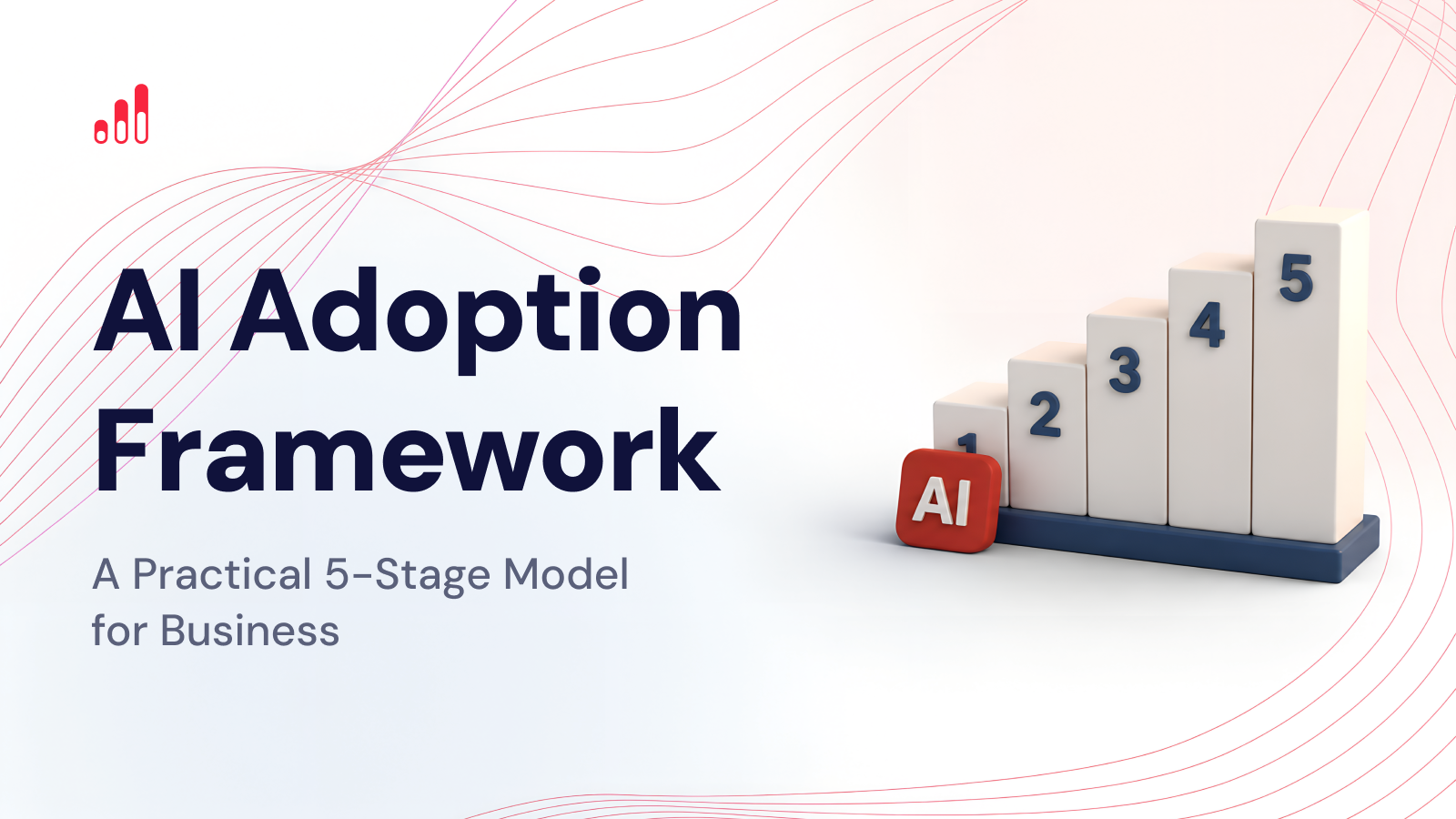
A CoE is rarely the first step: in our 5-stage AI adoption framework it belongs to the Govern stage, after you have assessed readiness and run a first pilot.
If you're still exploring where AI could help, begin with a few practical use cases and basic oversight.
What does an AI CoE do?
An AI CoE helps the company choose the right projects, manage risk, establish shared standards, train employees, and measure results.
For most mid-size businesses, five responsibilities matter most.
Decide which AI projects are worth pursuing
The CoE helps departments identify problems that AI could realistically solve.
That means looking beyond whether a use case sounds impressive.
A good candidate has a clear business owner, accessible data, a manageable implementation scope, and an outcome you can measure.
For example, automating a repetitive document review process may be a better first project than building an ambitious AI assistant that needs access to six disconnected systems.
The CoE should maintain a simple list of proposed use cases and help leadership decide which ones deserve attention first.
Establish rules and manage risk
The CoE decides which tools employees can use, what data they can share and when a person must review AI output, and AI governance best practices sets out what each of those rules should contain.
The CoE coordinates those decisions with IT, security, and legal.
It also sets basic requirements for evaluating vendors, handling sensitive data, monitoring AI output, and documenting important decisions.
Match oversight to risk: the NIST AI Risk Management Framework splits the work into four functions (Govern, Map, Measure, Manage), which a CoE can use as its checklist for higher-risk use cases.
You don't need to adopt every enterprise-level control immediately. You do need rules that reflect the risks of the AI systems your company uses. If customers or regulators ask for certification, ISO/IEC 42001: AI management systems is the standard auditors certify against.
Create shared technical standards
The CoE helps departments make consistent decisions about AI platforms, integrations, data access, and monitoring.
That doesn't mean forcing everyone to use the same model or vendor.
It means agreeing on essentials such as approved services, authentication, data handling, testing, and support responsibilities.
Shared standards make AI solutions easier to maintain and help prevent teams from rebuilding the same infrastructure.
Help employees use AI effectively
Training is one of the easiest parts of AI adoption to underestimate.
A policy won't accomplish much if employees don't understand what it means for their daily work.
The CoE should help people learn when AI is appropriate, how to check its output, what information they can share, and when human judgment is necessary.
Role-specific AI training for your teams is usually more useful than a generic presentation about AI.
A finance manager, recruiter, and customer support specialist all use AI differently. Their training should reflect that.
Employees also need somewhere to ask questions, report problems, and share useful examples.
Track results and share lessons
A successful CoE doesn't need dozens of pilots.
It needs evidence that AI is improving work.
That might mean reducing manual processing time, helping employees find information faster, improving response quality, or allowing a team to handle more work without adding unnecessary steps.
The CoE should track those results, document what worked, and help other departments apply the lessons.
Who should be on an AI Center of Excellence team?
A mid-size AI CoE needs clear ownership of a few essential functions, not a large team of full-time specialists.
Microsoft Cloud Adoption Framework: Establish an AI Center of Excellence staffs the CoE with senior data scientists, ML engineers and a steering committee; at 50 to 1,000 employees you can cover the same functions with part-time owners, mostly people you already employ.
One person may cover several roles, especially during the first few months.
Here's a practical AI Center of Excellence structure to start with.
| Role | Responsibilities | Typical time commitment | Can an external partner help? |
|---|---|---|---|
| Executive sponsor | Sets priorities, resolves conflicts, and supports funding decisions | 1–2 hours per month, plus key decisions | No. Leadership should retain accountability. |
| CoE lead | Coordinates the program, manages priorities, and reports progress | 1–2 days per week initially | Yes, as an interim lead |
| Business champions | Identify use cases, support pilots, and gather feedback | 2–4 hours per week each | Partially. Internal champions are still needed. |
| Technical lead | Reviews architecture, integrations, tools, and implementation requirements | 4–8 hours per week initially | Yes |
| Governance and legal owner | Reviews policies, data handling, and regulatory requirements | A few hours per month, more for higher-risk projects | Partially |
| Security owner | Reviews access, vendor risks, and technical safeguards | A few hours per month, more during reviews | Partially |
| Enablement lead | Coordinates training, communications, and adoption | 2–4 hours per week initially | Yes, with internal coordination |
These time commitments are planning estimates, not industry benchmarks. Actual needs depend on the number and complexity of your AI projects.
Start with responsibilities, not new hires
You don't need to recruit seven people.
Your COO might serve as executive sponsor. A transformation manager could lead the CoE. Your IT manager might cover the technical role, with legal and security contributing when needed.
Department heads can nominate business champions.
What matters is that everyone knows who owns each responsibility.
When ownership is vague, decisions get delayed and problems fall between teams.
Who should lead the CoE?
Choose someone who understands the business and can work across departments.
Technical knowledge is useful, but the CoE lead doesn't need to be your strongest engineer.
They need to manage priorities, coordinate people, make decisions, and keep projects moving.
A strong technical lead can support them.
For many mid-size companies, that combination works better than placing the entire program under an IT specialist who has limited authority outside their department.
Which AI CoE operating model should you choose?
Most mid-size companies should begin with centralized coordination, then give departments more independence as their AI capabilities develop.
There are three common operating models.
| Operating model | When it works best | Advantages | Risks |
|---|---|---|---|
| Centralized | Early adoption, limited AI expertise, or a small number of projects | Clear ownership, consistent standards, easier oversight | The central team can become a bottleneck |
| Hub and spoke | Several departments have active AI projects | Shared standards with local ownership and faster execution | Responsibilities between central and departmental teams can become unclear |
| Federated or advisory | Departments have mature AI capabilities and established governance | Greater autonomy and flexibility | Inconsistent standards and weaker coordination |
Centralized: keep things simple at first
In a centralized model, the CoE reviews use cases, coordinates implementation, and manages shared standards.
This works well when AI experience is limited and the company needs a consistent approach.
The downside is capacity.
If every department has to wait for one small team to approve or build every AI workflow, progress slows.
Hub and spoke: give departments more ownership
In a hub-and-spoke model, the central CoE manages shared standards, governance, and support.
Departments take responsibility for their own use cases and day-to-day implementation.
For example, the central team might define approved tools and data-handling requirements while finance runs its own document-processing pilot.
This gives departments more room to move without losing coordination.
Federated or advisory: suitable for mature teams
A federated model gives departments greater independence.
The CoE mainly provides guidance, training, shared resources, and support.
This can work when teams already have strong technical capabilities and understand their responsibilities.
It's usually not the best starting point when AI adoption is still informal.
How do you set up an AI Center of Excellence in 90 days?
You can get a lean AI CoE up and running in 90 days by assigning ownership, setting basic rules, choosing a few use cases, and testing them before expanding.
The first three months aren't about building a permanent department.
They're about creating a workable process for making decisions and learning what your company needs.
| Timeline | Focus | What to do | Deliverables |
|---|---|---|---|
| Days 1–30 | Establish ownership and visibility | Appoint a sponsor and lead, write a charter, create an AI policy, inventory tools, and introduce a use-case intake form | CoE charter, AI policy, tool inventory, intake process |
| Days 31–60 | Prioritize and test | Score use cases, select one or two pilots, assign owners, define success criteria, and begin implementation | Prioritized backlog, pilot plans, evaluation criteria |
| Days 61–90 | Measure and improve | Review pilot results, document lessons, establish standards, plan training, and decide what to scale | Pilot results, operating standards, training plan, next-quarter roadmap |
Days 1–30: Find out what's happening
Start by appointing an executive sponsor and someone to lead the CoE.
Then write a short charter covering what the CoE is responsible for, which decisions it owns, who participates, and how progress will be reported.
One or two pages may be enough.
Next, inventory the AI tools employees are already using.
Ask department heads which products their teams use, what the company pays for, and whether any tools process sensitive information.
You'll probably discover some shadow AI: tools employees adopted without formal approval. Most people adopt them to get work done, so the fix is a usage policy, not a crackdown: start from a free AI policy template that lists approved tools, data rules and when output needs review.
Days 31–60: Pick one or two pilots
Start month two with an AI readiness assessment: the data, systems and skills gaps it finds tell you which use cases are realistic. Then ask departments to propose AI use cases.
Evaluate them against a few practical criteria:
- Business value
- Implementation effort
- Data availability
- Security and compliance risk
- Internal ownership
- Ability to measure results
Don't choose a project simply because the technology looks impressive.
A straightforward internal workflow with a clear owner may be a better first pilot than a complex customer-facing AI agent.
For each pilot, define the problem, the process being improved, the systems involved, the person responsible, and what success looks like.
Also decide what would make you stop the project.
Then begin implementation.
Keep the scope small enough that you can learn something useful within the first few weeks.
Days 61–90: Review what worked
By the third month, you should have enough information to assess your first pilots.
Did the solution work reliably? Did employees use it? Did it save time or improve quality? Did it create new problems?
Document the answers.
If a pilot worked, identify what it needs before a wider rollout. That might include security review, training, monitoring, support, or additional integrations.
If it didn't work, understand why before investing more.
Use what you've learned to establish standards for future projects.
You should also create a training plan and decide whether the CoE needs more internal capacity or external support.
By day 90, you don't need AI running across the entire company.
You need a reliable way to decide which projects are worth pursuing and how to introduce them.
How do you measure an AI Center of Excellence?
Measure the CoE by how effectively it turns useful ideas into working solutions, supports adoption, manages risk, and delivers business value.
The number of tools purchased or pilots launched doesn't tell you much on its own.
A handful of successful projects may be worth far more than dozens of experiments nobody uses.
Start with five metrics.
| Metric | What it tells you | How to measure it |
|---|---|---|
| Use cases in production | Whether pilots are becoming useful business tools | Count active solutions that meet agreed production criteria |
| Time from idea to pilot | How quickly the CoE helps teams move forward | Track days from approved proposal to working pilot |
| Employee adoption | Whether people actually use the solutions | Monitor active usage and gather feedback |
| Policy compliance | Whether teams follow approved tools and data-handling rules | Review approvals, tool usage, and exceptions |
| Business value delivered | Whether AI improves a measurable outcome | Compare agreed process metrics before and after implementation |
Keep reporting simple
You don't need an elaborate dashboard.
A monthly review of active projects, adoption, risks, and results is a good starting point.
For each use case, establish a baseline before implementation.
If the goal is faster document processing, measure how long it takes today.
If the goal is better customer support, track current response and resolution times.
That gives you something meaningful to compare against after launch.
Avoid setting arbitrary targets for how many AI tools employees should use.
Adoption matters when the tools are useful and appropriate for the work.
What mistakes do AI Centers of Excellence make?
AI CoEs struggle when they become too bureaucratic, focus on technology instead of business needs, or try to control every AI project.
Six mistakes are especially common, and avoiding them covers most AI Center of Excellence best practices.
Hiring too much, too early
A mid-size company doesn't need an enterprise AI department from day one.
Start with part-time responsibilities and expand when the workload justifies it.
Turning every decision into an approval process
If a simple, low-risk AI experiment requires weeks of review, employees may stop experimenting or work around the process.
Match the level of oversight to the level of risk.
Running pilots without business owners
Every pilot needs someone who cares whether it works and can help turn it into part of daily operations.
Without that person, even a technically successful project may go nowhere.
Measuring activity instead of results
Counting workshops, experiments, and software subscriptions is easy.
Measuring whether work actually improved takes more effort, but that's what leadership needs to know.
Treating training as an afterthought
People won't adopt tools they don't understand or trust.
Build training into the rollout plan, not just the final week of implementation.
Keeping everything centralized forever
As departments gain experience, they should be able to take ownership of more AI work.
The CoE should gradually spend less time managing every implementation and more time supporting teams, maintaining standards, and sharing lessons.
Can an external partner run part of your AI CoE?
Yes. An external partner can help set up the CoE, provide technical expertise, develop pilots, or train employees while your company retains control of priorities and decisions.
This is particularly useful when you have capable business leaders but limited internal AI expertise.
For example, an operations director might be well placed to coordinate the CoE but need technical support to assess architecture, integrations, and model selection.
An external team can fill that gap.
Some companies bring in AI strategy consulting to support the technical lead role until they're ready to hire.
Others bring in an AI adoption and transformation partner for the first 90 days to set up the operating model, pick the first use cases and ship the initial pilots.
What should stay inside the company?
Even with an external partner, your company should retain responsibility for business priorities, investment decisions, approval of AI use cases, ownership of data and accounts, internal policies, employee adoption, and acceptance of business results.
A good partner should make your team more capable, not create a dependency you can't easily unwind.
How RapidDev can help
At RapidDev, we work with companies that want to introduce AI across departments without building a large internal team first.
We can help assess readiness, establish an operating model, prioritize use cases, develop integrations, and support employee training.
For some businesses, that means providing interim technical and implementation support while their internal CoE takes shape.
For others, it means helping an existing team move successful pilots into production.
The right approach depends on what you already have and where you need support.
FAQs
What is an AI Centre of Excellence?
An AI Centre of Excellence, or AI CoE, is a team or function that coordinates AI adoption across an organization.
It helps set priorities, establish policies, support implementation, train employees, and measure results.
Centre is the British spelling; Center is the American spelling. Both refer to the same concept.
How many people does an AI CoE need?
A mid-size company can start with a small group of existing employees working part-time.
The essential responsibilities include executive sponsorship, program leadership, business input, technical expertise, governance, security, and training.
One person can cover several functions, and external specialists can help where internal expertise is limited.
You don't need seven full-time employees to cover seven responsibilities.
Who should lead an AI Center of Excellence?
Choose someone who understands the business, can work across departments, and has enough authority to coordinate priorities.
That might be a transformation leader, operations manager, IT leader, or another senior employee.
Technical knowledge helps, but the lead doesn't need to be the company's strongest engineer.
What is the difference between an AI CoE and AI governance?
AI governance refers to the rules, responsibilities, and controls used to manage AI risks and ensure appropriate use.
An AI Center of Excellence is the team or function that helps coordinate governance alongside adoption, implementation, training, and measurement.
Governance is part of the CoE's work, not its entire purpose.
Should the AI CoE sit in IT or in the business?
For most mid-size companies, the CoE works best with a business leader responsible for priorities and outcomes, supported by IT for architecture, security, and implementation.
Keeping it entirely in IT can make AI adoption feel like a technology project rather than a business initiative.
Running it entirely from the business side without technical oversight can create integration and security problems.
A cross-functional structure usually works better.
RapidDev can help you put that structure in place, whether you're starting from scratch or trying to bring several disconnected AI initiatives under one roof.
Our AI adoption and transformation team can help you plan the first 90 days, establish responsibilities, and move your first use cases forward.
To discuss what a lean CoE could look like for your business, book a free AI strategy call.