Get your dream built 10x faster
Can I build a personal travel journal app with no-code?
We build custom applications 5x faster and cheaper 🚀
Book a Free ConsultationWe build custom applications 5x faster and cheaper 🚀
Book a Free ConsultationParameter |
Value |
|---|---|
| Can it be built without code? | Yes |
| Development time | 2–7 days (practical builds, 2024) |
| Typical cost | $15–$40/month (vendor pricing pages, 2024) |
| Best platform for... | Glide for personal journals, Power Apps for corporate use |
| Main limitation | Deep offline support and fully custom UX patterns require custom code |
You open a no-code app builder, drop in a list component for “Trips,” and realize you can’t easily nest daily entries or map views under each trip the way you sketch them in your notebook. You try to force it with tags and the interface becomes messy and confusing.
You test a template that promises “travel journal” features, add a few photo-heavy entries, and the app starts loading slowly on mobile. Uploading a batch of images from one long trip feels clunky and you’re not sure where the data is actually stored.
You attempt to add privacy controls so some trips stay private, others visible to friends, and a few fully public. The platform gives you only “public / private” at the whole-app level, with no clear way to handle per-entry or per-trip visibility.
No-code databases or spreadsheets create structured collections for Trips, Entries, Photos, and Locations, which enables user registration, journal entries, image uploads, and search to be modeled as records instead of custom tables. This causes non‑developers to configure relationships visually, which reduces schema errors.
Built‑in authentication modules handle sign‑up, login, and basic access control, which gives you per-user data isolation but often only coarse‑grained visibility rules. That causes friction when you want nuanced sharing logic, such as per-entry visibility or invite-only trips.
Prebuilt integrations for Google Maps, device camera, and file storage allow location tagging and photo uploads with minimal setup; however, some builders add substantial overhead per plugin. WordPress mobile stacks, for example, often depend on dozens of plugins for modest apps (WP Engine, 2022), which can slow load times at scale.
Mobile users abandon apps that take longer than 3 seconds to load a screen (Google, 2020)
Low-code/no-code adoption reached ~26% of developers worldwide (Statista, 2023)
Around half of no-code users build internal or personal productivity tools like trackers and journals (Makerpad, 2022)
Open a free Glide account and build a “Trips / Entries / Photos” prototype from a spreadsheet to measure how well the data model matches your journal idea.
Expect $15–$40/month for a maintained, shareable travel journal app with user logins and basic storage on mainstream no-code platforms.
If you need full offline-first syncing with conflict resolution for more than 5,000 entries per user, use React Native or Flutter plus a local database such as SQLite or Realm. If you require highly customized map rendering (e.g., Mapbox GL with custom vector tiles and route animations), use Next.js or Expo with the Mapbox API instead of a generic map component.
If you plan to invite thousands of users and expose a public API for third‑party travel services, move to a custom backend (for example, Node.js + PostgreSQL) once you outgrow the platform’s rate limits or pricing tiers. When you hit those thresholds and mostly need performance and API freedom, switching earlier can save your money.
| Criteria | OutSystems | Appy Pie | Glide | Microsoft Power Apps |
|---|---|---|---|---|
| Price/month ($) | $$$ (quote-based, typically high) | $16–$50 | $25–$99 | Included in some M365 plans or ~$20+ |
| Launch time | Weeks | 1–3 days | 1–3 days | Days–weeks |
| Customization (1–5) | 5 | 3 | 4 | 4 |
| Best for | Enterprise, complex logic | Very simple consumer apps | Personal and small-team journals | Organizations on Microsoft 365 |
| Main drawback | Overkill and costly for personal apps | Limited data modeling and scaling | Less suited for heavy custom logic | Tied to Microsoft ecosystem and licensing |
When to choose
1–3 days for a basic personal journal once you know your data structure and have example content ready.
Yes, most modern builders support image uploads and map components, but you may need external storage once your photo library grows into the thousands.
Yes for typical personal use, provided you enable authentication and per-user data rules, but no-code rarely supports fine-grained, audited access like custom enterprise stacks.
Yes, if you keep data in exportable tables (e.g., CSV or a relational backend), migration to a custom stack mainly involves rewriting the UI and business logic.

Seeking the optimal method to swiftly create your website or app? Dive into Bubble.io, a top no-code platform.

If you're hunting for an easy way to create mobile apps, Outsystems, a leading low-code platform, could be your answer.

Glide is a standout no-code platform that's perfect for those wanting a simple way to build mobile apps.
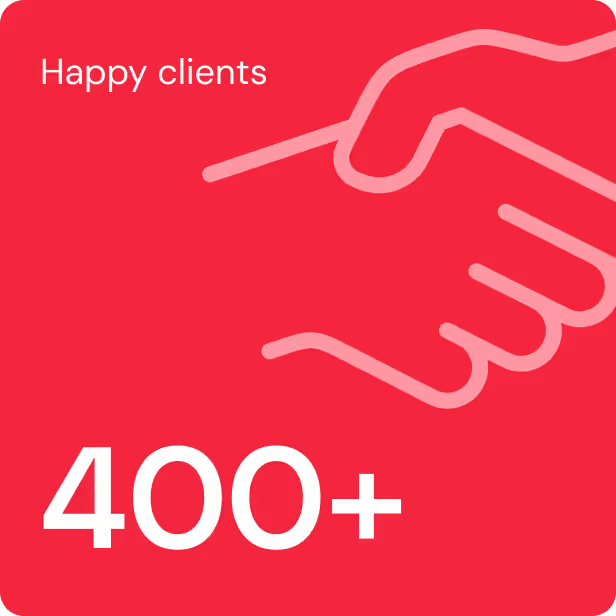













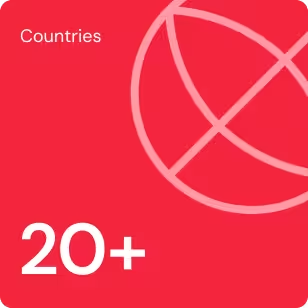



We deliver more than just code; we build lasting partnerships. That’s why businesses across industries trust us to develop and scale custom solutions that drive real results.



.png)
.png)


