Get your dream built 10x faster
Can I build a personal budgeting tool with no-code?
We build custom applications 5x faster and cheaper 🚀
Book a Free ConsultationWe build custom applications 5x faster and cheaper 🚀
Book a Free ConsultationParameter |
Value |
|---|---|
| Can it be built without code? | Yes |
| Development time | 1–7 days (hands-on prototyping) |
| Typical cost | $0–$30/month (platform pricing pages, 2025) |
| Best platform for... | Glide for sheet-based tracking; Power Apps for Microsoft 365 users |
| Main limitation | Complex bank-sync logic and custom analytics are harder without code |
You open a spreadsheet every month, copy last month’s tabs, and manually color cells to see where rent, groceries, and subscriptions went. You want recurring categories, monthly limits, and a clear “left to spend” number but keep rebuilding the same layout.
You tried a finance app, but it forces US banks, default categories that don’t match your life, and yearly views when you budget weekly. You want to design your own categories, salary schedule, and savings buckets without changing how you think about money.
You test a no-code platform, manage to build forms for expenses and income, but get stuck turning those entries into monthly summaries, category charts, and alerts when a category crosses 80% of its limit. You can record data but not yet understand it.
Visual database builders cause structured tracking, which causes reliable monthly summaries. When you design tables for Transactions, Categories, and Budgets, the platform can auto-link each new expense to a month and category, generating totals without extra formulas.
Built-in logic blocks cause consistent rules, which cause repeatable budget behavior. When you use tools like “If total(category) > limit then flag = true,” the system updates warnings the moment a transaction is added instead of relying on manual recalculation. One misconfigured rule can silently mislabel dozens of entries.
Hosted dashboards cause always-on visibility, which causes better adherence to targets. Platforms that render charts directly from your data eliminate export/import cycles; however, loading too many plugins or add-ons can slow dashboards significantly (median 26 third‑party components on small business apps; WP Engine, 2022).
55–60% of adults do not use any formal budget tracking tool (Consumer Financial Protection Bureau, 2023)
Spreadsheet-based budgets remain the primary method for budgeters worldwide (OECD, 2020)
No-code adoption is growing at ~20–25% annually among non-developers (Gartner, 2021)
Open a free Glide account and connect a Google Sheet with three tabs—Income, Expenses, Categories—to see how quickly you can get a working prototype.
Expect $0–$15/month for a personal budgeting app unless you require custom domains or advanced automations.
If you need direct, real-time bank integrations across many regions via APIs like Plaid or Tink with custom reconciliation rules, use a coded stack such as Next.js + PostgreSQL + Plaid SDK once you exceed 1,000 automated imports per month. If you plan to run multi-tenant budgeting for thousands of users with advanced forecasting, consider Django + React instead of stretching a no-code plan.
If you cannot build and test a basic “add transaction → update monthly total” flow in a weekend, or you already maintain finance logic in Python notebooks, switching purely to no-code will slow you down. When your requirements exceed what you can prototype in 2–3 evenings, custom development will save your time.
| Criteria | OutSystems | Appgyver | Glide | Microsoft Power Apps |
|---|---|---|---|---|
| Price/month ($) | $$$ (enterprise quotes) | $0–$50 | $0–$60 | Included in many M365 plans / $5–$20 add-on |
| Launch time | Weeks for full setup | Days | Hours–days | Days–weeks |
| Customization (1–5) | 5 | 4 | 3 | 4 |
| Best for | Enterprise budgeting workflows | Cross-platform mobile/desktop apps | Sheet-driven personal budgets | Organizations on Microsoft 365 |
| Main drawback | Overkill for solo users | Steeper learning curve | Tied to spreadsheet backend | Locked into Microsoft stack |
When to choose
Yes, but only on platforms that integrate with services like Plaid or offer webhooks; many personal-grade tools still rely on manual CSV imports.
1–3 days for a single-user app with income, expenses, and monthly summaries, assuming your categories and starting data are ready.
Yes on some platforms, but you must design currency fields and conversion rules yourself; few no-code templates include robust FX handling.
Yes for personal use when using reputable platforms with HTTPS and account login, but you should avoid storing full bank credentials or card numbers directly.

Seeking the optimal method to swiftly create your website or app? Dive into Bubble.io, a top no-code platform.

If you're hunting for an easy way to create mobile apps, Outsystems, a leading low-code platform, could be your answer.

Glide is a standout no-code platform that's perfect for those wanting a simple way to build mobile apps.
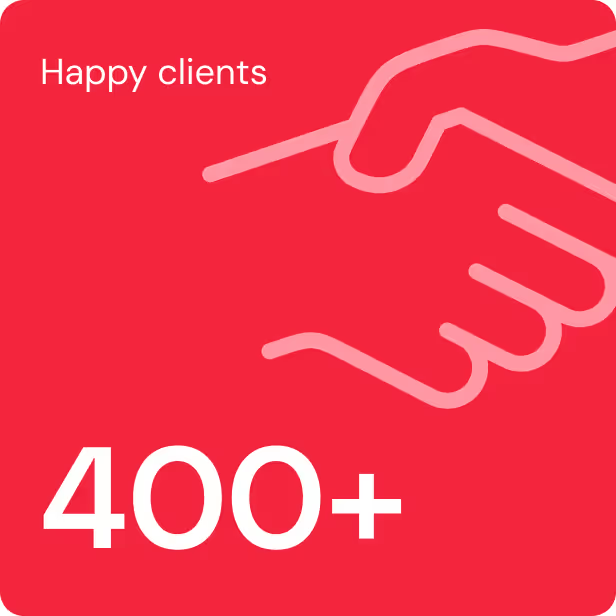













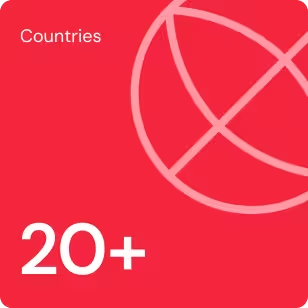



We deliver more than just code; we build lasting partnerships. That’s why businesses across industries trust us to develop and scale custom solutions that drive real results.



.png)
.png)


